Driving in Slovenia and the vignette: complete guide 2026
Logar Valley day trip from Ljubljana
Do I need a vignette to drive in Slovenia?
Yes. Any vehicle using a Slovenian motorway (avtocesta) or expressway (hitra cesta) must have a valid e-vignette. The weekly vignette costs EUR 16 and the monthly EUR 32. Buy it online at evinjeta.dars.si before you arrive — it registers to your number plate automatically. The fine for not having one is EUR 300–800.
Driving in Slovenia: what you need to know before you turn the key
Slovenia is one of the most enjoyable countries in Europe to drive in. The motorway network is fast and clear; the mountain roads through the Julian Alps are some of the most scenic drives on the continent; and the country is small enough that even a long day’s driving covers a remarkable range of landscapes. A car opens up the Soča Valley, Logar Valley, Goriška Brda and rural Karst in ways that no bus or train can match.
There are two things you must get right before you drive: the e-vignette and the snow rules in winter. Everything else is relatively straightforward.
| Vignette cost | EUR 16/week, EUR 32/month |
| Fine without one | EUR 300–800 |
| Speed limit (motorway) | 130 km/h |
| Alcohol limit | 0.05% (0.00% under 21 / under 3 yrs licence) |
| Winter tyres required | 1 Nov–15 Mar or when conditions require |
The e-vignette: the single most important rule
Slovenia uses an electronic motorway toll system. There are no toll plazas — instead, cameras read number plates at motorway entries and exits and check them against the vignette database. If your number plate is not registered, the fine is EUR 300–800 and is issued by post to the registered address of the vehicle.
How to buy the e-vignette:
- Go to evinjeta.dars.si (the official Slovenian motorway authority website)
- Enter your vehicle type, country of registration and number plate
- Select duration: 1 week (EUR 16), 1 month (EUR 32) or 1 year (EUR 117.50)
- Pay by card
The vignette activates 18 hours after purchase to prevent abuse — buy it at least the day before you plan to drive. There is no physical sticker; confirmation is emailed and the system is fully automated.
If you forget to buy online: most petrol stations near Slovenian borders and on the Austrian and Italian motorways approaching Slovenia sell e-vignettes at the till. You can also buy at some border rest stops. The price is the same as online.
Rental cars: If you rent in Slovenia, the car should include a valid vignette — but confirm this explicitly. If you rent in a neighbouring country and drive into Slovenia, you are responsible for buying the vignette yourself. ‘The rental company usually includes it’ is not acceptable evidence if a fine arrives.
Slovenian road rules: the essentials
Speed limits:
- Motorway (avtocesta): 130 km/h
- Expressway (hitra cesta): 110 km/h
- Regional and main roads: 90 km/h
- Built-up areas: 50 km/h (begins at the town sign)
Alcohol: Blood alcohol limit is 0.05% for drivers with 3+ years’ experience. For drivers under 21 or with less than 3 years of experience: 0.00%. Roadside testing is common. The safest approach is not to drink at all before driving.
Year-round requirements:
- Headlights on at all times (day and night), even in summer
- Warning triangle, first-aid kit and high-visibility vest mandatory in the car
- Children under 150 cm must use appropriate child seats
- Mobile phones: hands-free only; holding a phone while driving is illegal
Winter requirements (1 November – 15 March, or when conditions require):
- Winter tyres (or all-season M+S tyres) mandatory
- Snow chains must be carried in the car from 15 November onwards
- Some mountain roads require chains to be fitted
Fuel: Petrol stations are plentiful on motorways and in towns. In remote mountain areas (upper Soča Valley, near Triglav), stations are less frequent — fill up before heading into the Alps. Unleaded petrol (bencin) and diesel (dizel) are standard. LPG is available at some stations.
The motorway network
The main motorways form a rough cross:
- A1 (north-south): Šentilj (Austria border) → Maribor → Ljubljana → Postojna → Koper (Italy/coast)
- A2 (east-west): Ljubljana → Karavanke Tunnel (Austria) / Ljubljana → Bled → Kranjska Gora
The Karavanke Tunnel connects Slovenia to Austria (Villach direction) and has its own separate toll (approximately EUR 9 one-way for a passenger car) on top of the vignette.
The best scenic drives in Slovenia
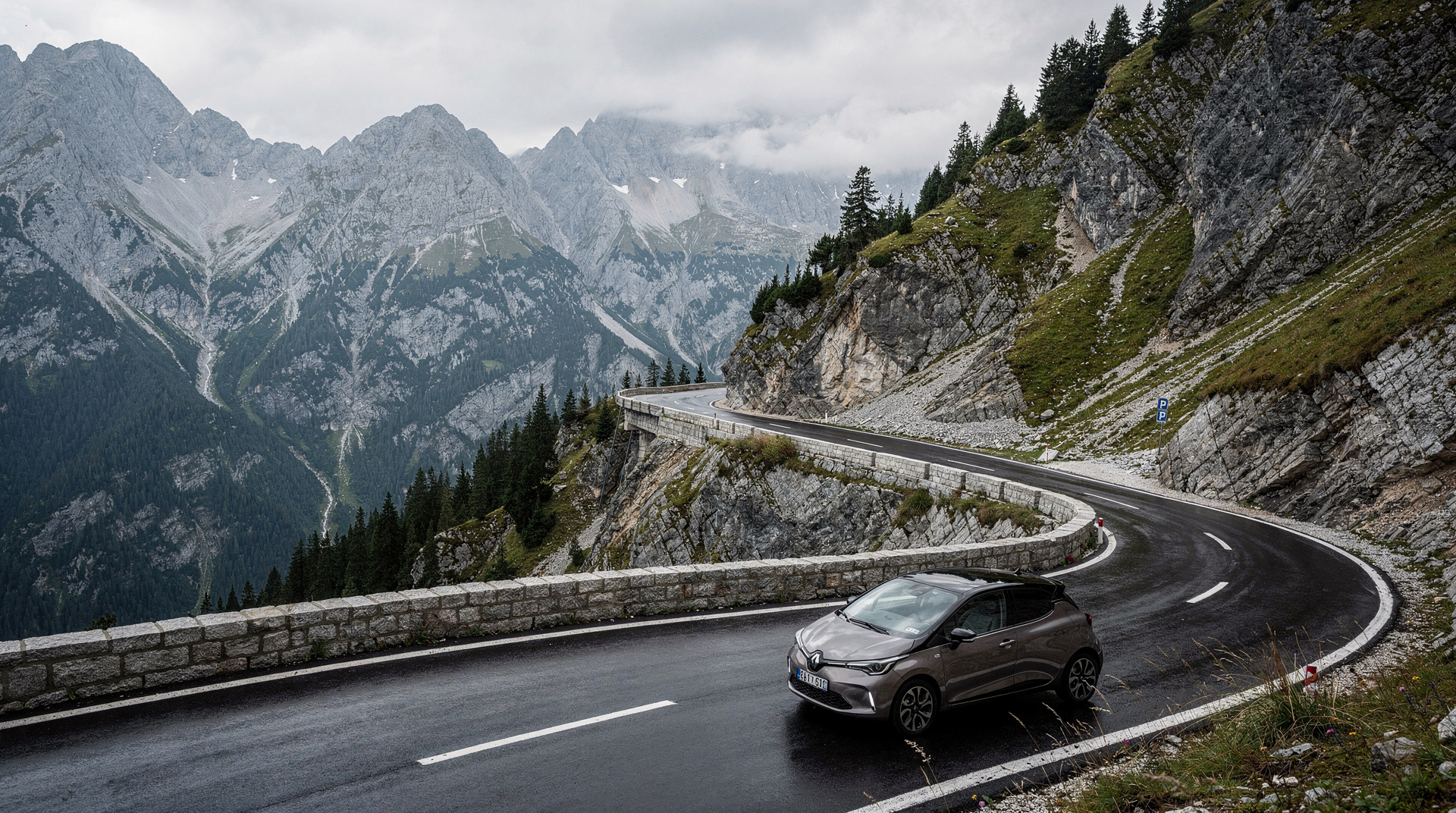
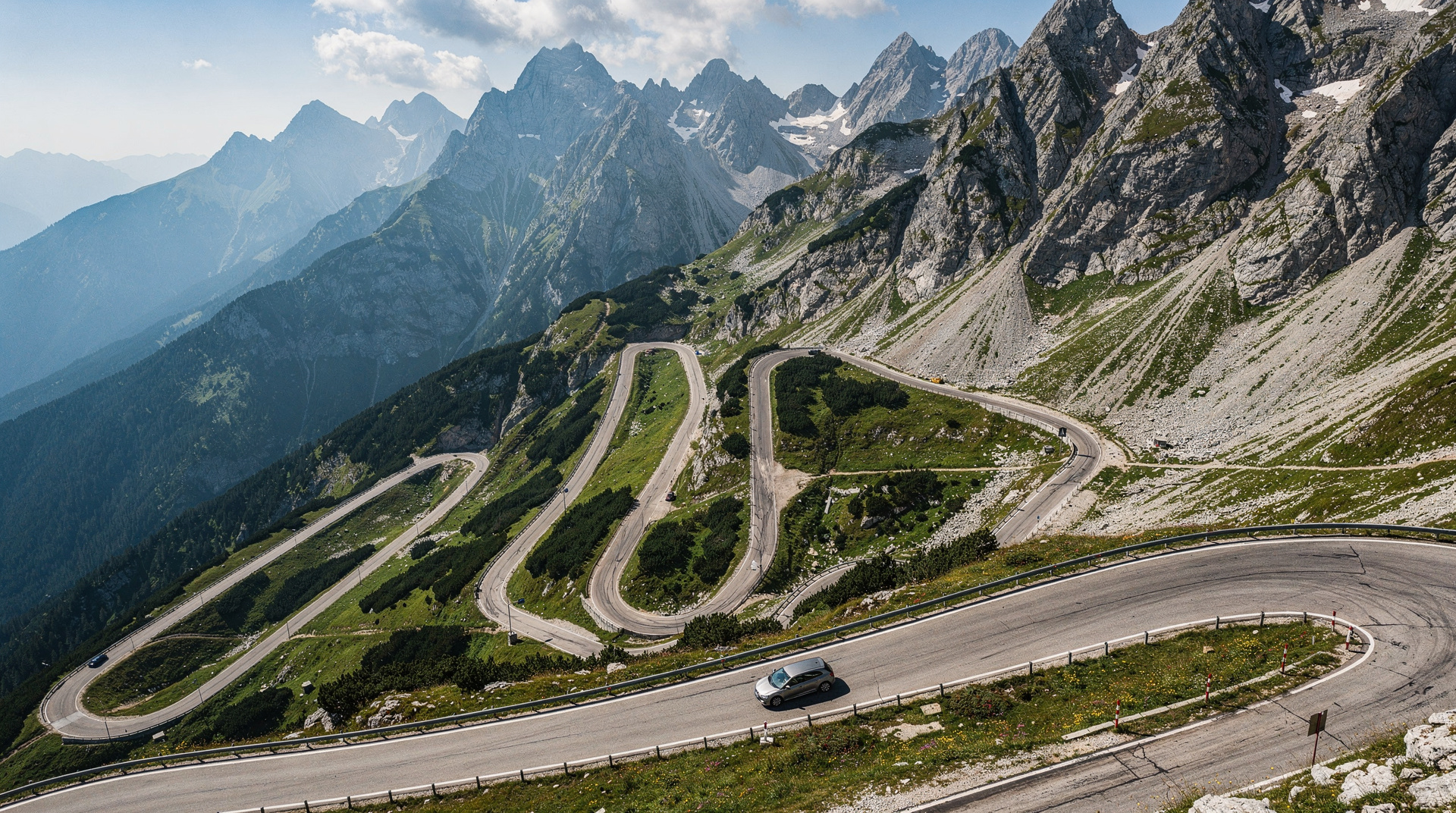
Vršič Pass (1,611 m): The most famous road in Slovenia. The route from Kranjska Gora over the pass to Bovec in the Soča Valley crosses 50 hairpin bends, passes Russian POW chapels from World War I and delivers staggering views of the Julian Alps. Allow 1–1.5 hours for the crossing without stops; more if you stop for views. The road is open approximately May–October and closed in winter. Not recommended for large vehicles or caravans — the turns are tight. For full detail, see the Vršič Pass driving guide.
Bohinj Valley road: From Bled to Bohinj takes 30 minutes on an increasingly scenic valley road that ends at the lake. Continue to Savica Waterfall and the Komna plateau for more. Light traffic, beautiful views.
The Soča Valley road (Bovec to Kobarid): Following the impossibly turquoise Soča River through a deep alpine gorge. One of the most photogenic drives in Europe. The road is in excellent condition. The Kobarid to Tolmin section continues the scenery.
Mangart road: A spur from the Soča Valley that climbs to Mangart Saddle at 2,072 m — the highest paved road in Slovenia. Dramatic views of the Italian and Slovenian Alps. Open approximately June–October. Narrow upper section requires caution.
The Karst plateau road (Ljubljana to Piran via Sežana): A motorway for most of the route, but the Karst plateau between Postojna and the coast has an otherworldly character — flat, windswept limestone, dotted with villages and wine cellars. The bora wind can be severe here in winter.
Goriška Brda: The wine-growing hills on the Italian border, full of narrow lanes between vine rows and stone villages. Slow driving at its best.
If you would rather leave the wheel to someone else on the northeastern side of the Alps, a guided day along the Logar Valley and the Solčava panoramic road covers one of the most scenic drives in the country without any parking or navigation to think about.
Back in the capital, a car is more of a burden than a help, and a guided mountain bike tour around Ljubljana is an easy way to see the green edges of the city without worrying about where to leave the rental.
Parking
Ljubljana: the city centre has paid parking throughout. The Slovenika park-and-ride at the edge of the city (EUR 3.60/day, with a park-and-ride bus to the centre) is the most sensible option if you’re staying in Ljubljana.
Lake Bled: main lakeside car parks charge EUR 1.20–2 per hour and fill by 10:00 in peak summer. The Grajsko Kopališče car park on the south shore is cheaper and a short walk from the best viewpoints. Consider arriving before 8:00 in July–August.
Postojna: large car park immediately adjacent to the cave entrance, EUR 1.50–2 per hour.
Piran: Piran’s old town is traffic-free. Park in the main car park outside the old town gate (EUR 1–1.50/hour) or use the Fornače park-and-ride. Do not try to drive into the historic centre.
Fuel prices and range planning
Slovenian fuel prices are typically 5–10% lower than in Austria and broadly similar to Germany. Prices are posted on the motorway service station signs and at forecourts. Motorway petrol stations are slightly more expensive than town stations — fill up in town if you’re nearby.
For Alpine drives: fill the tank before heading into the mountains. The upper Soča Valley has petrol in Bovec but nowhere else. On the Vršič route, there is nothing between Kranjska Gora and Bovec. Range planning matters if you’re driving an EV — charging infrastructure in rural areas is expanding but still sparse.
Tolls beyond the vignette
The Slovenian e-vignette covers the national motorway and expressway network. There is one significant additional toll:
Karavanke Tunnel (connecting Slovenia to Austria under the Alps on the A2/E61): EUR 9 one-way for a passenger car. Pay at the toll booth before entry. This is separate from the vignette. If you’re crossing into Austria at this point, the Austrian motorway vignette (EUR 9.90 for a 10-day sticker) also applies on the Austrian side.
Tunnel alternatives: if you’re heading to Kranjska Gora from Ljubljana, you can avoid the tunnel by staying on the Slovenian side and driving directly — no extra toll required. The tunnel is only relevant if you’re crossing into Carinthia (Austria).
Road quality by region
Slovenian roads range from excellent (motorways) to challenging (narrow mountain lanes).
Motorways (excellent): The A1 and A2 form the core network. Well-maintained, clearly signed and typically lightly trafficked outside Ljubljana peak hours. The A1 from Ljubljana to Koper drops steeply through the Karst — elegant engineering, good road surface, some tight curves on the descent.
Regional and main roads (good): The network of two-lane regional roads linking towns and villages is generally in good condition. Some older roads through villages have worn surfaces.
Mountain roads (variable): The major mountain routes — Vršič Pass, the road to Mangart Saddle, the Bohinj valley roads — are paved throughout but narrow in places. Some sections near the tops of passes use original cobblestones from the World War I era — slow down significantly on these.
Rural lanes (narrow): In wine country (Goriška Brda especially), rural lanes between vineyard villages are narrow enough that two cars meeting requires one to reverse to a wider point. This is normal and locals do it without drama. Take it slowly.
Petrol stations and refuelling
Slovenian petrol is typically EUR 1.40–1.65/litre for unleaded 95 and EUR 1.50–1.70 for diesel (2026 estimates). Prices are slightly higher at motorway service stations than at town forecourts.
Key refuelling points for mountain routes:
- Before Vršič Pass: fill up in Kranjska Gora (last station before the pass)
- Upper Soča Valley: Bovec has a petrol station, but nothing between Bovec and Kobarid on the main road
- Triglav approaches: fill up in Bohinjska Bistrica or Bohinj village
- Mangart road: no fuel above the valley — fill in Bovec
Most petrol stations accept cards. A few rural stations are unmanned with automated payment by card only — this works fine but requires a PIN.
Electric vehicles: EV charging infrastructure is expanding. Good coverage in Ljubljana, Bled, Maribor and on the motorway network (IONITY stations at most motorway service areas). In rural areas and mountain regions, charging is sparse. Plan around the network at plugshare.com or use the Mobi app (Slovenian EV charging network).
Road signs and navigation
Slovenian road signs follow the EU standard, using blue for motorways, green for regional routes and white for local roads. Signs are in Slovenian with place names given in their Slovenian forms (not translated). Key terms:
- Avtocesta: motorway
- Hitra cesta: expressway
- Cesta: road
- Obvoz: diversion
- Prepoved prehitevanja: no overtaking
- Počivališče: rest area
GPS navigation works reliably throughout Slovenia, including in remote areas. Download an offline copy of the maps before heading into the mountains where mobile data can be patchy.
Cross-border driving
Slovenia borders Austria, Italy, Hungary and Croatia. EU residents can cross all borders freely. Non-EU residents should carry passports and check visa requirements. The Croatia border involves crossing from Schengen into an EU country that joined Schengen in 2023 — border formalities are minimal.
The motorway from Ljubljana to Zagreb is fast and entirely motorway; the Croatian motorway vignette (EUR 13–28 depending on duration) applies once you cross. See getting to Slovenia for more on cross-border logistics.
Green zones and low-emission requirements
Ljubljana does not currently operate a strict low-emission zone for tourists, but urban traffic restrictions are increasing. Check the Ljubljana Mobility Portal for current requirements if you’re driving an older diesel vehicle.
The main motorway and road network has no specific emissions requirements beyond standard Slovenian road rules.
Breakdown and emergencies
- Emergency number: 112 (police, ambulance, fire)
- AMZS roadside assistance: 1987 (Slovenian automobile club, covers all registered vehicles)
- The AMZS has agreements with most European breakdown services; your home breakdown cover may operate reciprocally
Driving tips for specific popular routes
Ljubljana to Bled: A2 motorway north (e-vignette required), exit for Bled/Lesce. Journey 50 minutes. In peak summer, park at Grajsko Kopališče on the south shore (cheaper than lakeside parking) and walk 15 minutes to the best viewpoints. Arrive before 08:00 on summer weekends for lakeside parking.
Ljubljana to Postojna: A1 motorway south (e-vignette required), exit Postojna. 45 minutes. The cave entrance and car park are well-signed from the motorway exit. From the car park to the cave entrance is a 20-minute walk or a short hop on the tourist train that runs between the two.
Bled to Bovec via Vršič Pass: Leave Bled via Radovljica and Kranjska Gora. The pass begins after Kranjska Gora. The first section (north side) has numbered hairpin bends with cobblestones — take these at 15–20 km/h. The south side is smoother tarmac. Allow 2h for the full crossing Kranjska Gora to Bovec including stops. Fill up in Kranjska Gora — there is no fuel between the pass and Bovec.
Ljubljana to Piran: A1 south to Koper, then the coastal road (Jadranska cesta) south to Portorož and Piran. 1h30 total. The descent from the Karst plateau to the coast is steep and scenic — the road quality is good. Note that Piran’s old town is car-free; park at the entrance car park (EUR 1.50/hour) or the Fornače park-and-ride and walk in.
Driving the Soča Valley: the valley road between Bovec and Kobarid (26 km) is excellent — two lanes, good surface, no toll. The roadside scenery (emerald river, limestone gorge) is among the best on any road in Central Europe. Pull over at the Napoleon Bridge viewpoint near Kobarid.
Road etiquette and local driving culture
Slovenian drivers are generally courteous by Central European standards. A few observations that help:
On mountain roads: the vehicle driving uphill has priority on single-track sections where two cars cannot pass. The one going downhill is expected to reverse to the nearest passing place. This is widely understood and followed without confrontation.
At roundabouts: traffic on the roundabout has priority (as per EU standard). Give way before entering. This is sometimes treated casually in smaller towns — stay alert.
Flashing headlights: in Slovenia (and most of continental Europe) a single flash of headlights from an oncoming car typically means “police ahead” or “camera ahead” — a courtesy warning from other drivers. Replying with a brief flash acknowledges the message.
Slow convoys: camper vans and tractor-trailer trucks are common on mountain and rural roads. When a safe overtaking opportunity presents itself, it’s normal to pass — there are no unwritten rules against this.
Pedestrians: in towns and on main streets, pedestrians at marked crossings have priority. This is more strictly observed than in some neighbouring countries. Stop before the crossing line.
Emergency vehicles: pull over to the right and stop. Blue lights indicate police, green lights indicate mountain rescue (a specific Slovenian and Alpine convention).
Insurance and documentation checklist
Before leaving for Slovenia by car, gather:
- Valid driving licence (EU, UK or with IDP if required)
- Vehicle registration document (V5 in the UK; equivalent for other countries)
- Motor insurance certificate — a Green Card is recommended but not legally required within the EU for EU-registered vehicles
- The e-vignette receipt (digital confirmation on your phone is sufficient)
- Emergency triangle, first-aid kit and high-visibility vest (required by law to be in the car)
- Snow chains (required from 15 November to 15 March; advisable from October)
- Contact details for your rental company or roadside assistance
Comparing the vignette to Slovenia’s neighbours
Visitors driving a multi-country route sometimes assume the vignette systems work identically across borders — they do not, and mixing them up is a common source of unexpected fines.
| Country | System | Typical short-stay cost |
|---|---|---|
| Slovenia | Electronic, plate-registered | EUR 16 (1 week) |
| Austria | Physical or digital sticker | EUR 9.90 (10 days) |
| Croatia | Toll-by-distance, no vignette | Pay per section at toll gates |
| Hungary | Electronic, plate-registered | Similar system, separate purchase required |
The practical implication: an e-vignette bought for Slovenia does not cover Austrian or Hungarian motorways, and Croatia’s toll-by-distance system means you pay per section rather than buying anything in advance. If your route crosses two or three of these countries, budget separately for each and buy the Slovenian vignette specifically at evinjeta.dars.si regardless of what you have already bought elsewhere.
Booking a rental car: what to check before you sign
A few specific questions to ask when booking a rental car for Slovenia, beyond the standard price comparison: confirm whether the e-vignette is included (many Slovenian rental companies include it, but foreign-registered rentals crossing into Slovenia usually do not); ask about cross-border restrictions if you plan to drive into Austria, Italy or Croatia, since some rental agreements exclude Croatia specifically or charge a cross-border fee; check whether winter tyres are fitted by default between November and March, as this is a legal requirement rather than an optional extra; and clarify the excess/deposit on the credit card, since Slovenian rental companies commonly hold EUR 500–1,500 pending a clean return.
For mountain routes such as the Vršič Pass, ask specifically whether the insurance covers gravel or unpaved sections, since a small number of policies exclude certain minor roads.
Rush hour and traffic patterns to plan around
Slovenian motorways are lightly trafficked by Western European standards, but a few predictable pinch points are worth planning around. The Ljubljana ring road backs up on weekday mornings (07:30–08:30) and evenings (16:00–17:30) with commuter traffic. Summer Saturdays see queues at the Karavanke Tunnel and the Croatian border crossing at Obrezje/Bregana as holidaymakers move between Austria, Slovenia and the Croatian coast — delays of 30–60 minutes are common in July and August. The road to Lake Bled and the car parks there are effectively full by 10:00 on summer weekends regardless of the motorway itself running smoothly. Travelling a little earlier or later than the obvious departure time avoids most of this.
Fitting the car into your wider plan
Driving is only one way to move around, and it is not always the best one for every stop. In Ljubljana the old town is compact and best explored on foot, so many visitors collect the rental car on the day they leave the capital rather than paying for parking while it sits unused. If you land at the capital’s airport, the Ljubljana airport guide explains how to get to the city and where the rental desks are, which helps you decide whether to pick up the car at arrival or later.
For travellers who prefer not to drive every leg, the public transport guide and the trains in Slovenia guide show where buses and rail work well. A mixed approach is common: public transport between the main towns, then a car for the valleys and passes where timetables are thin. The Ljubljana to Bled transport guide compares the options on that popular route.
Planning drives by season
The seasonal closures mentioned above shape any route through the Alps. If you are travelling in the colder months, the Slovenia in winter guide explains what to expect from the weather and which areas are best reached with care, while the best time to visit Slovenia guide helps you choose a window that suits the kind of driving you want to do. In summer, the Slovenia overtourism and crowds guide is worth a look before you commit to a departure time for the busiest lakes.
Itineraries that work well by car
If you want a ready-made route, the Julian Alps in 7 days itinerary links the mountain roads described here into a sensible loop, and the Soča adventure itinerary is a good fit for drivers who want to spend time in the valley rather than only passing through. Both assume you have a vehicle and a valid vignette from the first day.
For the broader picture of Slovenian transport, the getting around Slovenia guide is the starting point, and the car rental guide covers the practicalities of hiring a vehicle in Slovenia.
Frequently asked questions about Driving in Slovenia and the vignette
How do I buy the Slovenian e-vignette?
Buy it at evinjeta.dars.si. You enter your country of registration and number plate, select the duration (weekly EUR 16, monthly EUR 32, annual EUR 117.50) and pay by card. There is no sticker — the system is fully electronic, with cameras checking number plates at entries and exits. Buy at least 18 hours before you intend to use the motorway. Most major petrol stations near the border also sell vignettes if you miss this.Does my rental car include the vignette?
It depends on the rental company and car. Slovenian law requires any car registered in Slovenia to have a valid vignette, so most Slovenian rental companies include it. However, if you cross from Austria, Italy or Croatia in a foreign-registered rental car, it will almost certainly not be included. Always check explicitly with the rental company — and get the confirmation in writing. 'Usually included' is not a guarantee.What are the speed limits in Slovenia?
Motorways: 130 km/h. Expressways: 110 km/h. Open roads outside built-up areas: 90 km/h. Built-up areas: 50 km/h. Lower speed limits are posted on mountain roads, near schools and in restricted zones. Speed cameras are common, radar detectors are illegal. The blood alcohol limit is 0.05% for most drivers and 0.00% for drivers under 21 and those with less than 3 years' experience.Which mountain passes are seasonal?
Vršič Pass (1,611 m, connecting Kranjska Gora to the Soča Valley) is typically closed from November to May due to snow. Mangart Saddle (2,072 m) has an access road open approximately June–October. Ljubelj Pass on the Austrian border is open year-round but can be difficult in winter. Always check DARS (Slovenian motorway authority) for current road conditions before driving in the mountains.What documents do I need to drive in Slovenia?
EU licence holders: your EU driving licence is valid. UK licence holders: your UK licence is valid post-Brexit. Most other countries: your national licence plus an International Driving Permit (IDP) — confirm before travel. Also carry: vehicle registration document, proof of insurance (green card recommended for non-EU vehicles), valid e-vignette. Keep them in the car.Is driving in Slovenia difficult?
No — Slovenia is an easy driving country for most visitors. Motorways are modern, well-signed and lightly trafficked outside of Ljubljana and peak summer weekends. Mountain roads require care but are well-surfaced and clearly signed. The Vršič Pass has 50 hairpin bends and is steep, but most drivers manage it without drama if they take it slowly. Narrow village roads in Goriška Brda and Istria are the trickiest terrain for large vehicles.