Plečnik's Ljubljana: the architecture walk you did not know you needed
Ljubljana: works of Plečnik tour with river cruise
What is Plečnik famous for in Ljubljana?
Jože Plečnik (1872–1957) redesigned the public spaces of Ljubljana over thirty years, creating Triple Bridge, the central market colonnade, Cobblers' Bridge, Kongresni trg, and the National and University Library, among many other works. His style blends Classical references, folk motifs and personal invention into a uniquely coherent urban language. UNESCO recognised his work as World Heritage in 2021.
The architect who rebuilt Ljubljana: understanding Jože Plečnik
Most visitors come to Ljubljana for the castle and the bridges. They take photographs of Triple Bridge and the riverside arcades and move on. Fewer realise they have been walking through one of the most coherent urban design projects of the twentieth century — a forty-year campaign by a single architect to give a medium-sized provincial capital the spatial dignity of a major European city.
| Where | Ljubljana city centre, from Prešernov trg to the National Library |
| Cost | Free (walking the route); ~EUR 6 for the Plečnik House museum |
| Time needed | 2–3 hours for the core route; add 1 hour for the house, 1.5 hours for Žale |
| Getting there | On foot from the old town; Žale Cemetery by city bus (line 2 or 7) |
| Best time | Early morning, before 09:00, for photographs without crowds |
Jože Plečnik (1872–1957) was born in Ljubljana when it was still Laibach, a Habsburg administrative town of about 40,000 people. He trained under Otto Wagner in Vienna, worked briefly in Jan Kotěra’s studio, spent two formative decades in Prague, and returned to Ljubljana in 1921 to teach and to build. What he built, over the following three decades, was a city.
UNESCO recognised the ‘Works of Jože Plečnik in Ljubljana — Human Centred Urban Design’ as World Heritage in 2021. The inscription acknowledges not a single monument but a network of public interventions — bridges, markets, parks, civic buildings, fountains, lamp posts, pavements — that collectively create an urban environment unlike any other.
Why Plečnik matters
Plečnik worked during the high years of European modernism. The dominant architectural discourse of his era — Le Corbusier, the Bauhaus, CIAM — was focused on functionalism, industrialisation and the rejection of historical ornament. Plečnik went a different way. His buildings draw on Classical antiquity (columns, colonnades, obelisks, urns) while incorporating Slovenian folk motifs, Byzantine references and pure personal invention.
This eclecticism made him deeply unfashionable in his lifetime among architectural critics. It also produced work that ages extraordinarily well. His public spaces do not demand interpretation to be enjoyed — they are simply pleasant places to be. But for those who do look closely, the detail is inexhaustible: every lamp post is slightly different; every bridge railing has its own profile; every fountain is placed exactly where a pause in the streetscape calls for one.
The main Plečnik works: a walking sequence
This route covers the core Plečnik landmarks in the city centre in walking order. Start at Prešernov trg (Preseren Square) and end at the National Library — about 2.5 kilometres on foot.
1. Triple Bridge (Tromostovje)
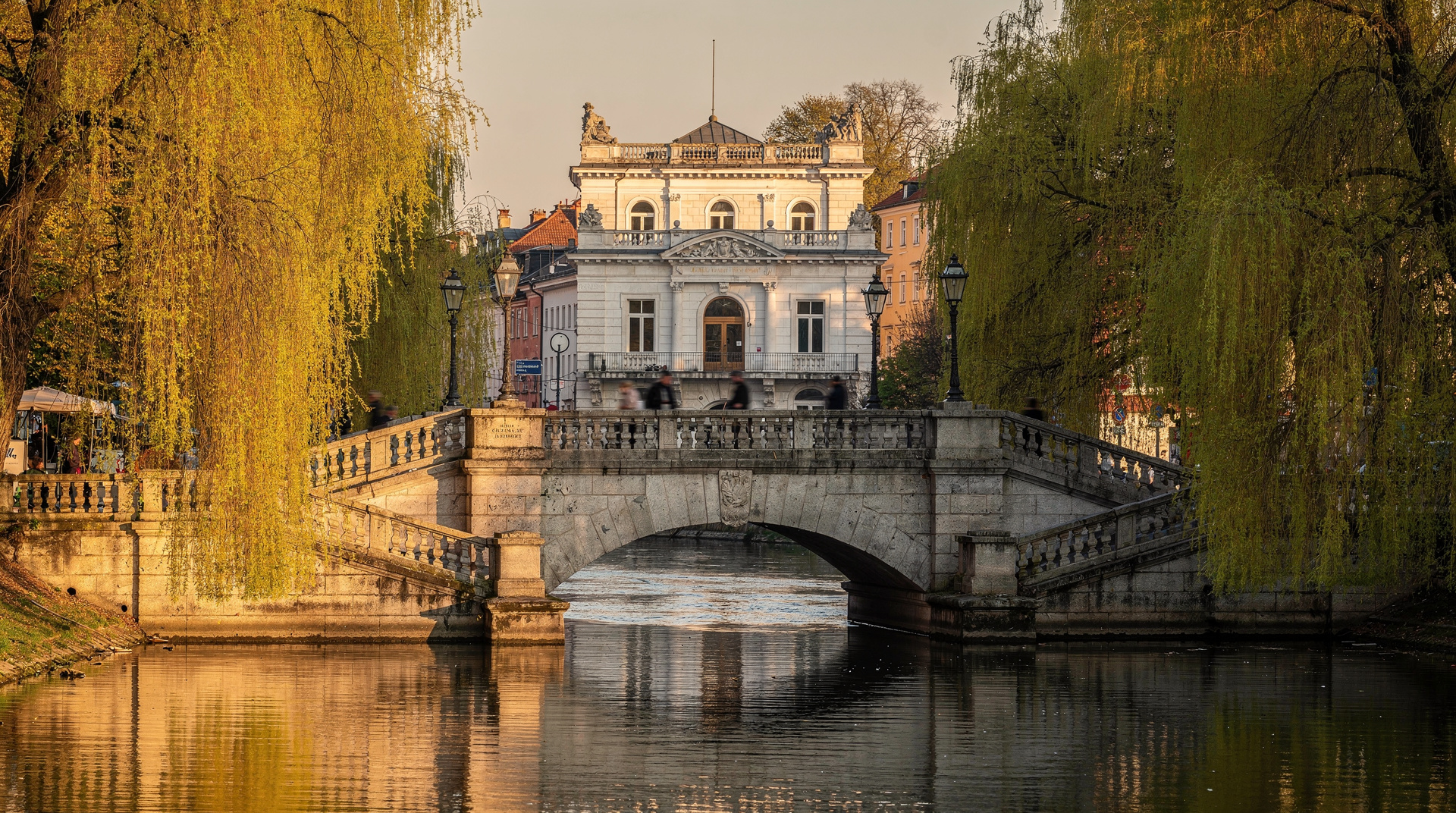
The single most visited Plečnik work, and rightly so. The original road bridge here dated from 1842; Plečnik was commissioned in 1931 to improve pedestrian flow. His solution — adding two pedestrian bridges flanking the original, creating a three-pronged crossing lined with stone balustrades, lamp posts and small pyramidal finials — transformed a functional crossing into a ceremonial gateway between the modern city and the old town.
Stand on the central span and look east along the river: the left bank colonnade, the castle hill above, the Baroque church beyond — this is the composed sequence Plečnik intended. Walk to the downstream end of the right-hand pedestrian bridge and look at the lamp posts: the profile of each element, from base to globe, is slightly different from its neighbours, as if the designer was trying permutations.
2. The Central Market Colonnade (Plečnikova tržnica)
Immediately east of Triple Bridge, Plečnik’s covered market colonnade runs along the river for approximately 200 metres. The Doric arcade was built in stages from the late 1930s through the 1940s, incorporating a fishmongers’ hall, a covered food market and what was intended as a civic ceremonial space. The columns are a simplified Doric, the detail in the friezes mixes Classical and folkish motifs.
This is still a working market. On weekday mornings, vendors sell vegetables, cheese, honey, mushrooms and local produce. On Fridays in summer, an open-air market extends along the entire riverside. Walk the full length of the colonnade on both levels — the upper level overlooking the river and the lower basement levels (Odprta Kuhna, the open kitchen market, operates here in warmer months) show the three-dimensional complexity of the project.
3. Dragon Bridge (Zmajski most) — 200 metres north
Not a Plečnik work (it predates him by twenty years, built in 1901 by Jurij Zaninovich) but a necessary stop as the most prominent bridge in the sequence. The four copper dragons are the city’s heraldic symbol. Compare the Secessionist ornament here with Plečnik’s more restrained approach visible at Triple Bridge — the contrast illuminates what was distinctive about Plečnik’s relationship to the ornamental tradition.
4. Cobblers’ Bridge (Šuštarski most)
Two blocks south of Triple Bridge, Cobblers’ Bridge was Plečnik’s second pedestrian bridge, built in 1931–32. It is lower-key than the Triple Bridge — a single span with paired Ionic columns at each end and a row of second-hand book tables along the parapets (the book dealers have been there since the 1970s, continuing a tradition of market trading on this crossing that dates back centuries). The columns here show Plečnik’s tendency to use Classical orders with quiet irregularity — the spacing is not canonical.
5. Kongresni trg (Congress Square)
Five minutes’ walk west of Triple Bridge, Congress Square was laid out in the early nineteenth century for a congress of the Holy Alliance in 1821. Plečnik redesigned the square in the 1920s, creating the tree-lined Zvezda (Star) park in the centre with its characteristic geometric paths, and addressing the square’s Ursuline Church (early eighteenth century Baroque) with a formal approach axis. The result is the city’s main outdoor public room — used for concerts, markets, political gatherings and student events.
The Philharmonic Hall on the south side is one of the oldest music venues in Europe; Haydn, Beethoven and Brahms were all honorary members of the Philharmonic Society. Plečnik’s contribution to this space was restrained, mostly in landscape and pavement treatment — but the overall composition shows his sense of urban scale.
6. The National and University Library (NUK)
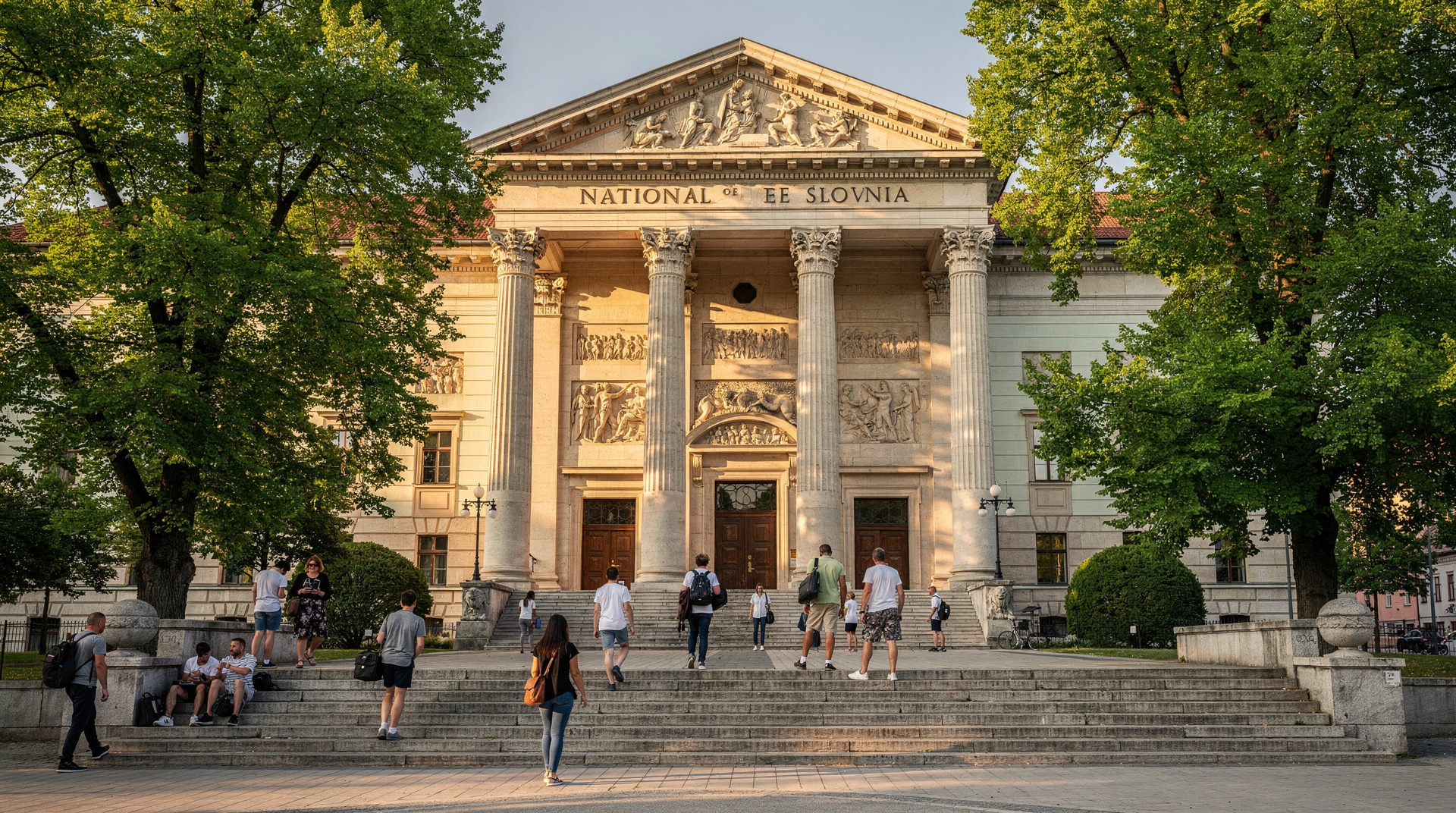
On Turjaška ulica, a 10-minute walk south of Kongresni trg, the National and University Library (1941) is Plečnik’s most ambitious single building. The façade is his most distinctive: dark grey and reddish granite blocks are laid in an irregular pattern that creates a texture unlike any conventional stonework. The windows are deeply set, their openings carved with characteristic Plečnik detail. The effect reads simultaneously as ancient and entirely invented.
The main staircase inside — a dark entrance vestibule leading to a brilliantly light reading room above — is considered one of the most powerful spatial sequences in European twentieth-century architecture. The symbolism is explicit: visitors ascend from the dark ignorance of the ground floor to the illuminated knowledge of the upper reading room. The reading room is accessible to the public during library opening hours (Monday–Friday, morning–evening). The entrance hall and main staircase are accessible without a library card; simply walk in and look.
The Plečnik House museum (Plečnikova hiša)
In the Trnovo neighbourhood south of the old town, Plečnik’s own house is preserved as a museum. He lived here from 1921 until his death in 1957, in a modest converted two-storey building he modified continuously over the decades. The garden, studio, kitchen, personal library and living rooms are intact.
The museum is extraordinary for its intimacy. Plečnik’s design work is all around you — furniture, fittings, tools — alongside his personal objects and the evidence of his working method. He lived simply, without professional vanity, and the house reflects this. Entry costs approximately EUR 6. Opening hours are limited (check the Ljubljana City Museum website for current times) and guided tours are strongly recommended. Pre-booking is advisable.
The walk from the old town to the Plečnik House takes about 15 minutes through the Trnovo neighbourhood, passing the Trnovo Church (another Plečnik project) and the canal-side path he designed for this formerly working-class suburb.
The Plečnik river cruise combines the major riverside Plečnik landmarks with a boat segment on the Ljubljanica, which provides a perspective on the colonnade and the bridges that is impossible from the bank. It is a good introduction before independent exploration on foot.
Žale Cemetery: the most undervisited Plečnik masterpiece
Six kilometres north of the old town, Žale Cemetery (1938–40) is Plečnik’s most emotionally powerful project and the least visited by tourists. The cemetery entrance — a portico of small chapels arranged around a garden court — is at once a Classical gateway, a series of private grief-spaces and an outdoor room of extraordinary quiet. Each chapel, dedicated to a different religious community, is slightly different in its detailing while maintaining an overarching architectural coherence.
Žale receives almost no international visitors. It is accessible by city bus (line 2 or 7 from the centre) in about 20 minutes. The cemetery grounds are open daily until dusk. Entry is free. It is, without hesitation, the most underrated sight in Ljubljana.
If the market colonnade makes you hungry, the Ljubljana Central Market guide explains what to taste and how the stalls work, and the Ljubljana food tour guide turns the same riverside into a tasting route.
Guided Plečnik walks and tours
For visitors with a serious interest in architecture, a guided walk is worthwhile — the density of detail in Plečnik’s work rewards explanation. Several Ljubljana guides specialise specifically in the Plečnik legacy, and the Ljubljana City Museum runs occasional themed tours. A private 2-hour walking tour is the most efficient option if you want focused attention on the architectural dimension rather than the general city narrative.
The UNESCO recognition and what it means
The 2021 UNESCO inscription is significant for how it was framed. The criterion was ‘human centred urban design’ — Plečnik’s interventions were valued not as aesthetic objects but as spaces that serve the daily needs of the city’s residents. The inscription covers a network of works, not a single monument, recognising that Plečnik’s contribution was systemic: he improved the city as a place to live, not merely to look at.
This framing explains why the inscribed sites feel so usable — markets that still serve markets, bridges that still carry pedestrians, parks that still host concerts. Plečnik’s architecture did not seek posterity through monumentalism; it sought permanence through usefulness.
For more on Slovenia’s UNESCO heritage sites, see the UNESCO sites in Slovenia guide and the broader Ljubljana old town guide for context on how Plečnik’s work fits into the historic urban fabric.
Plečnik’s work also sits comfortably alongside the city’s other cultural stops: the museums and galleries guide shows how to pair the architecture with an indoor visit on a wet day, and travelling with children is covered in Ljubljana with kids, since the riverside route is easy going for families. The wider story of the city’s reinvention is told in the blog piece on Ljubljana as a green capital.
Practical tips for Plečnik visitors
Best time to explore: Early morning (before 09:00) for photographs without people in frame — the market colonnade and Triple Bridge are especially photogenic at dawn. The National Library is best visited on weekday mornings when the reading room is open and operational, giving the space its full life.
Photography: All exterior Plečnik works are freely photographable. Interior photography in the NUK reading room is permitted for personal use (no flash, tripods). Photography in the Plečnik House museum is usually permitted without flash; confirm on arrival.
Maps: The Ljubljana Tourist Board produces a free Plečnik map available from the main tourist information office at Adamič-Lundrovo nabrežje 2. The UNESCO website has a detailed interactive map of all inscribed sites.
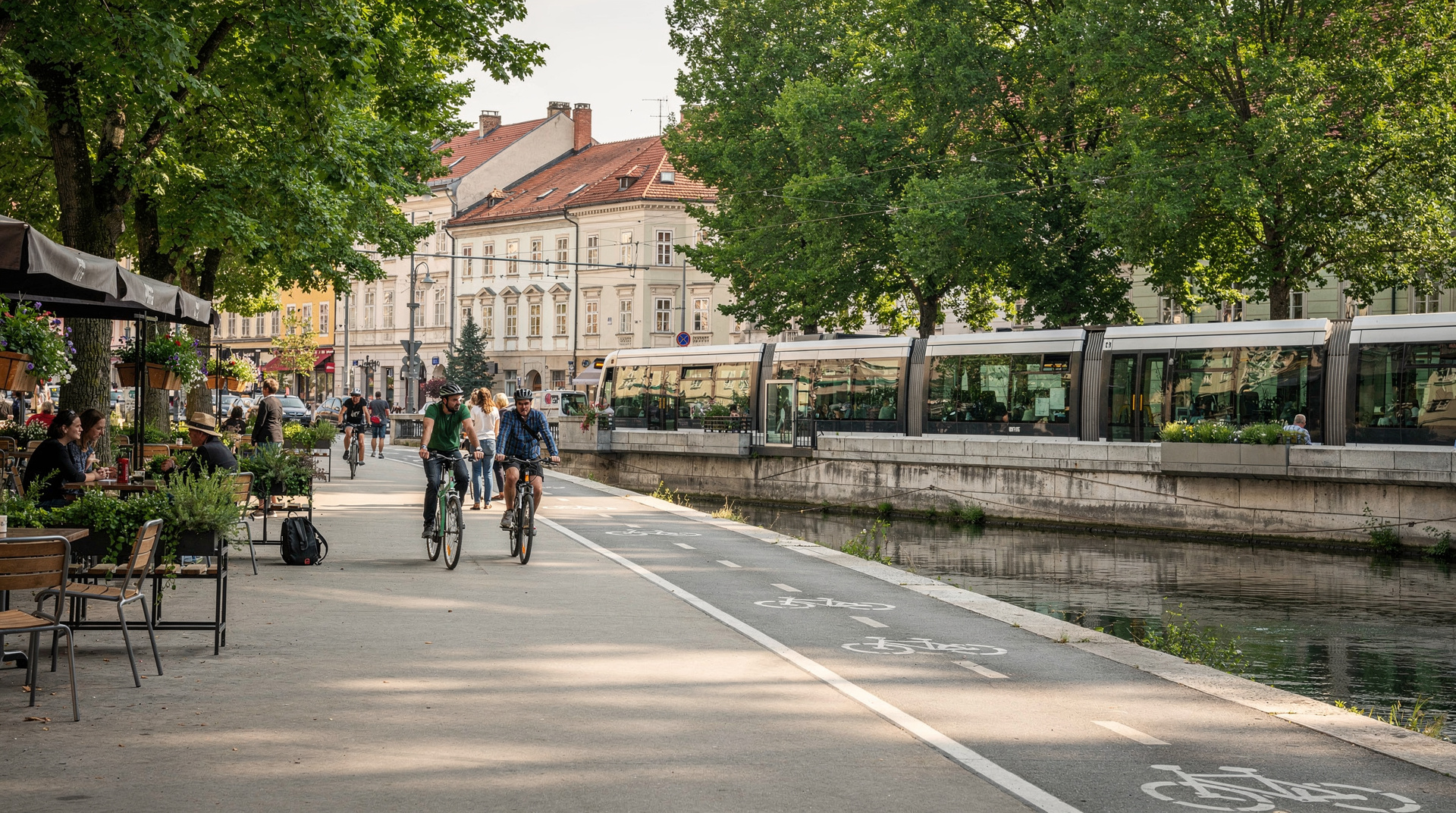
Cycling: The Plečnik works are well suited to a bicycle tour — distances between sites are short and the riverside paths are car-free. BicikeLJ city bikes are available from stands near Triple Bridge and Kongresni trg.
Plečnik versus Ljubljana’s other must-sees: is the detour worth it
Visitors with only a day or two in Ljubljana often ask whether a dedicated Plečnik walk is worth the time against the castle, the museums or simply wandering the old town. The honest answer: you do not need to choose, because the two overlap almost entirely. Triple Bridge and the market colonnade sit directly on the route between Ljubljana Castle and the old town’s main streets, so a Plečnik-aware walk adds perhaps 30–45 minutes of extra attention to a route you would walk anyway.
The real decision is whether to go further — to the Plečnik House in Trnovo or to Žale Cemetery — both of which require a deliberate detour and reward only visitors with a genuine interest in architecture or urban history. For a first Ljubljana day that also covers the castle and old town in one go, see the Ljubljana in one day guide; for a broader look at what else the city offers beyond Plečnik, things to do in Ljubljana covers the wider list.
With a few extra days, the city makes a good base for onward trips: see day trips from Ljubljana for ideas, or the long weekend in Ljubljana itinerary to fit the Plečnik route into a complete short stay.
A short table of the core sites
| Site | Time to allow | Cost |
|---|---|---|
| Triple Bridge | 15 min | Free |
| Central Market Colonnade | 20–30 min | Free (browsing) |
| Cobblers’ Bridge | 10 min | Free |
| Kongresni trg | 10 min | Free |
| National and University Library | 20–30 min | Free (entrance hall and staircase) |
| Plečnik House museum | 1 hour | ~EUR 6 |
| Žale Cemetery | 1–1.5 hours incl. travel | Free |
Frequently asked questions about Plečnik’s Ljubljana
Why is Ljubljana’s architecture called UNESCO World Heritage?
The Works of Jože Plečnik in Ljubljana were inscribed on the UNESCO World Heritage List in 2021 under the criterion of ‘human centred urban design’. The inscription recognises Plečnik’s redesign of Ljubljana’s public spaces — bridges, markets, parks and civic buildings — as an exceptional example of integrating modern architectural thinking with the city’s existing historic fabric and the needs of its daily users.
Can you visit the National Library without a library card?
Yes. The main entrance hall and grand staircase of the National and University Library (NUK) are accessible to the public without a library card during regular opening hours (Monday–Friday, mornings and afternoons; closed at weekends). The reading rooms above require a reader’s card but the primary spatial experience — the dark entrance vestibule and the ascending staircase — is accessible to all visitors.
How does Ljubljana compare to Prague or Vienna for architecture?
Ljubljana is far smaller (280,000 inhabitants versus Vienna’s 2 million or Prague’s 1.4 million), which means its architectural highlights are within easy walking distance of each other. The Plečnik legacy is unique to Ljubljana — Prague has Plečnik works too, in the castle complex, but they are fragments rather than a comprehensive urban project. For architectural tourists, Ljubljana offers exceptional depth in a small area, without the crowds that make photography and contemplation difficult in the larger capitals.
Are there guided architecture tours of Ljubljana in English?
Yes — several specialist guides offer dedicated Plečnik and architecture tours in English. The Ljubljana City Museum organises monthly themed tours (check their website). General guided walks available through tour operators typically include the main Plečnik works as part of a broader old town narrative. Private architecture-focused guides can be booked through the Ljubljana tourism portal or through specialist architecture travel agencies.
What is the best souvenir related to Plečnik?
The Ljubljana City Museum’s shop sells high-quality monographs on Plečnik in English, as well as architectural prints and design objects referencing his work. The museum also stocks Damjan Prelovšek’s biography, the standard reference work in English. More modestly priced are the postcards of Plečnik’s drawings and the reproductions of his architectural sketches available at the museum and in bookshops along Stari trg.
Top experiences
Bookable activities with verified prices and instant confirmation on GetYourGuide.