Sledding and snow fun in Slovenia: the best runs, night rides and tips
Ljubljana: Krvavec night sledding adventure
Where is the best sledding in Slovenia?
Krvavec operates the most organised dedicated sledding facility in Slovenia — a 2 km floodlit night run with artificial snow, open on Friday and Saturday evenings in January and February. For daytime sledding, the hillsides around Kranjska Gora and the Pokljuka plateau offer natural sled runs when snow conditions allow. Many Slovenian families sled on improvised local slopes after fresh snow.
Sledding and snow fun in Slovenia: the full guide
Not everyone in a winter travel group skis. Children who are not yet on skis, partners who prefer watching from the warmth, or visitors who simply want a snow day without committing to lift tickets and ski school — all of these people exist, and Slovenia caters for them better than its modest international ski profile suggests.
Sledding (sánkanje in Slovenian) is deeply embedded in Slovenian winter culture. A family with a plastic sled, a snowy hillside and an afternoon is the basic unit of Slovenian winter leisure. The organised facilities at Krvavec have professionalised this, but the informal tradition is the foundation.
This guide covers the organised sledding facilities, the best areas for natural sledding, and the full range of snow fun activities that do not require ski passes or ski lessons.
| Where | Krvavec (main sledding), Kranjska Gora, Pokljuka, Velika Planina |
| Cost | Krvavec night sledding around EUR 12–18 + gondola |
| Season | Late December to mid-March, snow permitting |
| Best for | Families with children 5+, non-skiing group members |
| Booking | Advance booking recommended for Friday/Saturday nights, Jan–Feb |
Krvavec night sledding: the main event
Krvavec night sledding is the most popular organised snow-fun activity in Slovenia for good reason. The facility is well-run, the 2 km run is genuinely exciting, and the evening atmosphere — cold air, floodlit forest, the noise of sleds — is distinctive.
How it works: The dedicated sledding track runs 2 km from an elevated start point down to the gondola upper station area. The track is prepared with artificial snow and shaped into a winding descent with speed sections and tight corners. Sleds are provided (sturdy plastic toboggans, not inflatable tubes). Helmets are mandatory and provided in the ticket price.
Practical logistics:
-
Operating evenings: Typically Friday and Saturday from approximately 18:00–22:00, with some extended periods in January and February. The resort sometimes adds Thursday or Sunday evenings during peak weeks.
-
Getting there: Drive to the Krvavec gondola base at Sv. Primož pri Kamniku (40–45 minutes from Ljubljana). Take the gondola up. The sledding track is accessed from the upper station area.
-
Ticket price: Approximately EUR 12–18 per person including sled and helmet (2025–26 estimates; check current prices). The gondola ticket is additional (EUR 12–16 one way for the evening session).
-
Booking: Advance booking strongly recommended for Friday and Saturday evenings in January and February — the run gets busy and queue times increase without a pre-booked slot.
Age and fitness: Children from around 5–6 can ride the full track independently. Younger children (3–5) can ride in a lap with a parent on a two-person sled (available on request). The track requires some core stability — it is not a gentle slide. Most physically able people between 5 and 70 handle it comfortably.
Natural sledding around Kranjska Gora
Kranjska Gora has multiple informal and semi-formal sled runs that form part of the winter social life of the resort.
The Vitranc area lower slopes: Below the main ski area, several natural slopes are used for sledding after fresh snowfall. These are not maintained or controlled; conditions depend on recent snow. Best in January and February after fresh overnight snow.
The Planica valley road: When the road through the Planica valley closes to traffic (it does on certain winter days), it forms a gentle 5 km slope that is used for cross-country skiing, walking and informal sledding. Bring your own sled; the gradient is gentle and the scenery is beautiful.
Around the village: Several small hillsides and football fields around the village become impromptu sled runs after significant snowfall. Ask at your accommodation — locals know the current best spots.
A practical note on natural sledding in Slovenia: it is informal, self-organised and depends entirely on snow conditions. It can be excellent after a fresh 30 cm snowfall; it can be nonexistent if there has been warm rain. The Krvavec artificial snow facility is the reliable alternative.
Snowshoeing
Snowshoeing (krpljanje) has grown significantly in popularity in Slovenia over the past decade. The main areas:
Pokljuka plateau: The broad plateau above Bohinj, at 1,300–1,400 m, is the best place in Slovenia for snowshoeing. The landscape of mixed forest and open meadow, the reliable snow cover (December to March) and the well-marked trails make it ideal. Snowshoe rental is available from operators in Bohinjska Bistrica and at the plateau access points.
Velika Planina: The pastoral plateau above Kamnik (accessible by cable car year-round) is extraordinary in winter. The traditional shepherds’ huts under snow, the wide open plateau views and the well-marked trail network make it one of the most satisfying half-days in winter Slovenia. Cable car round trip approximately EUR 15–18. See the Velika Planina guide.
Around Kranjska Gora: The Planica valley trail and the forest paths above the village are straightforward snowshoe terrain. The resort’s cross-country ski network (40+ km) doubles as good snowshoe territory.
Cross-country skiing
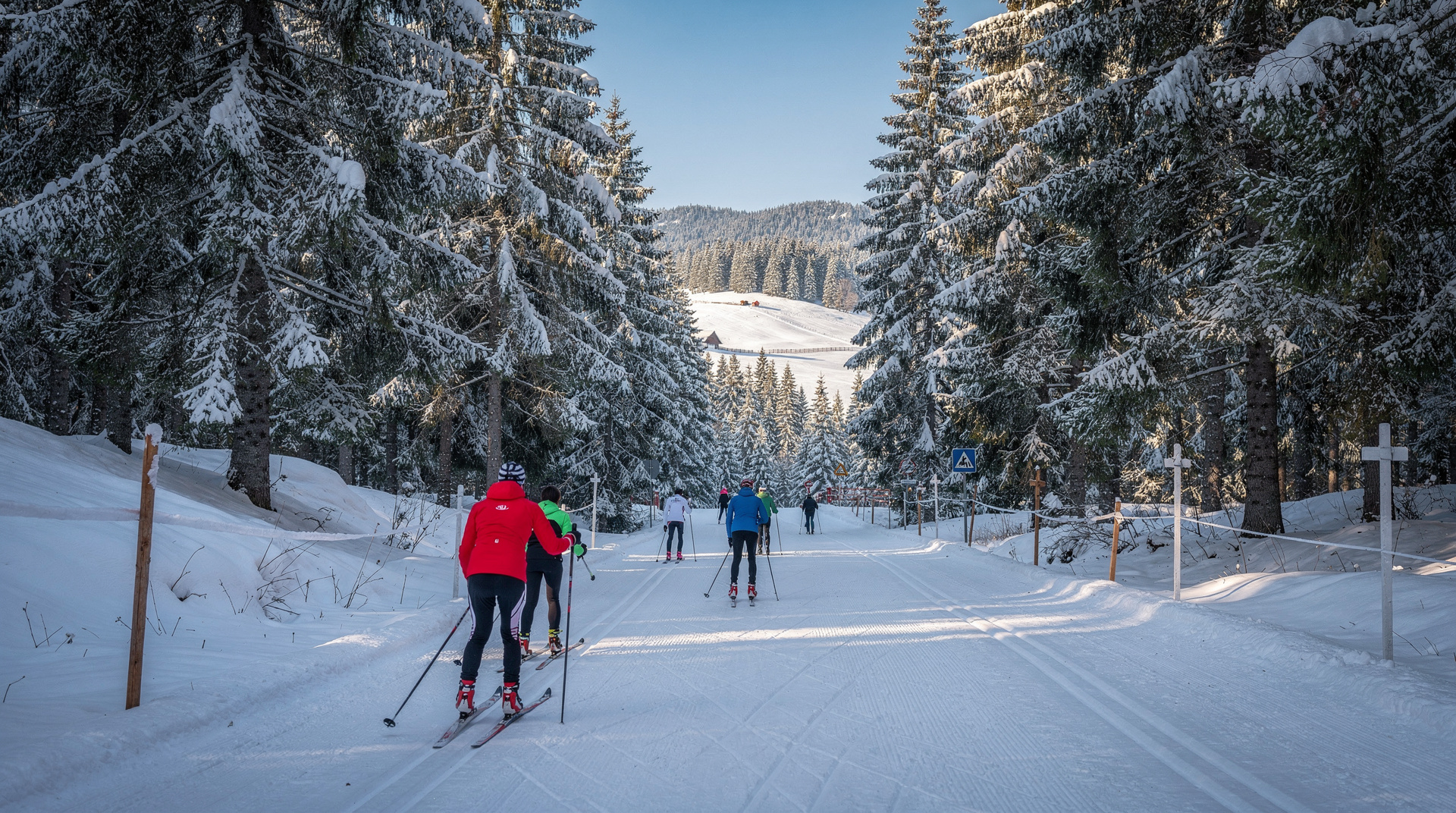
Kranjska Gora has the most developed cross-country skiing infrastructure in Slovenia. Over 40 km of groomed trails run through the Planica valley and surrounding landscape, including the Planica Nordic Centre used for World Cup competition.
Trail passes are separate from the downhill lift pass and cost approximately EUR 8–12 per day. Classic and skating tracks are groomed separately. Equipment rental (skis, poles, boots) is available at the Nordic Centre and in the village.
For intermediate and advanced cross-country skiers, the Planica trails offer a genuinely high-quality experience. The valley scenery — dominated by the Jalovec and Triglav massifs — is spectacular.
Ice skating
Ljubljana ice rink: An outdoor ice rink is set up in Ljubljana each winter season (typically December to February), usually in the riverside promenade area or near the castle. Public skating with skate rental is available.
Kranjska Gora ice rink: The village operates a covered and sometimes outdoor ice rink in season. Skate hire available.
Lake Bled (if it freezes): In exceptional cold winters — roughly once every 5–10 years — Lake Bled freezes solid enough for skating. The last notable freeze was 2017. When it happens, it is a national event and worth seeing if you happen to be there. Do not plan a trip for this; plan for the normal Bled winter experience and consider the freeze a bonus.
Snow activities with children
Slovenia is well set up for winter activities with children. Key practical notes:
Ages 3–6: Snow play areas at ski resort bases, gentle natural sledding slopes, snowman building. The beginner “snow gardens” at Kranjska Gora and Krvavec are specifically designed for this age group.
Ages 7–12: Krvavec night sledding (from about 7), ski school at any of the three resorts, cross-country skiing introduction at Kranjska Gora.
Ages 12+: Full ski programme at all resorts; Krvavec terrain park for snowboarders; independent sledding.
Snowshoeing with children: The Velika Planina plateau is excellent for family snowshoe walks — the terrain is gentle, the cable car eliminates the approach hike, and the huts provide shelter.
Snow tubing and other snow sports
Snow tubing: Available at some ski resort bases — essentially sledding in large rubber tubes rather than toboggans. Less technical than structured sledding and very popular with young children. Check the Kranjska Gora and Krvavec base area for current availability.
Ski-bob (bob): A small wheeled frame with ski attachments, ridden in a seated position down ski slopes. Available for hire at some Slovenian resorts. Novel and entertaining for children.
Horse-drawn sleigh rides: Traditional horse-drawn sleighs (sani) are available for hire at several rural locations around Kranjska Gora and the Bohinj valley in good snow conditions. A popular winter experience, particularly romantic in the early evening. Book through local stables or your accommodation.
Building snow: The practical and free option. A good snowfall and a hillside behind your accommodation is all that is needed. Slovenian winters above 500 m produce reliably packable snow (not the dry powder of the high Alps). Snowmen, snow forts, basic sledding on any convenient hill — this is how Slovenian families spend winter afternoons when the organised facilities are not the goal.
Visiting the Planica valley in winter
The Planica valley, 2 km from Kranjska Gora, is worth visiting in winter even if you are not cross-country skiing. The famous ski jumping hills (among the largest in the world) are visible from the valley floor and are themselves a dramatic sight in snow. When World Cup events are held in March, the valley fills with spectators.
A winter walk through the Planica valley (the road closes to traffic in winter, creating a car-free snow path) is a pleasant, flat excursion. The valley is wide, sheltered and particularly beautiful after fresh snow. Snowshoes are helpful in deep snow but not necessary on well-trodden days.
Equipment for winter activities
Sledding: Krvavec provides sleds for the organised night run. For natural sledding, simple plastic sleds are available at petrol stations and sports shops across Slovenia for EUR 5–15. More substantial wooden or aluminium toboggans are EUR 30–80 at sports shops.
Snowshoe rental: Available in the Bohinj valley (multiple providers), at the Pokljuka plateau access points and increasingly at outdoor equipment shops in Kranjska Gora. EUR 8–15 per day for basic kit. A guide is not required for the prepared plateau trails.
Winter walking gear: Waterproof boots with grip are mandatory for any winter walking in Slovenia. Standard trail shoes become dangerous on icy paths. Micro-crampons (small traction devices that attach to boots) are sold everywhere and are useful for the lower, icy sections of paths.
Planning a snow day around the rest of your trip
A sledding afternoon rarely stands alone, and a few neighbouring guides help you fit it into a wider plan. If you are still deciding when to travel, the Slovenia in winter guide explains what the season feels like overall, and the weather month by month page helps you judge how likely reliable snow is in the weeks you have available.
Travelling with children is the most common reason people look for sledding in the first place. The Slovenia for families guide covers the wider picture of what works with younger travellers, while the five-day family itinerary shows how a snow day can sit alongside gentler activities. If your group is built around a longer cold-season stay, the seven-day winter itinerary gives a sense of how to pace several snow days without exhausting anyone.
Getting to the snow also needs thought. Most of the places in this guide are far easier with a car, and the car rental guide and the vignette driving guide cover the practical side of winter driving. For evenings after the sleds are put away, the Pokljuka plateau guide is useful if you want to extend the snow theme into a second day, and a soak in one of the thermal spas is the classic way to warm up once the cold has got into your bones.
Seasonal notes
December: Snow conditions can be marginal at lower elevations before mid-December. The organised facilities at Krvavec typically open from late November with artificial snow. Natural sledding depends on early snowfall.
January: Best conditions overall. Coldest month. Krvavec night sledding fully operational. Cross-country trails at Kranjska Gora in peak condition.
February: Peak season. School holiday periods make the resorts busiest. Book Krvavec night sledding well in advance for February weekends.
March: Conditions at altitude still excellent. Lower elevations warming up. Good for snowshoeing on the Pokljuka plateau as the snowpack consolidates.
Combining sledding with a family ski trip
Families with children across different ages often face the challenge of keeping everyone entertained. Slovenian winter resorts are well-equipped for this:
Typical family day at Krvavec: Parents ski independently in the morning while children aged 5+ attend ski school. In the afternoon, the whole family meets for the night sledding run (children from ~5, parents welcome). A full day with each family member appropriately occupied.
At Kranjska Gora: Children 7+ in ski school, parents on the slopes. After skiing, the children’s snow garden at the base allows younger children to play in a safe area. Cross-country skiing on the flat Planica trail is suitable for family groups with children 8+.
Winter trip for non-skiing adults: If adults in the group do not ski, the Krvavec night sledding + gondola ride is a complete winter sports experience without requiring ski lessons. Combined with a morning snowshoe walk on the Planica valley or Pokljuka plateau, and a thermal spa day, it is a full and satisfying winter trip.
For families where some members ski and others do not, a half-day lesson at Vogel in the morning followed by sledding or snow play in the afternoon is a workable split:
Vogel half-day skiing with instructorChoosing between Krvavec, Kranjska Gora and Bohinj for a snow-fun day
Visitors planning a single non-skiing snow day sometimes struggle to decide which base to choose, since the three main areas each offer a genuinely different experience:
Krvavec is the strongest single choice if the organised night sledding run is the priority — nothing elsewhere in Slovenia matches its dedicated 2 km floodlit track. It’s the closest of the three to Ljubljana (40–45 minutes), which also makes it the most practical for a half-day or evening trip without an overnight stay.
Kranjska Gora offers the widest range of snow activities in one place: natural sledding slopes, the Planica valley walk, extensive cross-country trails, and an ice rink, plus proximity to Lake Bled for a combined day. It suits families wanting variety over a multi-day stay rather than a single organised activity.
Bohinj and the Pokljuka plateau are the right choice for snowshoeing specifically — the plateau’s gentle terrain and reliable snow cover from December through March make it the most accessible winter walking in the country, and it pairs naturally with a Lake Bled and Bohinj sightseeing day.
For a single day trip from Ljubljana with children who want sledding specifically, Krvavec wins on convenience. For a multi-day winter base with variety, Kranjska Gora or the Bled/Bohinj area serves better.
What to do if there’s no snow
Slovenia’s lower-elevation snow cover is not guaranteed every winter, and a warm spell or rain event can strip snow from areas below 800–1,000m even in January.
If natural sledding conditions have failed at your planned destination, the practical fallbacks are: Krvavec’s artificial-snow night sledding track, which operates independently of natural snowfall at lower elevations because it sits at 1,450m and uses snow-making equipment; the higher-altitude trails at Pokljuka and Velika Planina, which retain snow longer than valley floors; or pivoting the day toward a thermal spa visit instead, treating the lack of snow as an opportunity for a different kind of winter day rather than a wasted one. Checking the ARSO snow depth reports for specific resort elevations before travelling, particularly in a marginal-snow year, saves considerable disappointment.
Safety on organised sledding runs
The Krvavec night sledding run is a managed facility with safety measures in place, but some practical points:
Helmets are mandatory and provided in the ticket price. Use them — the run reaches genuine speed in the faster sections.
Sled control: The sleds have simple drag braking (lift your feet to slow, lower them to brake). Practice the braking in the gentle opening section before the steeper parts. Children who are nervous about speed should be accompanied by an adult on a two-seat sled.
Queuing and flow: The run is one-directional with a conveyor lift or walk back to the top. Do not start your descent until the sled ahead has a clear gap (around 15–20 seconds). The operators manage the queue and spacing.
Clothing: You will get cold on the sled (wind chill). Dress warmly — waterproof outer layer, gloves, hat under the helmet. Goggles or glasses are useful in the lower sections where ice crystals can hit the face.
After the run: The body temperature drops on the descent. Have a warm drink planned immediately after — the complex has a restaurant and warm drinks available.
The Planica valley in winter: a non-ski adventure
For families or groups who want a distinctive Slovenian winter experience without skiing or paying for organised facilities, the Planica valley deserves a mention.
The valley road closes to traffic in winter (usually from first significant snowfall). The result is a 5 km car-free snow path through the valley, with the enormous ski jumping hills visible at the far end. Walking the valley in fresh snow is a genuinely beautiful experience — the scale of the Triglav massif views, the silence, the tracks of wildlife in the snow.
A round trip (from the Rateče-Planica car park at the valley entrance to the ski jumping complex and back) is 10 km and takes 2.5–3 hours at a comfortable pace with stops. This is family-friendly (prams are feasible in packed snow conditions, snowshoes or crampons for icy sections).
The Planica complex itself is usually open for visitors in winter, with the ski jumping museum and a café at the base of the hills. The Letalnica hill (the largest) is visually extraordinary from directly beneath.
Winter photography at the resorts
Slovenia’s winter landscape offers exceptional photography conditions, particularly around the ski resorts and lakes.
Golden hour at Kranjska Gora: The valley orientation means the mountains catch the first light on the eastern faces (Razor, Prisojnik) at dawn. A clear winter morning in Kranjska Gora, with the snow-covered peaks turning pink and orange as the sun rises, is one of the most photogenic situations in Slovenian winter.
Lake Bled in snow: The classic combination — island church, castle, snow — is most often photographed from the Ojstrica viewpoint (15-minute climb from the lake). In winter, arrive at dawn and wait for the mist to clear; the first 30 minutes after sunrise are often the best light. Bring a tripod for long exposures in low light.
The Planica valley in fresh snow: After overnight snowfall, the walk into the Planica valley (car-free in winter) offers extraordinary photography conditions — the scale of the ski jumping hills against the deep snow, the valley silence, the animal tracks.
Krvavec upper plateau: On clear days, the upper plateau at Krvavec offers views south across the Ljubljana basin and the Krim hill range, with the flat plateau in the foreground and the blue-grey hills beyond. Best photographed in the late morning when the sun is on the plateau.
Sledding etiquette and shared-slope courtesy
On informal natural slopes around Kranjska Gora and elsewhere, a few unwritten local rules keep things safe and pleasant for everyone sharing a hillside. Sledders generally keep to one side of a slope while walkers and dog owners use the other, and it’s customary to check the slope below is clear before setting off, since a loaded sled travels considerably faster than it looks from the top.
Young children should always be positioned lower on the slope than older, faster sledders, and parents typically walk the sled and child back up rather than letting them walk down against the traffic. These conventions aren’t posted anywhere — they’re simply how Slovenian families use shared snow slopes safely, and visitors who observe locals for the first run or two before joining in tend to fit in without incident.
Guided winter experiences
Several operators in Slovenia offer organised winter experiences that are worth knowing about:
Guided snowshoe tours: The PZS (Slovenian Alpine Association) and several commercial operators offer guided snowshoe tours in the Julian Alps, on the Pokljuka plateau and around Velika Planina. Groups of 4–10 people, professional mountain guide. Prices EUR 45–70 per person for a half-day. Book through local tourist information or the operator websites.
Winter birdwatching tours: DOPPS (the Slovenian ornithological society) organises winter birdwatching excursions, particularly to the Sečovlje saltpans (flamingos, waders) and Škocjanski zatok (wintering waterbirds). Available from November to March. Check the DOPPS website for current schedule.
Night sledding with guide: Some operators combine the Krvavec night sledding with a pre-sledding guided walk in the forest or a hot drink at a mountain hut. These add an experiential layer to the standard night sledding facility.
Budget guide for winter activities
A realistic cost summary for a winter Slovenia week (per person, mid-range budget):
| Activity | Cost per day |
|---|---|
| Skiing (pass + hire) | EUR 65–80 |
| Cross-country skiing trail pass | EUR 8–12 |
| Night sledding (Krvavec) | EUR 25–35 |
| Snowshoeing (guided half-day) | EUR 45–70 |
| Thermal spa day | EUR 20–35 |
| Lake Bled: castle admission | EUR 19 (pletna fare: confirm at the landing or via bled.si) |
Accommodation ranges from EUR 60–100 per night in Kranjska Gora guesthouses to EUR 150–250 at Lake Bled hotels. Meals: gostilna dinners EUR 12–20, hotel restaurants EUR 20–35 per head.
A 5-night winter trip (ski 3 days, spa 1 day, Bled 1 day) for two people runs approximately EUR 1,400–1,900 including accommodation, activities and meals. This compares very favourably with equivalent trips in Austria or Switzerland.
For the skiing side of winter, see the skiing in Slovenia guide. For the full winter activities picture, see Slovenia in winter.
Frequently asked questions about Sledding and snow fun in Slovenia
What is Krvavec night sledding like?
The Krvavec night sledding run is a 2 km prepared track with artificial snow and floodlighting. Sleds are provided and helmets are mandatory. The run is fast in sections and winding in others — genuinely exciting for adults and children. It operates on selected evenings (mainly Friday and Saturday, January–February). Book in advance for busy weekend evenings.Do I need my own sled for sledding in Slovenia?
No — sleds are provided at organised facilities like Krvavec. For natural slopes elsewhere, bringing or borrowing a sled locally is standard. Basic plastic sled trays are sold at petrol stations and sports shops throughout Slovenia for EUR 5–15 in winter.What other snow activities are available in Slovenia?
In addition to skiing (at Kranjska Gora, Vogel and Krvavec) and sledding, popular snow activities include snowshoeing on the Pokljuka plateau and Velika Planina, cross-country skiing at Kranjska Gora (40+ km of trails), ice skating at outdoor rinks in Ljubljana and Kranjska Gora, and building snow infrastructure around the Planica Nordic Centre area.Is sledding in Slovenia good for families with young children?
Yes. The Krvavec night sledding is suitable for children from around age 5–6 (a parent rides with smaller children). For very young children (3–5), the smaller natural slopes around ski resort bases are more appropriate. The ski resort beginner areas at Kranjska Gora and Krvavec have dedicated gentle snow areas for children who are not yet skiing.When is the snow season for sledding?
Natural sledding conditions depend on snowfall — reliable from late December to February at most elevations above 500 m, and from November to March above 1,000 m. The Krvavec artificial snow facility operates the dedicated sledding run from late December to mid-March, snow conditions permitting.
Top experiences
Bookable activities with verified prices and instant confirmation on GetYourGuide.