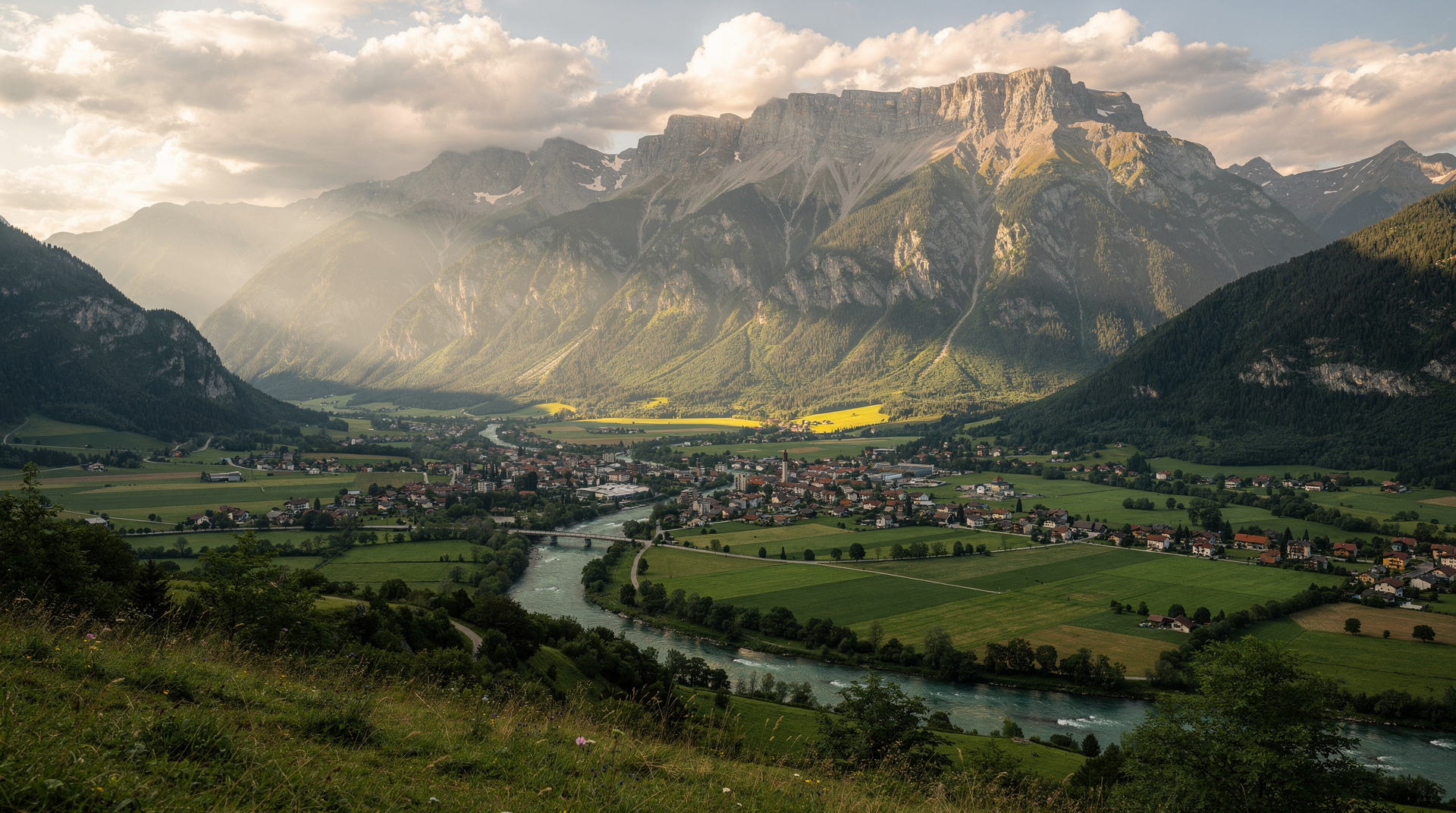
Tolmin: the Soča Valley's unhurried south
Tolmin anchors the lower Soča Valley with deep river gorges, a quiet old town, and Slovenia's best e-bike network. Honest travel guide with EUR prices.
Soča Valley: the ultimate explorer e-bike tour
Quick facts
- Best time to visit
- May–October
- Days needed
- 1–2 days
- Getting there
- Car from Ljubljana (1h 30min) or bus via Idrija
- Budget per day
- EUR 50 to 100
The Soča Valley without the crowd
Tolmin is where the tourist economy of the Soča Valley thins out. It is the largest town in the valley — about 3,500 residents — but receives a fraction of the visitor numbers of Bovec, and almost no international travel writing covers it. This is partly explained by geography: Tolmin sits at the bottom of the valley where the Soča broadens and loses the canyon drama that makes the upper sections so photogenic. But that reading misses what makes Tolmin worth knowing: the Tolmin Gorges are genuinely exceptional, the lower Soča is ideal for paddling, and the e-bike network radiating south and west from the town is among the best-developed in Slovenia.
| Where | Lower Soča Valley, southwest Slovenia |
| Cost | EUR 5 gorge entry; EUR 50–100/day overall |
| Time needed | 1–2 days |
| Getting there | Car (1h 30min from Ljubljana) or bus via Idrija |
| Best time | May–October; September for cycling and gorge walks |
The town itself is modest. A square with a fountain, a Baroque church, a good local supermarket, and a scattering of guesthouses and restaurants. No tourist infrastructure to speak of. Prices are measurably lower than in Bovec or Kobarid. It functions well as either a budget base for exploring the upper valley or as a one-night stop between the Soča Valley and the Slovenian coast.
The Tolmin Gorges
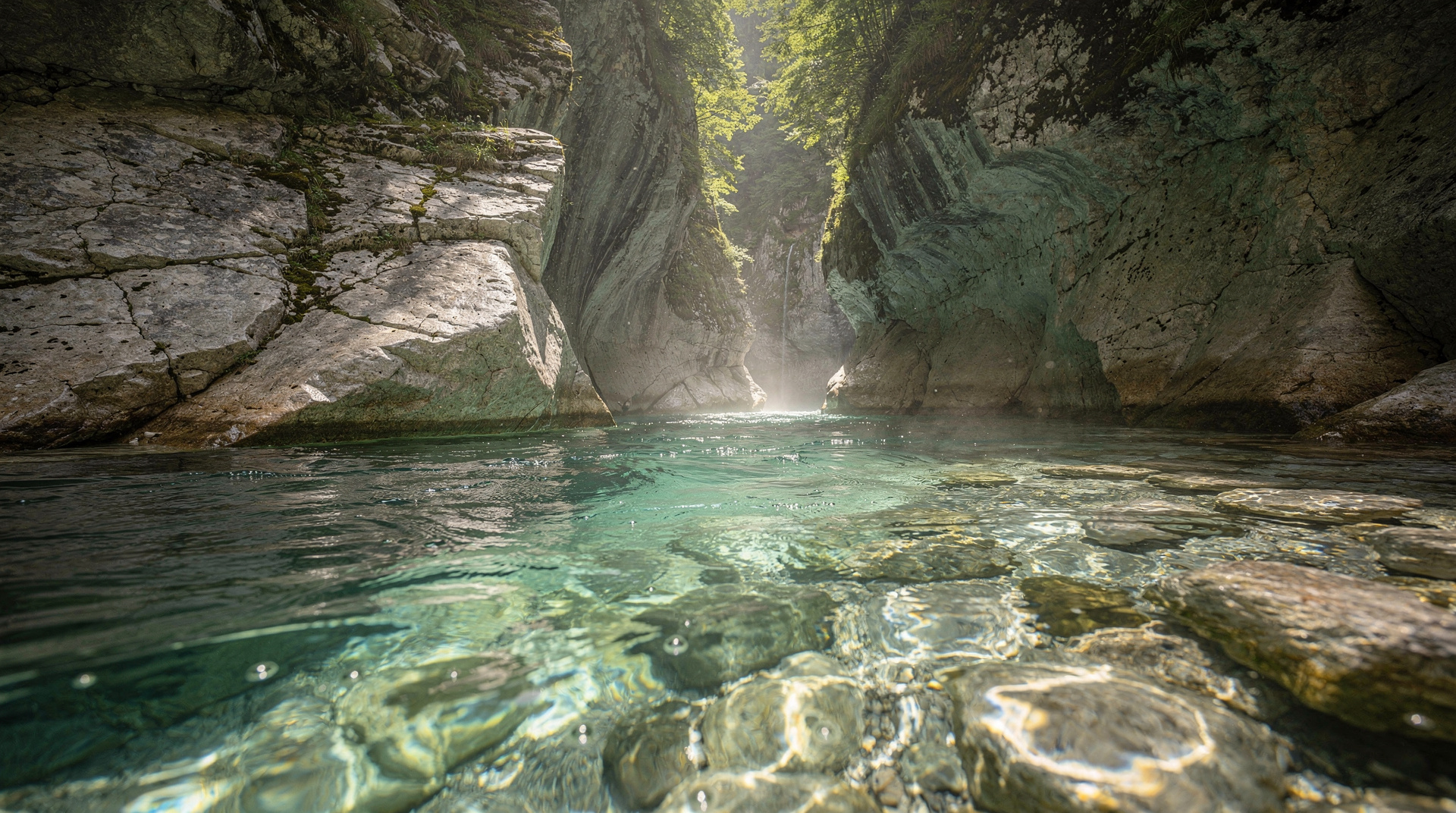
The Tolmin Gorges (Tolminska Korita) are cut by the Tolminka and Zadlaščica rivers in the final kilometre before they join the Soča. The canyon path — 1.5km, roughly 45 minutes one-way — follows a series of wooden walkways bolted into the gorge walls, passing through sections where the rock walls close to within a few metres of each other overhead. At the confluence point, the two streams run side by side in different colours — the Tolminka a cold grey-green, the Zadlaščica warmer and more translucent — before mixing.
Entry is EUR 5 (2026 price; check locally). The path is open May to October; it closes in winter due to ice and flood risk. Arrive early in July–August; parking at the trailhead is limited and fills by mid-morning on weekends. On weekday mornings in June or September, you may have the gorge almost to yourself.
At the entrance to the gorge, a natural rock bridge — the Medvedova Glava (Bear’s Head) formation — has been used as a thermal jump point for generations of local teenagers. The water below runs deep and cold. It is not officially supervised; act accordingly.
E-biking from Tolmin
The e-bike network from Tolmin is the best in the Soča Valley for distance riding. Signed routes head south toward the Baška Grapa valley, west toward Goriška Brda wine country, and north along the Soča toward Kobarid. The cycling is not technical — most routes follow paved minor roads through farming villages — but the gradients that would make them exhausting on a standard bicycle are manageable on an e-bike.
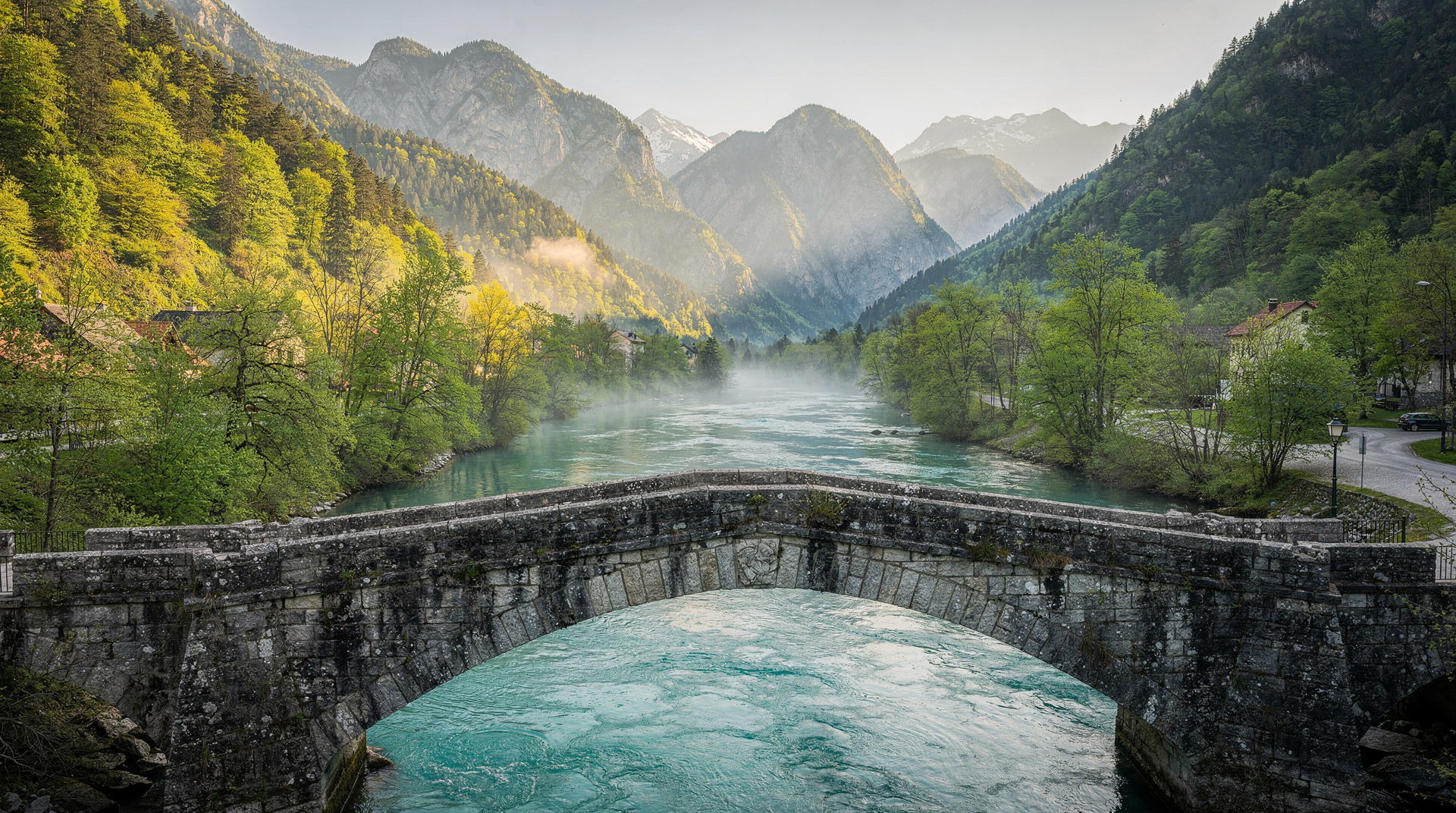
E-bike guided tour through the Soča Valley from TolminThe Most na Soči route (15km south from Tolmin) passes through the village of Modrej, known for its characteristic Soča stone architecture, and reaches the archaeological site at Most na Soči where Iron Age finds are visible in context (interpretive panels, free access). The bridge over the Soča here is a popular photography spot.
Rental e-bikes from outfitters in Tolmin run EUR 30–50 per day including charger and helmet. Most operators can provide a cue sheet for the main circuits; guided tours add narrative and logistics support for EUR 50–80 per person.
Paddling the lower Soča
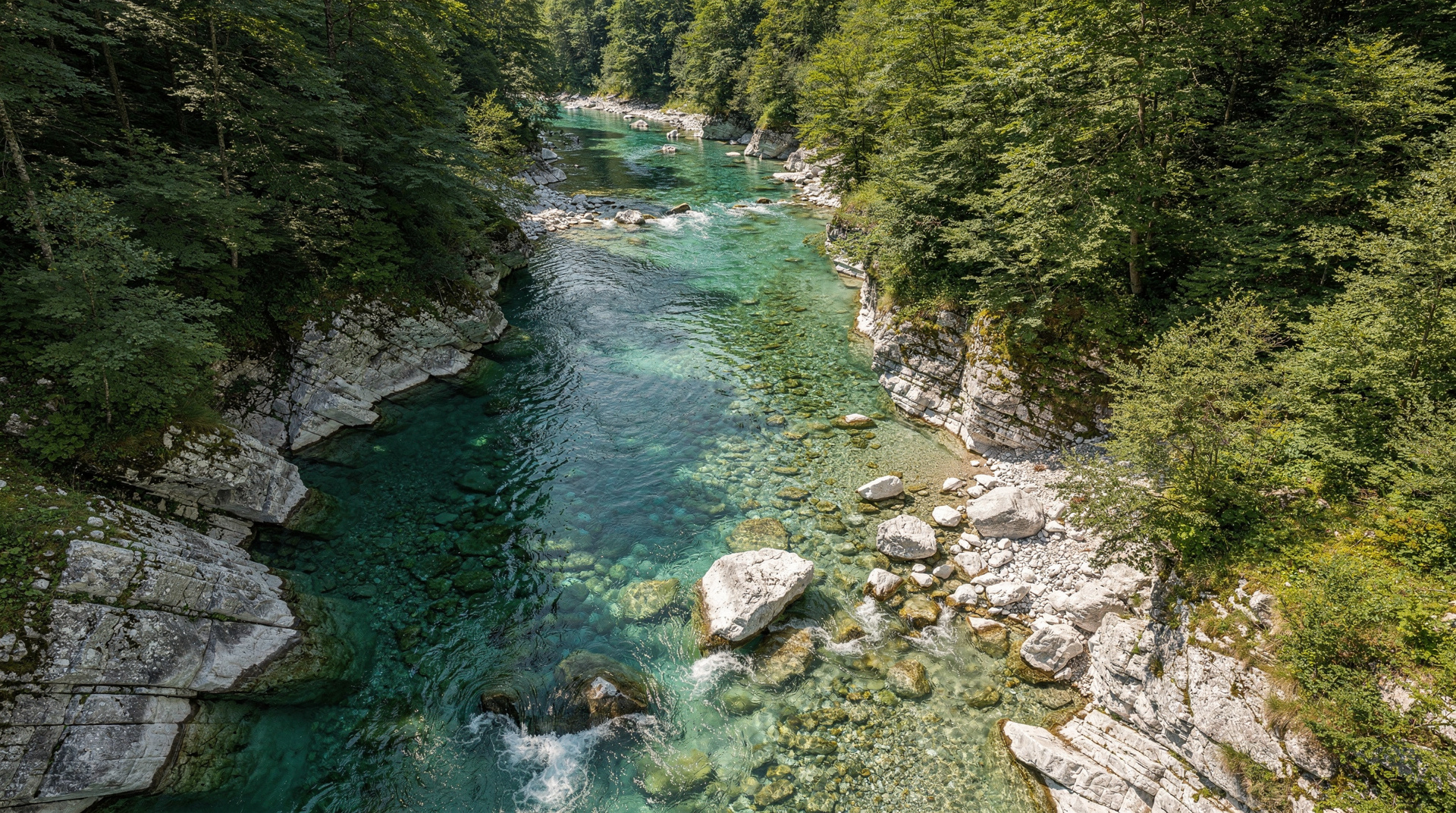
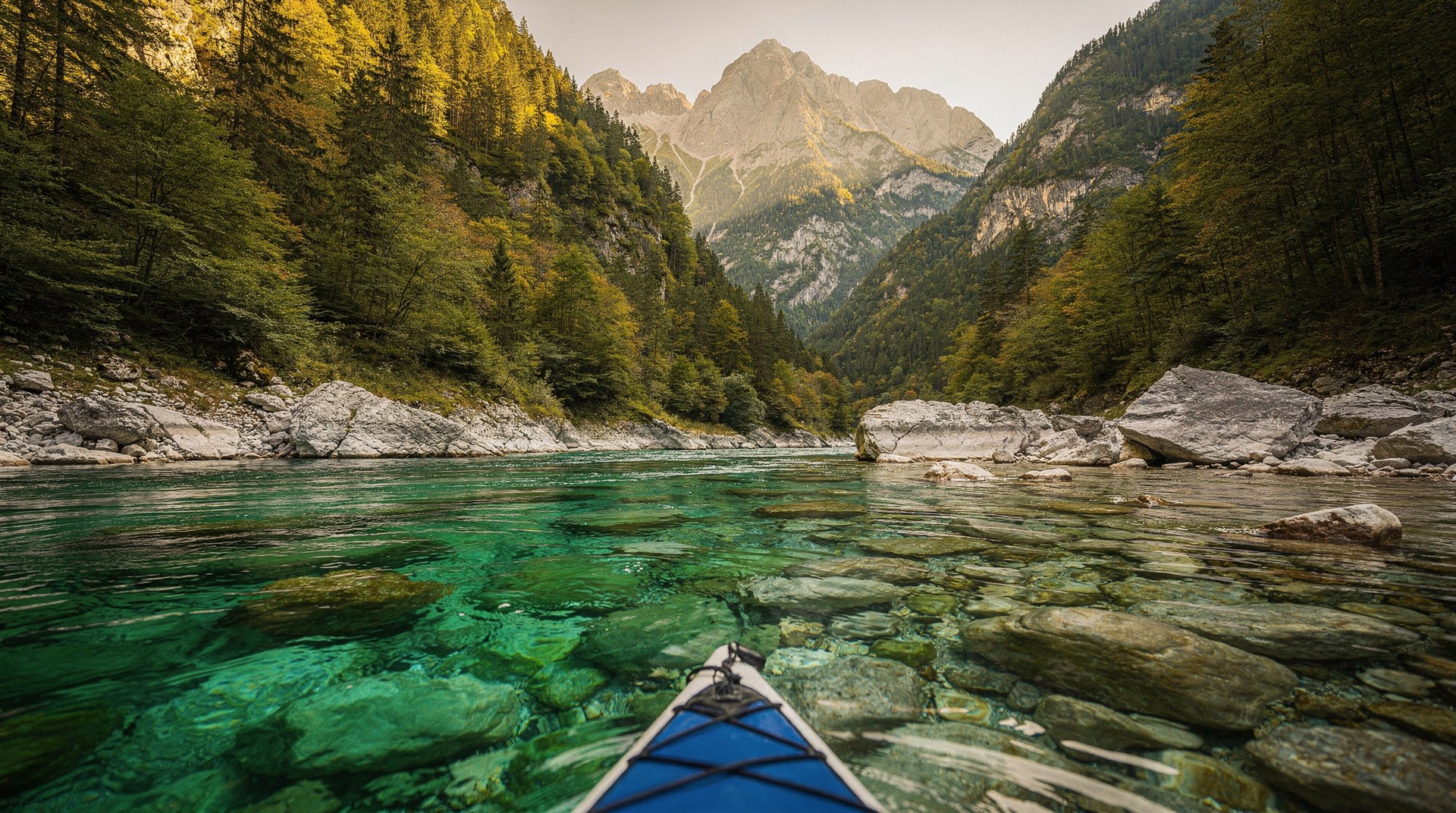
The Soča between Tolmin and Most na Soči is slow, wide, and clear — completely different from the whitewater sections upstream. Stand-up paddleboarding here is genuinely peaceful: the mountains are still high on either side, the water is clean, and on weekday evenings in summer you may paddle for an hour without seeing another person.
Evening SUP session on the lower Soča near Most na SočiSeveral launch points along the lower Soča are signposted from the road; no booking is needed if you have your own board. Rental SUP boards are available in Tolmin from kayak outfitters (EUR 20–30 for a half-day). The water is cold by sea standards (15–18°C in summer) but warm enough for extended paddling sessions.
If paddling on flat water is what you came for, the kayaking the Soča River guide covers the other stretches of the river, and the SUP on Lake Bled guide is a useful comparison if you plan to paddle both a river and an alpine lake on the same trip.
The Baška Grapa valley
East of Tolmin, the Baška Grapa valley runs for 20km toward the town of Podbrdo and eventually connects to the Bohinj tunnel and the Sava watershed. This valley is almost unknown outside Slovenia — a long, narrow gorge with stone villages perched above the valley floor, a few small farms, and a hiking trail that follows the old road used by mule trains for centuries before the road was built. The valley bottom has a small river (the Bača) that is good for fly-fishing and cold-water swimming in summer.
The Baška Grapa is a useful transit corridor for cyclists heading between the Soča Valley and Lake Bohinj (the Bohinj tunnel allows bikes; check timetables). For non-cyclists, it is simply a beautiful valley that sees essentially no international tourism and can be driven through in 45 minutes as part of a return to Ljubljana via a different route than the Idrija road.
The Tolmin gorges: what to know before you go
The Tolmin Gorges are the most visited single attraction in the lower Soča Valley, and the 5 EUR entry fee (2026) is one of the best-value paid experiences in the region. A few practical notes that are not obvious from the tourist information:
The walk is linear, not a loop. You enter from the car park, walk 1.5km into the gorge to the confluence point, and return the same way. The path is carved into the gorge walls in places and crosses the rivers on wooden bridges; it is safe but narrow, and if you meet groups going the other direction, one side must wait. In peak season (late July, August) this creates bottlenecks at the narrowest sections.
The confluence pool at the far end of the walk is the best swimming spot in the lower valley — the water is deep and clear and the setting is enclosed by limestone walls on three sides. You cannot see this from the entrance; many visitors who come for a quick look end up staying an extra hour.
Open May–October; the gorge floods in winter. Check the Tolmin Tourism website for exact seasonal hours as these vary.
Goriška Brda: the wine country connection
One of Tolmin’s underappreciated assets is its proximity to Goriška Brda — Slovenia’s most celebrated wine region, 30km west. The hills of Goriška Brda produce some of Central Europe’s finest whites (Rebula, Pinot Grigio, Malvazija) in a landscape that looks more Tuscan than Alpine: rolling hills, stone villages, terraced vineyards. The drive from Tolmin via the Bača Valley and into Brda takes about 40 minutes and is beautiful in its own right.
Several estates in Brda operate small-group tastings (EUR 15–25 per person including 4–5 wines and food pairing). Edi Simčič, Movia, and Klinec are the three most respected names; all require advance booking. A Tolmin-to-Brda wine afternoon is an excellent counterpoint to a morning of gorge walking or river paddling.
The Soča Trail (Soška pot)
The Soška pot is a long-distance trail following the Soča River from its source near Trenta all the way to Tolmin — approximately 25km through the upper valley. The Tolmin section of this trail (8km south from Kobarid to Tolmin, or in reverse) is the most accessible segment for visitors based in the lower valley.
The path is mostly valley-floor level, passing through meadows and patches of riverside forest. It is not dramatic in the way of high-mountain routes, but the river itself is the constant companion: the emerald water, the occasional white-water section audible before visible, the kingfishers that work the calmer pools. The 8km Kobarid-to-Tolmin section takes about 2.5 hours at a steady pace; return by local bus (check timetable at the Tolmin bus stop, EUR 2.50).
The entire 25km from Trenta to Tolmin can be done in a long day (6–7 hours, relatively flat), but this requires either a car shuttle or a bus from Bovec back to Trenta for the start — plan the logistics the day before.
Most na Soči and the archaeological site
Most na Soči, 15km south of Tolmin, is where the Soča meets the Idrijca at the edge of the Tolmin region. The site has been continuously settled since the Iron Age — excavations in the late 19th and early 20th centuries recovered over 7,000 grave artifacts that are now held in the National Museum of Slovenia in Ljubljana, one of the largest Iron Age cemeteries ever excavated in Europe.
The site itself has little left to see — the finds are all in Ljubljana — but the interpretive panels at the trailhead explain the archaeological context, and the position at the confluence of two rivers makes the strategic logic of a major settlement obvious. The junction is also a noted photography spot: two river colours merge visibly before mixing, the Soča green and the Idrijca blue-grey.
Fly-fishing on the Soča
The Soča River is one of the best fly-fishing rivers in Europe, home to the marble trout (soška postrv), a subspecies endemic to the Soča basin and its tributaries. The marble trout was nearly extinct by the 1990s due to hybridization with introduced brown trout; a conservation programme has restored the wild population to sustainable levels. Licensed fishing on the Soča requires a day permit (EUR 35–60 depending on section and season) from the Tolmin or Bovec fishing association, and several licensed guide services in Tolmin run half-day and full-day guided sessions.
The season runs from the last Saturday in April through October 31. Early morning fishing in May and June, before the day-trip groups arrive on the river, is the most productive. The Tolmin sections of the river see fewer fishing parties than the Bovec sections and are preferred by anglers who want solitude alongside fish.
Anglers who want more background on the sport, the rivers and the etiquette will find it in our fly-fishing in Slovenia guide.
Tolmin Cheese and local products
Tolmin has a distinct food identity rooted in its position as the regional agricultural centre. Tolminc cheese — a firm, slightly piquant cow’s milk cheese aged 60–120 days — is the local product with protected designation of origin status. It is sold directly from producers at the weekly market (Friday mornings, town square) and from the Mlekarna Planika dairy cooperative on the edge of town, which also offers tastings and sells direct (EUR 8–12 per kg). Better gostilne in the valley serve Tolminc with walnuts and local honey as an aperitivo; it pairs well with the dry whites from Goriška Brda.
Practical information
Getting there: From Ljubljana, Tolmin is 1h 30min by car via the Idrija road (the most direct) or 1h 45min via Most na Soči. Direct buses from Ljubljana to Tolmin run multiple times daily via Idrija (EUR 8–12, 1h 45min). No train access to Tolmin; the closest rail station is Most na Soči (12km south, connected by local bus).
Accommodation: Budget options dominate. Gostišče Pri Mostu (EUR 50–75 double), several private rooms via local tourism boards (EUR 40–60 double). Camping at Kamp Soča (EUR 12–20 per pitch) is well-maintained with direct river access, a 5-minute walk from the gorge entrance.
Eating: Restaurant Mangart on the main square (mains EUR 10–16) is the reliable town-centre choice. Gostilna Mrak (EUR 12–18), near the bridge, is better for evening meals with a menu that skews more toward local seasonal ingredients. The supermarket on the ring road is larger and better stocked than the Bovec equivalent and is useful for self-caterers.
Tolmin as transit: Many cyclists and van-lifers use Tolmin as a quiet overnight between the Soča Valley and the Vipava wine region (35km west) or the Slovenian coast (50km southwest via the Vipava Valley). The position works well; the town accommodates this without resentment. It is also the starting point for the best budget option on the Soča Valley drive: following the valley road south from Tolmin along the river as it opens into lower gorge country before reaching the motorway junction at Most na Soči — a 40-minute drive that is better scenery than anything on the motorway.
For the full picture of the Soča Valley, see our complete Soča Valley guide and our Kobarid guide for the historical middle section. The Soča rafting guide covers all three sections with difficulty ratings and logistics. For wine country context, the canyoning Slovenia guide covers the tributary gorges above Tolmin.
Planning a longer trip around the valley? The Soča adventure 7-day itinerary shows how Tolmin fits alongside the upper valley, and the Soča Valley day trip guide is the better starting point if you only have a single day. For the walking side of the valley, the Soča trail hike guide goes deeper than the summary above, and the Bovec adventure base guide helps you weigh the two bases against each other. If you are driving, our car rental in Slovenia guide and getting around Slovenia guide cover the practicalities, and the Triglav National Park page describes the high-mountain scenery to the north.
Tolmin vs Bovec vs Kobarid at a glance
| Tolmin | Bovec | Kobarid | |
|---|---|---|---|
| Character | Quiet, budget, cycling-focused | Adventure-sports hub | History and food |
| Prices | Lowest in the valley | Highest, especially July–August | Mid-range |
| Best activity | E-biking, gorge walk, SUP | Rafting, canyoning, zipline | WWI museum, fine dining |
| Crowds | Lightest | Heaviest in summer | Moderate |
Budget-conscious travellers and those prioritising cycling over whitewater consistently do best basing themselves in Tolmin rather than Bovec, accepting a slightly longer drive to the upper valley’s rafting put-in points in exchange for lower accommodation and food prices.
A two-day Tolmin base for cyclists
For visitors treating Tolmin as their main base rather than a stopover, a workable two-day plan: day one covers the Tolmin Gorges in the morning (before the parking fills) and an afternoon e-bike loop toward Most na Soči and the archaeological site; day two extends further, either west toward Goriška Brda for a wine-tasting afternoon or north along the Soča toward Kobarid, returning by local bus if you’d rather not cycle the full round trip. Both days can be done without a car once you’ve rented an e-bike in town, which makes Tolmin one of the more realistic car-free bases in the Soča Valley.
Honest verdict
Frequently asked questions about Tolmin
Is Tolmin a good base for the whole Soča Valley, or just the lower section?
Tolmin works well as a budget base for the whole valley if you have a car — Bovec’s rafting put-ins are about 30–40 minutes north. Without a car, Tolmin is better suited to exploring the lower valley (gorges, e-biking, Goriška Brda) than the upper Bovec adventure-sports zone.
How does the Tolmin Gorges walk compare to Vintgar Gorge near Bled?
Both are wooden-walkway river gorges, but Tolmin’s is longer (1.5km one-way vs Vintgar’s similar length), less crowded, and ends at a genuine swimming pool rather than a waterfall viewpoint. Vintgar is more convenient from Bled; Tolmin rewards the extra travel time with more solitude.
Can I cycle between Tolmin and the Soča Valley’s other towns?
Yes — the e-bike network connecting Tolmin, Kobarid, and Most na Soči is well signed and manageable even for casual cyclists thanks to e-assist. A standard bicycle is harder going given the terrain; most visitors rent e-bikes locally rather than bringing their own.
Top experiences
Bookable activities with verified prices and instant confirmation on GetYourGuide.