Climbing Mount Triglav: what you actually need to know
From Bled: 2-day Mount Triglav summit hike
How hard is it to climb Mount Triglav?
Triglav is a grade 1 via-ferrata climb requiring solid fitness, mountain boots, and ideally a harness and helmet. It is achievable by fit non-climbers but is not a casual hike. Most people do it over two days with an overnight at a mountain hut.
The honest guide to climbing Triglav
Mount Triglav stands at 2,864 metres on the border between Slovenia and Italy, and appears on the Slovenian coat of arms. Every Slovenian is expected to climb it at least once — or so the saying goes. In reality, it’s a serious mountain that requires preparation, the right conditions, and honest self-assessment. This guide cuts through the romanticism.
| Where | Triglav National Park, Julian Alps |
| Difficulty | Grade 1 via ferrata, sustained exposure |
| Time needed | 2 days with an overnight mountain hut |
| Cost | Around EUR 250–400/person guided, 2-day |
| Best season | Late June–September (snow-free ridge) |
Is Triglav a technical climb?
No — Triglav does not require ropes, technical climbing skills, or previous alpine experience. But it is not a trail hike either. The upper sections involve steep rock scrambles with fixed steel cables and iron pegs driven into the cliff. These are via-ferrata sections, graded at the lower end of the scale (typically F to PD in French alpine grading). The summit ridge is narrow and exposed.
What you need: genuine physical fitness (the standard approach involves 1,400–1,600 m of elevation gain in a single day), mountain boots with ankle support and sticky rubber soles, and the ability to move confidently on steep rock while clipped to a cable. Via-ferrata gear — harness and helmet — is strongly recommended, especially if you are unfamiliar with the terrain. The gear costs around EUR 15–25/day to rent in Bled or Kranjska Gora.
What you don’t need: technical climbing experience, ropes, or specialist knowledge. But do not underestimate the mountain. People are evacuated from Triglav every season due to inadequate preparation.
The main routes
There are several standard approaches to the summit. The three most common are via the Bohinj valley, via the Vrata valley (from Mojstrana, north of Kranjska Gora), and via the Krma valley. The difficulty differences between them are modest; the scenery and logistics differ more than the technical challenge.
Route 1: Via Bohinj and the Seven Lakes Valley
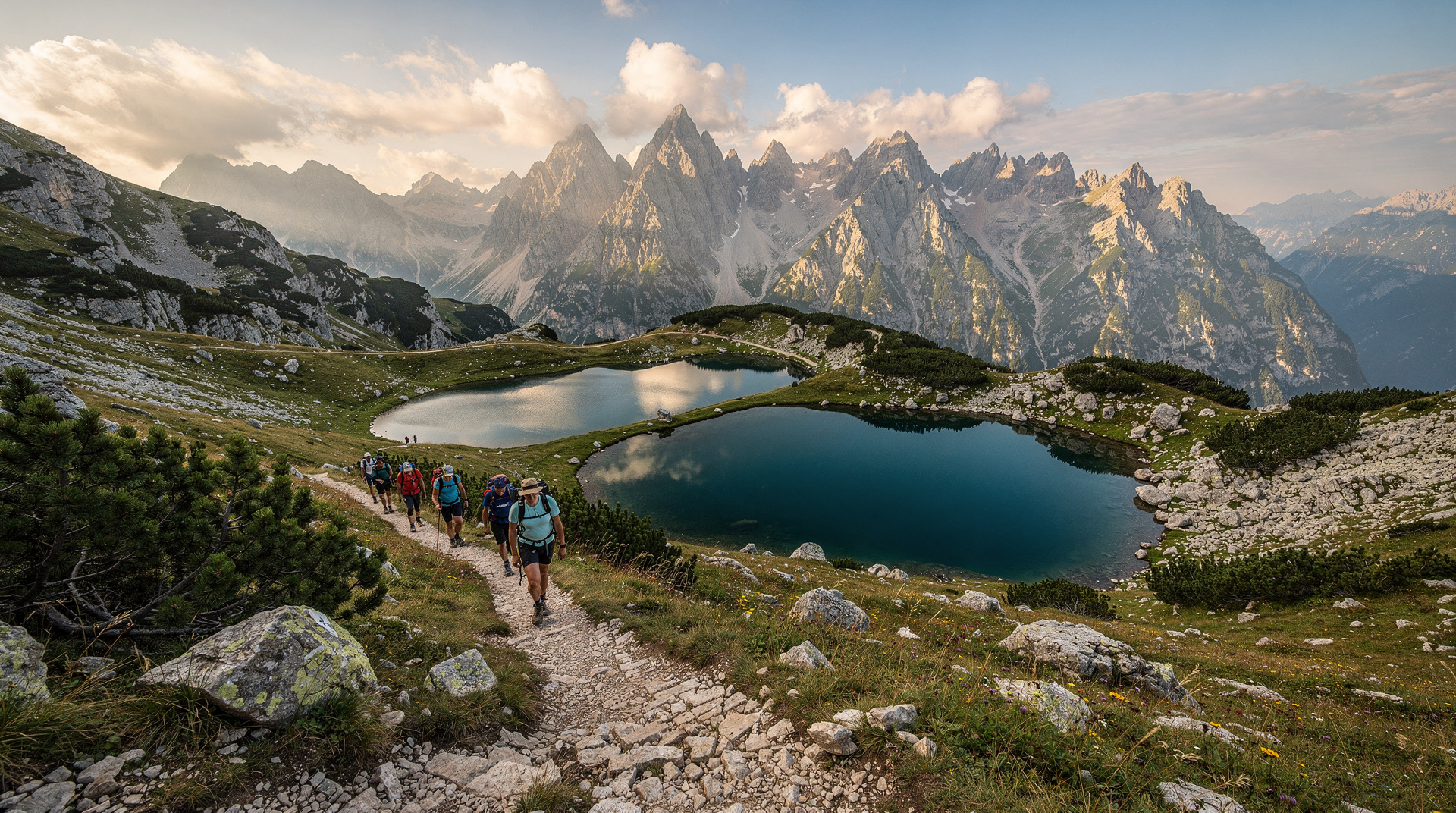
This is the most popular route and combines two of the park’s great experiences. The approach goes from Ribčev Laz in Bohinj, up by cable car to Vogel (1,535 m), then on foot through the Triglav Lakes Valley — a string of seven alpine lakes between 1,300 and 1,990 metres. From the highest lake (Jezero v Lužnici), the route climbs steeply to the Hribarice plateau (2,358 m) and then to the summit.
Overnight option: most hikers on this route spend the night at Koča pri Triglavskih jezerih (the Seven Lakes Hut, 1,685 m) or at the Planika hut (Dom Planika, 2,401 m) — the higher option, which puts you just 463 metres below the summit for the final morning push.
This route is the most scenic of the standard approaches and works well for those combining the Seven Lakes hike with a summit bid over two or three days. See also the Seven Lakes Valley guide.
Route 2: Via Vrata Valley (the north face approach)
The Vrata Valley is accessed from Mojstrana (20 km west of Kranjska Gora on the road toward Jesenice). From the Aljažev Dom hut (1,015 m) in the valley floor, the trail climbs directly toward the north wall of Triglav. This is a classic Alpine north-face approach — dramatic, direct, and the standard route for those wanting to experience the full vertical gain of the mountain. The Luknja Pass approach (via the Prag route) takes you up to the Tržaška koča (2,151 m) for the first night.
From Aljažev Dom to the summit is 1,849 m of elevation gain — a serious day even without via-ferrata sections. Most hikers spend two nights: one at the Tržaška koča and the summit on day two. This route is busiest in July and August.
Route 3: Via the Krma Valley
The Krma Valley approach starts near Mojstrana and is less crowded than either of the above routes. It is slightly longer but gentler in character for the first half, before joining the via-ferrata sections shared with the Vrata route. A good choice for fit hikers who want to avoid the busiest paths.
If you are basing yourself around the lakes, Lake Bohinj is the natural starting point for the first route, while Kranjska Gora is a practical base for the Vrata and Krma approaches. Reaching either valley by road is covered in the Vršič Pass driving guide, and if you want to practise on easier fixed-cable terrain first, the via ferrata in Slovenia guide is a good place to start.
Two-day vs. one-day ascent
The one-day ascent (bottom to summit and back in a single day from a valley start) is possible for very fit, acclimatised hikers in good conditions. It is a long, hard day — typically 12–14 hours on the mountain — and leaves almost no margin for weather changes or slower progress on the via-ferrata sections.
The two-day approach is standard and strongly recommended. Spending the night at a high-altitude hut means you start the summit push in the early morning (before weather deteriorates), you are rested, and you have time to enjoy the experience rather than racing against daylight. Huts at 2,000–2,400 m serve hot meals and provide bunk accommodation; book ahead in July and August, as they fill up.
Fitness preparation: what level do you need?
The standard Triglav routes (Bohinj or Vrata approaches) involve 1,400–1,600 m of elevation gain in a single day if done without using the Vogel cable car. This is the equivalent of climbing from sea level to 1,500 m twice, back to back. For context: completing a trail with 700–800 m of elevation gain in 3–4 hours without significant difficulty is a reasonable baseline. If your current fitness wouldn’t comfortably handle a 1,000 m day hike, build up for 4–6 weeks before attempting Triglav.
Specific useful conditioning: stairs (stair climbing is the most direct simulation of the sustained uphill required), loaded hiking with a day pack (5–7 kg is typical for a Triglav day), and at least two or three multi-hour hikes with 500–700 m of elevation in the months before the trip. Arriving in Slovenia a day or two early and doing a mid-altitude hike (Vogel cable car + plateau walk, or the Martuljek Falls circuit) acclimatises your legs and lungs before the main event.
The descent is where fitness failures most often show — tired legs on steep, loose rock lead to falls. Specifically training quadriceps (stair descents, downhill running) significantly reduces the risk on the way down.
Going with a guide
A certified mountain guide removes the logistics burden, handles route-finding on the via-ferrata sections, and can assess conditions you wouldn’t be able to evaluate independently. For anyone without previous via-ferrata experience, a guided ascent is the sensible choice.
Guided two-day Triglav summit climbs include transport from Bled, all mountain hut fees, a certified guide, and via-ferrata equipment. For those who want to experience the Triglav area without the summit commitment, full-day guided hikes in the Triglav area cover the park’s most rewarding terrain without the alpine exposure.
Privately guided ascents offer full flexibility — your own guide, your preferred route, your own pace. Private Triglav guides departing from Ljubljana are available for solo travellers and small groups.
When to attempt the summit
July and August: the standard season. Huts are open, routes are clear of snow, and weather windows are most reliable. Also the busiest period — Triglav’s summit area can feel crowded on peak weekends.
Late June and September: excellent alternatives. Conditions are good, huts are open, and crowds are significantly thinner. Early June can still have snow on the upper sections; late September has shorter daylight hours.
Outside the July–September window: not recommended without winter mountaineering experience. Snow and ice above 2,000 m are common from October onward, and the fixed cables on the via-ferrata sections can be iced over from September. In winter, the mountain requires crampons, ice axes, and full alpine kit.
For a broader view of how the seasons change the mountains, the best time to visit Slovenia guide and the month-by-month weather guide help you choose a window, and the packing guide lists the layers worth carrying for mountain days.
The summit itself
The summit pyramid of Triglav is marked by the Aljaž Tower — a small iron cylinder placed there in 1895 by local mountaineer Jakob Aljaž for EUR 1 coin from a landowner who sold him the entire summit. It has since been replaced and restored several times. The view from the top, on a clear day, covers the entire Julian Alps, the Adriatic coast, and on exceptional days as far as the Dolomites in Italy and the Kamnik Alps to the east.
The summit book (carried in the tower or kept at the highest hut) is a tradition: most visitors sign it. The Slovenian tradition involves a gentle tap on the summit to “properly” climb the mountain, though this is of course informal.
Practical notes
- Mountain rescue: register with GRZS (Slovenian Mountain Rescue) before a solo or unsupported ascent. This costs nothing and allows rescue teams to act immediately if you don’t return.
- Weather: Triglav generates its own weather. Clear skies at 8am in the valley do not guarantee clear skies at 2pm on the summit. Turn back if lightning approaches — the ridgeline is dangerously exposed.
- Hut reservations: book by phone or email at least two to four weeks ahead for July and August. The Planika hut and the Seven Lakes hut fill quickly.
- Food and water: huts provide meals. Carry at least 2 litres of water and some emergency food in case you move more slowly than expected.
- Costs: hut overnight accommodation is typically EUR 20–35 per person in shared dormitory. Dinner and breakfast at the hut add another EUR 20–30. Via-ferrata gear rental in Bled: EUR 15–25/day.
Acclimatisation and altitude
Triglav reaches 2,864 m — not high enough to cause altitude sickness in most healthy adults, but high enough that the thinner air is noticeable if you ascend rapidly from sea level. Most visitors arriving in Slovenia fly into Ljubljana at 300 m and drive to their trail start the following morning. This is fine for fit hikers. If you notice unusual fatigue or headache on the approach, rest, drink water, and descend if symptoms persist.
The greater concern at altitude on Triglav is cold and wind. Summit temperatures in July can be 5–12°C even on warm valley days, and wind chill on the exposed ridge can take the effective temperature well below zero. The summit weather changes faster than the valley weather. Checking the ARSO (Slovenian Environment Agency) mountain forecast before setting out is not optional — it is part of the preparation.
The via-ferrata sections in detail
The via-ferrata sections on Triglav are not uniformly exposed throughout. For most of the approaches to the summit, the trail is a steep but ordinary mountain path. The fixed equipment begins in the final 300–500 metres of ascent.
On the Vrata/north-face route, the Bamberg route (the main via-ferrata ascent to the summit) involves approximately 45 minutes of fixed cable and rungs on steep rock. The rock is limestone — when dry, the grip is good; when wet, it is slippery. The rungs and cables are maintained by the Slovenian Mountain Association (PZS) and are inspected annually. Do not rely on them as the only protection — unclipped falls from the via-ferrata sections are the most common cause of serious accidents on Triglav.
On the Bohinj/Seven Lakes route, the via-ferrata section approaches the summit from the Triglav plateau side — less dramatic in aspect than the north wall, but still requiring the same care and the same equipment.
What harness to hire or buy: a simple H-frame via-ferrata harness (not a full climbing harness) is adequate. Add a via-ferrata set (two lanyards with shock absorbers, clip alternately as you move) and a helmet. This equipment is available to hire in Bled (several sport shops on the main street), Kranjska Gora, and from some guided tour operators for EUR 15–25 per day.
Hut culture and mountain etiquette
The mountain hut network on Triglav is one of the best in the Eastern Alps. The huts are not simply shelters — they are proper establishments with hot meals, beer and wine, and staff who have seen every kind of hiker come through. A few notes:
Booking: in July and August, the Planika hut (Dom Planika na Kredarici, 2,401 m — the highest staffed hut) requires advance reservation. Phone bookings are accepted from May onward; the number is listed on the PZS (Slovenian Mountain Association) website. Dormitory-style accommodation is the norm at altitude; private rooms, where they exist, cost EUR 10–15 more.
Hut meals: dinner at the mountain huts is typically a set two-course affair — soup, then a main of stewed meat, goulash, or pasta. This is not gourmet territory, but after 1,400 m of climbing you will be very glad for it. Breakfast is available from 5–6am for those wanting an early summit start.
The hut book: most huts maintain a summit register or visitor book. It is customary to sign it.
Behaviour above 2,000 m: the mountains are shared by climbers and casual hikers. Slower parties yield the trail to faster parties on via-ferrata sections (let faster groups pass at the next anchor point). Do not dislodge rocks without shouting a warning. Silence in the huts after 9pm is expected.
After the summit: the descent
The descent from Triglav is, statistically, where most accidents happen — fatigue, loose rock, and the desire to move quickly. Plan the same time for descent as ascent (or longer on unknown terrain). The via-ferrata sections on the way down require the same attention as on the way up; clip in on every section.
If weather has deteriorated significantly while you were at the summit, discuss descent options with the hut manager before leaving. The huts have radio contact with mountain rescue and can provide current route information.
For the Bohinj/Seven Lakes route, the descent can be varied by returning via a different valley — either back to Bohinj via Komna, or descending to the Vrata Valley and arranging transport from Mojstrana. A guide will know current conditions and the most practical descent for your group’s fitness level.
The Triglav summit certificate
An informal tradition: once you have climbed Triglav, you can receive a “Triglavski junaki” (Triglav hero) certificate from several mountain huts. This is a lightweight souvenir — a simple paper document — but it has been issued for decades and is a genuine piece of Slovenian hiking culture. Ask at the Planika hut or the Seven Lakes hut.
What this mountain requires — honestly
Triglav is not for everyone, and that’s fine. If you’re fit, comfortable on steep terrain, and prepared, it’s one of the most rewarding mountains in Central Europe. If you’re uncertain about heights, unconfident on loose rock, or not in good physical condition, there are extraordinary hikes in Triglav National Park that don’t involve the summit — the Seven Lakes Valley, the Soča Trail, and the Pokljuka Plateau among them.
The mountain will be there next year. The peak-season rescue statistics are a reminder that more people get into trouble through overconfidence than through a single technical mistake.
The broader Julian Alps offer exceptional hiking at all difficulty levels. For an overview of the park and its full range of hiking options, see the Triglav National Park guide and the Julian Alps hiking guide. For a list of the best day hikes that don’t require summit experience, see best hikes in Slovenia.
Once you are back in the valley, the legs will thank you for an easier day. A gentle walk to the Savica waterfall, a lazy morning on the shores of Lake Bled, or a slow drive across the Pokljuka plateau are all good ways to round off the trip. If you are fitting the climb into a longer holiday, the 7-day Julian Alps itinerary shows how to pair the summit with the rest of the region.
Training and preparation before your attempt
The single most useful preparation isn’t technical climbing skill but sustained cardiovascular fitness combined with comfort on steep, exposed terrain. In the months before your attempt, build up with long hikes involving 1,000+ metres of elevation gain, ideally including some via-ferrata or scrambling routes to test your comfort with exposure before committing to Triglav specifically. The Julian Alps hiking guide lists several lower-stakes routes — including sections of the Vršič Pass trails — that make good preparation hikes in the weeks before a Triglav attempt.
Choosing between a guided ascent and going independently
For anyone without prior via-ferrata experience, a guided ascent is the sensible choice — a professional mountain guide handles route selection based on current conditions, manages hut bookings (which fill up fast in peak season), and provides the clipping and exposure technique that makes the difference between a controlled climb and a frightening one. Experienced via-ferrata hikers with strong Julian Alps knowledge sometimes go independently, but even they benefit from checking current conditions with the mountain huts before committing, since route conditions (snow patches, storm damage to cables) change from year to year.
Guided two-day Triglav summit ascent is the standard format most first-time climbers use — hut overnight included, with a certified mountain guide managing the technical sections.
What a realistic two-day itinerary looks like
Day 1: Start from the trailhead (commonly the Krma or Vrata valley, or via the Kredarica route from Rudno Polje) in the morning, ascend steadily through forest and then alpine terrain to the Kredarica hut (2,515m) or Triglavski Dom (2,515m), arriving by mid-afternoon. Rest, eat, and get an early night — huts are basic but functional, with dormitory bunks and hot meals.
Day 2: Pre-dawn or early morning start for the final push — the exposed via-ferrata ridge to the summit takes 2–3 hours from the hut, weather permitting. Summit, photos at the iconic metal marker, then descend the same route back to the hut and onward to the valley. Total descent day is typically 6–8 hours including the initial ascent.
Building in a spare day for weather is standard practice among experienced guides — summit attempts are routinely postponed a day when wind or visibility make the ridge unsafe, and rigid two-day-only scheduling is the single biggest cause of forced retreats.
Frequently asked questions about Climbing Mount Triglav
Do I need a guide to climb Triglav?
It's not legally required, but strongly recommended for anyone without via-ferrata experience or Julian Alps mountain knowledge. A guide handles route-finding, hut booking, weather judgment and clipping technique on the exposed sections. Experienced via-ferrata hikers with good fitness can go independently, but the huts fill fast in peak season and route conditions change year to year.What is the success rate for reaching the Triglav summit?
There's no official statistic, but experienced guides estimate that most physically prepared parties who commit to a two-day ascent with good weather reach the summit. The main reasons parties turn back are weather (high wind or storms near the exposed ridge), inadequate fitness for the sustained exposure, or fear of heights that surfaces only on the final ridge. Building in a weather buffer day significantly improves the odds.
Top experiences
Bookable activities with verified prices and instant confirmation on GetYourGuide.