Plitvice Lakes from Slovenia: day trip from Ljubljana to Croatia's UNESCO park
From Ljubljana: Rastoke, Plitvice to Split or Dubrovnik tour
How far are Plitvice Lakes from Ljubljana and is it a feasible day trip?
Plitvice Lakes are about 200 km from Ljubljana — roughly 2 to 2.5 hours by car crossing into Croatia. The park itself requires three to four hours to walk properly. With an early start from Ljubljana (07:00), you arrive at the park by 09:30, spend the day, and return to Ljubljana by 19:00–20:00. It is entirely feasible and one of the most rewarding day trips from Slovenia.
Plitvice Lakes from Ljubljana: the cross-border day trip
Plitvice Lakes National Park is one of the most photographed natural landscapes in the Balkans — a series of sixteen terraced lakes connected by waterfalls, with water that ranges from deep azure to brilliant turquoise depending on the angle of the light and the mineral composition of the inflow. It is a UNESCO World Heritage site, a Croatian national park, and entirely reachable from Ljubljana in under 2.5 hours.
| Where | Plitvice Lakes National Park, Croatia, ~200 km from Ljubljana |
| Cost | EUR 13–42/person entry (season-dependent) + fuel/toll or tour price |
| Time needed | Full day: 3–4 hours walking plus ~5 hours driving round trip |
| Getting there | A1 then A2/A6 via Karlovac (~2–2.5h by car) or guided tour |
| Best time | May, June or September for water flow and manageable crowds |
Since Croatia joined the Schengen zone in January 2023, the border crossing is seamless. You drive from Slovenia to Croatia without stopping, continuing south on the motorway until the park signs begin. For travellers based in Ljubljana with a free day and a car, it is one of the most spectacular day trips in the region.
Getting there from Ljubljana
By car: Take the A1 motorway south from Ljubljana past Postojna, then switch to the A2/A6 (direction Karlovac and Zagreb). Cross into Croatia and continue south on the motorway to the Plitvice exit. The drive takes 2–2.5 hours depending on Ljubljana traffic.
Parking at Plitvice is at two main entrances: Entrance 1 (lower lakes section, larger car park) and Entrance 2 (upper lakes section, smaller car park). Entrance 2 is closer to the most impressive waterfall section. Both are well signed. Parking costs approximately EUR 1.50–2.50/hour.
By guided tour: Guided day trips from Ljubljana to Plitvice are popular and well-organised. They typically combine the park with Rastoke — a small village built over a river confluence near Slunj, where old watermills straddle the rapids.
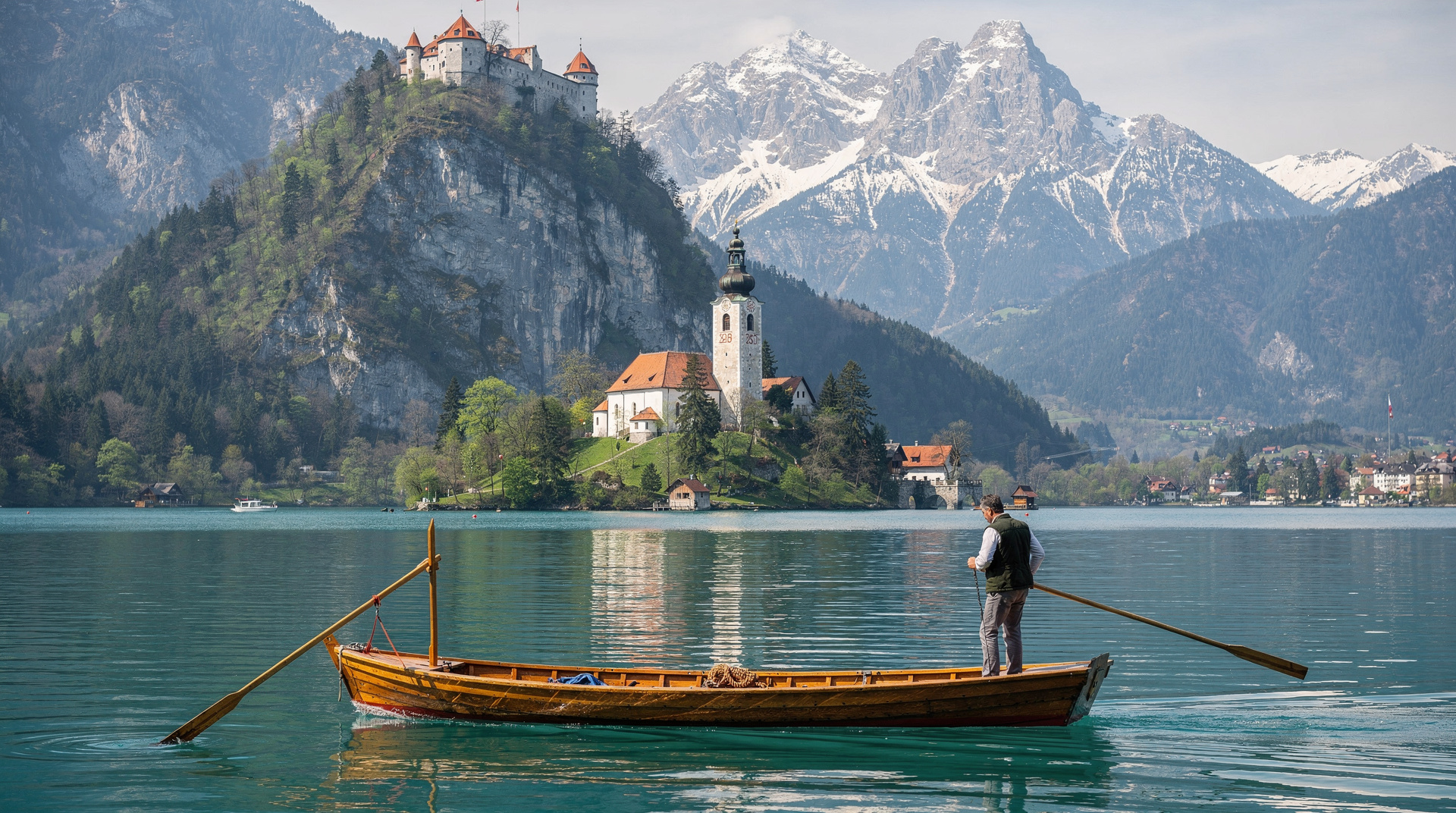
Guided day trip: Ljubljana to Plitvice, Rastoke and moreIf a full day of cross-border travel feels like too much, the Slovenian Alps offer a lighter alternative from the same starting point: a full-day trip to Lake Bled and Triglav National Park keeps the driving shorter and leaves more time on the trail.
The park itself: routes and what to see
Plitvice divides into upper and lower sections, connected by the Korana River gorge. Most visitors walk a loop of both sections, taking wooden boardwalks that cross the water directly above the cascades.
The lower lakes (Donja jezera): More dramatic scenery — the Great Waterfall (Veliki Slap, 78 metres high) is here, as is the path that runs along the base of the travertine barriers with water on both sides. The famous boardwalk sections cross directly above the cascading water. Most accessible from Entrance 1.
The upper lakes (Gornja jezera): More serene — wider lakes with dense forest on the banks and less dramatic falls but equally blue water. The colour here, away from the main tourist flow, can feel almost supernatural on a sunny afternoon.
Route B (recommended): The standard recommended route for day visitors covers both sections in about 4 hours of walking (approximately 8 km). It includes the electric boat across the main lower lake and a park shuttle bus between sections. Both are included in the admission price.
Route A: A shorter version (2–3 hours) covering the lower lakes only. Good if you are short on time or travelling with young children.
Admission and booking
Adult admission ranges from EUR 23 (low season, October–March) to EUR 42 (peak season, June–August). Children aged 7–17 pay EUR 10–22. Under-6 is free. The admission includes the boat and the shuttle bus within the park.
Booking online is strongly recommended in July and August: the park caps daily visitor numbers and sells out. Book at np-plitvicka-jezera.hr several days ahead in peak season. In May, June and September, you can generally buy tickets at the entrance on the day.
Rastoke: the watermill village worth combining
Rastoke is 15 km north of Plitvice entrance and easily combined with the park visit. This tiny village is built where two rivers (the Korana and Slunjčica) meet, and for centuries its inhabitants built watermills directly over the cascades. The old mills are now partly converted into houses and a small ethnographic museum, and the waterfalls running beneath the buildings create an extraordinarily photogenic scene.
Allow 1–1.5 hours in Rastoke. It is a paid entry village (around EUR 5), but the central waterfall area can be seen from the adjacent footbridge for free. Most guided tours include it in the schedule before or after the park.
Comparing Plitvice with Slovenian waterfalls
Slovenia has its own spectacular waterfall scenery — the Savica Waterfall above Lake Bohinj, the Peričnik Waterfall near Mojstrana, the Boka Waterfall in the Soča Valley. None of them are quite like Plitvice’s terrace system, which is unique in Europe. The park is worth visiting specifically for what it is — not as a substitute for Slovenian landscapes but as a complement.
Practical tips
Croatian currency: Croatia joined the euro in January 2023, so you do not need to change money — euros work everywhere.
Croatian motorway vignette: If you use the Croatian motorway, you need either a Croatian e-vignette (purchase at the border or online) or pay a toll at the few remaining toll plazas. The section used is short; the alternative scenic route via Kočevje avoids Croatian motorways entirely.
Park opening hours: The park opens at 07:00 year-round. Arriving at opening gives you 1–2 hours before the day-tripper surge. In July–August, the first tour buses arrive at 09:00–10:00.
What to bring: Comfortable walking shoes (boardwalk sections are wet and occasionally slippery), water, sunscreen (the walk is largely exposed in summer), and camera with a wide lens for the waterfall sections.
Combining with Zagreb: Zagreb is 130 km north of Plitvice. Some travellers do Plitvice on the way to or from Zagreb — stopping at the park for half a day, then spending the afternoon in the Croatian capital. This makes for a long but rich day.
For the full overview of day trips from Ljubljana, including the best Slovenia-only options, see the main pillar guide.
The Plitvice experience: what makes it different
Slovenia has extraordinary natural beauty — Lake Bled, the Soča Valley, Triglav National Park — but Plitvice is different in character. It is a flat-water landscape: not a gorge or a mountain lake but a series of terraced pools connected by waterfalls and cascades over tufa (calcium carbonate) barriers. The water builds the barriers; the barriers create the pools; the pools fill, overflow and fall to the next level. The whole system is slowly, visibly growing.
The colour is the defining feature — a blue-green that is different from the turquoise of the Soča (mineral-rich glacial meltwater) and different from the clear blue of Bled (mountain springs). Plitvice’s colour comes from the calcium carbonate in suspension combined with the blue sky reflected from the flat surface — on an overcast day the lakes appear greenish; on a clear day they are deep cobalt blue.
Walking over the boardwalks directly above the cascades gives you a physical closeness to the water that few natural landscapes provide. You are walking on platforms built into the edge of the waterfalls, with the water rushing past on both sides. The sound and the spray are part of the experience.
Seasonal variation at Plitvice
The park changes dramatically with the season:
Spring (April–June): The falls are at maximum flow from snowmelt and spring rains. The tufa barriers are submerged and the boardwalks cross sheets of shallow water. The forest is brilliant spring green. This is the most visually dramatic season.
Summer (July–August): The falls reduce but the colours are most vivid in the clear air. Swimming is not permitted in the lakes (strictly enforced) but the temperature is warm and the park is at peak visitor numbers.
Autumn (September–November): The beech and maple forest around the lakes turns gold and red — the most photogenic season by many visitors’ reckoning. The crowds thin from mid-September and by October the park feels genuinely quiet.
Winter (December–March): The falls partially freeze; the boardwalks are sometimes iced or closed. Admission is at the lowest price of the year and visitor numbers are minimal. If you can handle the cold, the frozen waterfall sections are extraordinary.
Plitvice and the Slovenian cave comparison
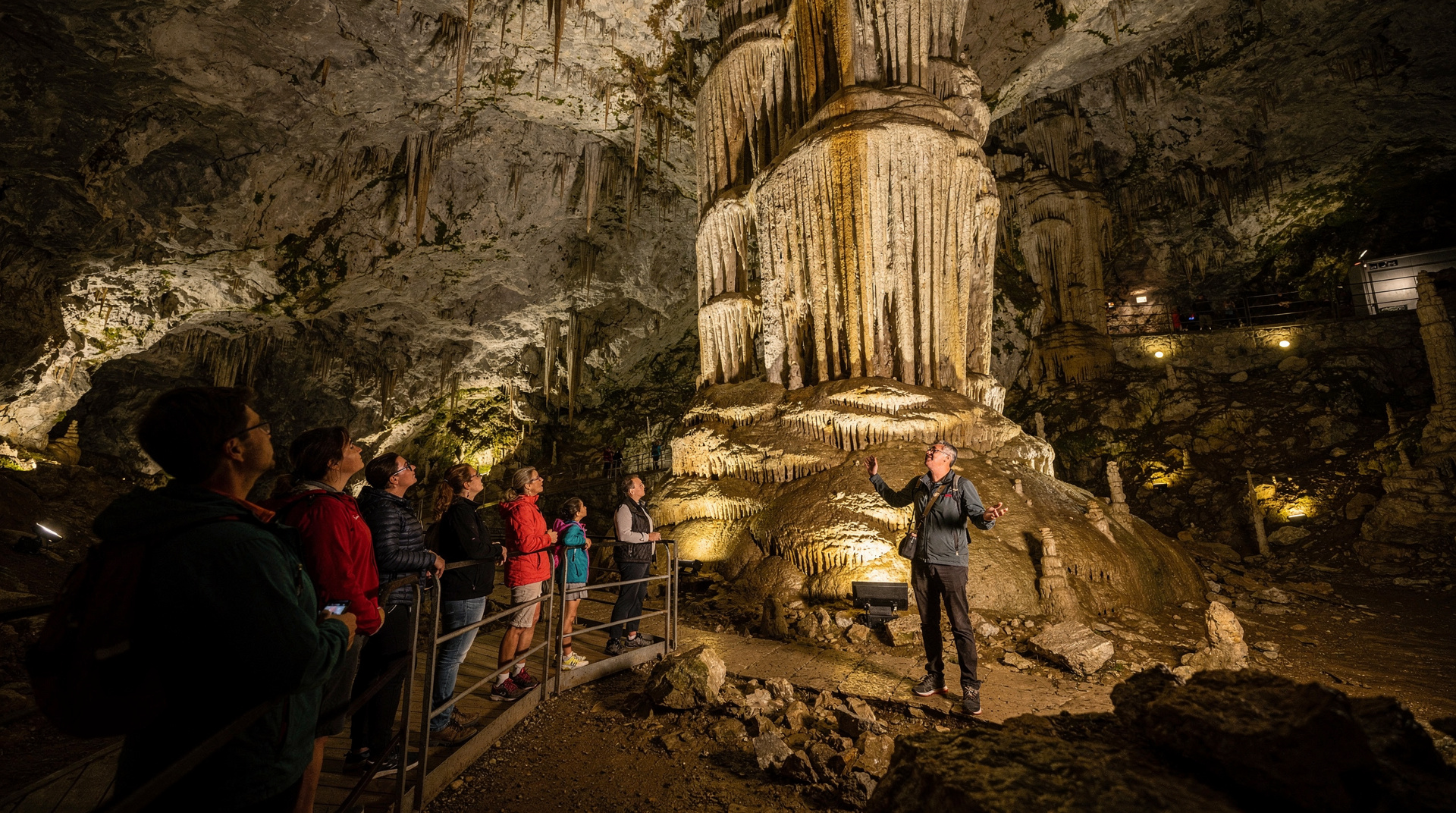
Several visitors to Slovenia ask how Plitvice compares with the cave systems — Postojna Cave and Škocjan Caves. The answer is that they are entirely different experiences: the caves are underground limestone formations, dramatic in geology and atmosphere; Plitvice is an open-air water landscape, the most beautiful in the Balkans.
If you have limited time and must choose between a Slovenian cave and Plitvice, consider: the caves are uniquely Slovenian experiences that you cannot replicate elsewhere; Plitvice has the most spectacular lake-and-waterfall landscape in the region. Both are worth making time for. Most visitors with five days in Slovenia make time for both — the cave on one day, Plitvice as a cross-border extension.
What to know about visiting Plitvice with children
Plitvice is excellent for children of all ages. The boardwalks are level and accessible for prams; the boat crossing the main lower lake is a highlight for young visitors; and the waterfall viewpoints are impressive enough to hold the attention of children who might find cave tours or museum visits challenging.
Practical notes for families:
- Prams and pushchairs: The main boardwalk route is accessible for most prams on the flat sections. Some paths (particularly on Route B’s upper section) have steps or steep gravel inclines. A carrier may be more practical than a pram for the full circuit.
- Swim stops: Swimming is not permitted in Plitvice’s lakes (strictly enforced). Pack swimming gear for a stop at the Mrežnica River on the drive back to Ljubljana — clear, fast water with excellent swimming holes just 30 km from Plitvice.
- Entrance timing: Buy tickets online for peak season. With children, the standard Route B (which includes the boat and the main lower lake section) is the most manageable — about 4 hours at an easy pace.
The drive from Ljubljana to Plitvice: what to see along the way
The drive south from Ljubljana through Slovenia and into Croatia passes through varied landscape worth noting:
Logatec Basin: The first section of the drive leaves Ljubljana through the low karst plateau south of the city — the same landscape that eventually produces Postojna Cave. The flat limestone fields and villages of white stone are distinctly different from the mountains visible to the north.
Kočevje junction: About 40 km before the Croatian border, you pass near Kočevje — the centre of the Dinaric forest zone and the primary area for Slovenia’s brown bears. The forests along this section of road are part of the continuous bear habitat.
The Croatian border: Since January 2023, the Slovenia-Croatia border is fully Schengen — no stopping, no passport check in normal circumstances. You know you have crossed when the road signs switch from Slovenian to Croatian and the motorway surface (noticeably rougher in Croatia) begins.
Rastoke village: 15 km north of Plitvice entrance, Rastoke (detailed earlier) is worth a 45-minute stop if you have not visited before.
Croatia’s national parks: beyond Plitvice
For visitors interested in Croatian natural heritage beyond Plitvice, two other parks are within reasonable reach of Ljubljana on a multi-day trip:
Krka National Park: 3 hours from Ljubljana (via Plitvice or direct via Rijeka), Krka has a similar tufa-lake landscape to Plitvice but with the advantage of legal swimming in the lower lake sections (near Skradinski Buk, the most visited section). Krka is often combined with the medieval town of Šibenik on the Dalmatian coast.
Paklenica National Park: 3.5 hours from Ljubljana, Paklenica is a dramatic canyon park in the Velebit Mountains near Zadar — more orientated towards hiking and climbing than Plitvice but equally spectacular.
These parks extend the range of a Slovenian base significantly — from Ljubljana, you have access to not just Slovenia’s extraordinary natural landscapes but to much of the north-western Balkans’ protected areas within a half-day’s drive.
Is Plitvice worth giving up a Slovenian day for?
This is the honest question most Ljubljana-based travellers should ask before committing a full day to a cross-border trip. The case for going: Plitvice’s terraced lake system genuinely has no Slovenian equivalent, and the round trip, while long, is entirely manageable in a single day with an early start. The case against: it is a full 10–11 hour day including driving, which eats into time that could go to Lake Bled, the Julian Alps or the Soča Valley — all closer and each spectacular in its own way.
For a first-time visitor with five days or fewer in Slovenia, prioritising Slovenian sights first and adding Plitvice only if a sixth or seventh day is free is the more sensible order. For a longer trip (a week or more), Plitvice earns its place. See how many days in Slovenia for how to fit it into a broader itinerary.
Planning the rest of your trip around Plitvice
Because the day is long, it helps to treat the day before and the day after as lighter ones. A gentle morning in Ljubljana’s old town or a slow stroll through the central market makes a good recovery day once you are back. If you are still shaping the wider route, the Slovenia highlights itinerary and the Slovenia and Croatia itinerary show where a Plitvice day fits naturally.
Travellers without a car should read getting around Slovenia and the guide to car rental in Slovenia before deciding between a tour and a self-drive day. If you do drive, the notes on the Slovenian motorway vignette explain what to sort out on the Slovenian side before you even reach the border.
Weather matters more than most people expect for this trip. Check Slovenia’s weather month by month and the best time to visit Slovenia when choosing your date, and keep a flexible day in the plan so you can swap if the forecast turns poor.
If you want a second long day out afterwards, Venice and Trieste are the other cross-border options, while the best day trips in Slovenia cover everything that stays inside the country.
Budget breakdown for the day
| Item | Approximate cost |
|---|---|
| Admission (peak season) | EUR 23–42/adult |
| Fuel (round trip, per car) | EUR 25–35 |
| Croatian toll/e-vignette | EUR 3–5 |
| Lunch at the park or Rastoke | EUR 10–20/person |
| Guided tour alternative (all-inclusive) | Check current tour pricing |
Frequently asked questions about Plitvice Lakes from Slovenia
Do you need a visa to visit Plitvice from Slovenia?
Croatia is a full EU and Schengen member since 2023, so there is no border control between Slovenia and Croatia. EU citizens and most visa-exempt nationalities (including UK, US, Australia) cross freely. Your passport or ID card is sufficient. Check your specific nationality's entry requirements if you are from a country that previously required a Croatian visa.How much does Plitvice Lakes cost to enter?
Admission varies by season: EUR 23–42 for adults in peak season (June–August), EUR 13–23 in low season. Children aged 7–18 pay reduced prices; under-6 are free. There are two main routes (Route A and Route B), covering different parts of the park. Route B includes the famous upper and lower lakes and is the most recommended. Book tickets online at np-plitvicka-jezera.hr to guarantee entry in July–August.When is the best time to visit Plitvice from Ljubljana?
May, June and September are ideal: the water level is high after spring rains (maximum waterfall flow in spring), crowds are manageable, and the weather is pleasant. July–August are beautiful but the park is very crowded — arrive at opening time (07:00–08:00) to beat the tour groups. October sees autumn colours and fewer visitors. Winter is possible but some boardwalks may be icy.Is the drive from Ljubljana to Plitvice straightforward?
Reasonably so. Take the A1 motorway south towards Koper, then the A2/A6 towards Karlovac and follow signs for Plitvice. The Croatian motorway (you'll use a short stretch) requires a separate Croatian e-vignette or toll payment (around EUR 3–5 for the section used). Alternatively, take the scenic route via Kočevje avoiding the Croatian motorway entirely — slightly longer but with no toll.Can you visit Plitvice Lakes without a car from Ljubljana?
Guided day tours are the best option without a car. Several Slovenian operators run Plitvice day trips from Ljubljana that include transport and park entry. These often combine Plitvice with Rastoke (a small watermill village near Slunj, 15 minutes from Plitvice) for an excellent full-day circuit.
Top experiences
Bookable activities with verified prices and instant confirmation on GetYourGuide.