Postojna vs Škocjan: which Slovenian cave should you visit?
Škocjan Caves day tour from Ljubljana
Should I visit Postojna Cave or Škocjan Caves?
Postojna offers the famous cave railway, massive stalactite chambers and the Proteus vivarium — it's more family-friendly and easier to reach. Škocjan has a UNESCO underground canyon up to 150m deep with a river and waterfall — it's more dramatic geologically and significantly less crowded. For families and first-timers: Postojna. For serious nature/geology travellers: Škocjan. Budget and time permitting: visit both.
The real difference between Postojna and Škocjan — and which one to choose
Postojna Cave and Škocjan Caves are the two great cave destinations in Slovenia’s Karst region, 30 km apart, each world-class by any measure. They also happen to be quite different experiences, and the choice between them is one of the most common planning questions for Slovenia visitors.
This guide makes the comparison honest and specific.
| Where | Karst region, 30 km apart, southwest Slovenia |
| Postojna cost | EUR 34.90 adult |
| Škocjan cost | EUR 18 adult |
| Time needed | 1.5–2 hours per cave, plus travel |
| Getting there | Postojna: bus/train/car. Škocjan: car or tour recommended |
| Best for | Postojna = families & the olm; Škocjan = atmosphere & scale |
What each cave actually is
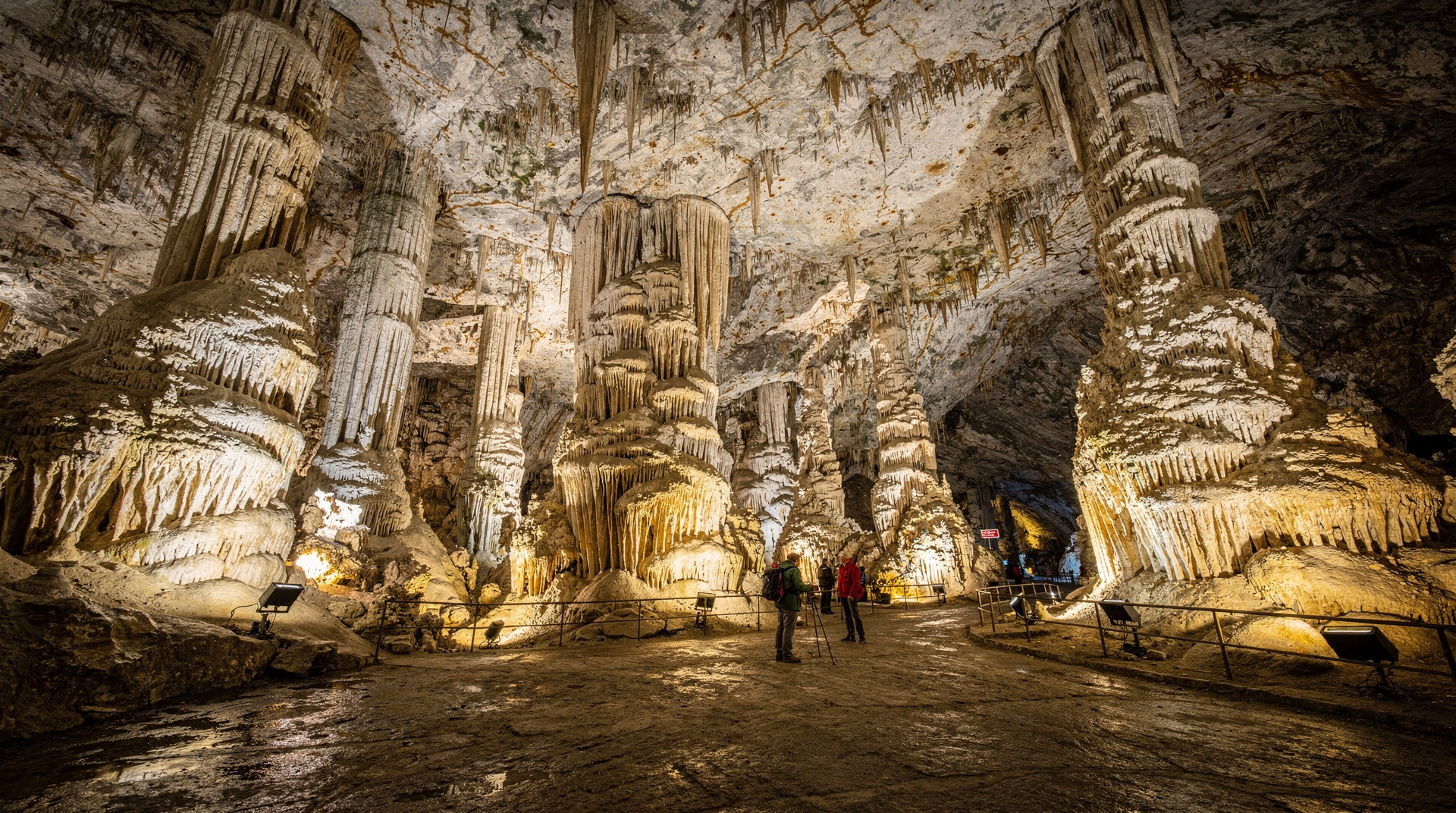
Postojna Cave: a 24 km system of karst passages and chambers, famous for:
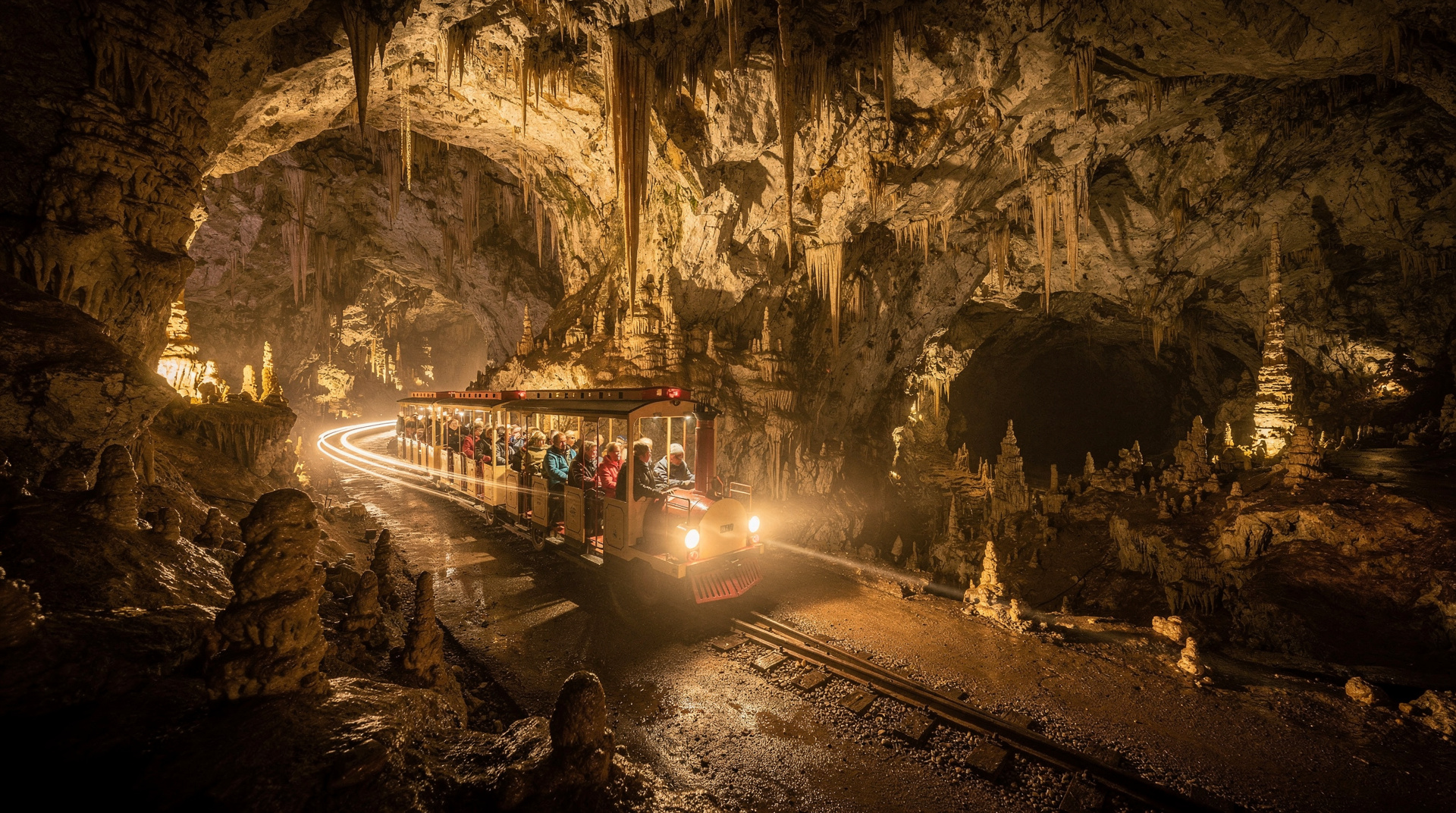
- The world’s first (and still most impressive) underground tourist train
- Extraordinary stalactite and stalagmite formations — “cave calcite sinter” that looks like crystallised lace
- The Brilliant Hall: the densest concentration of formations in any accessible cave in Europe
- The Proteus anguinus vivarium — the only place you can reliably see the blind cave salamander
- About 700,000 visitors per year — Europe’s most-visited cave attraction
Škocjan Caves: a karst canyon system with the Reka River, famous for:
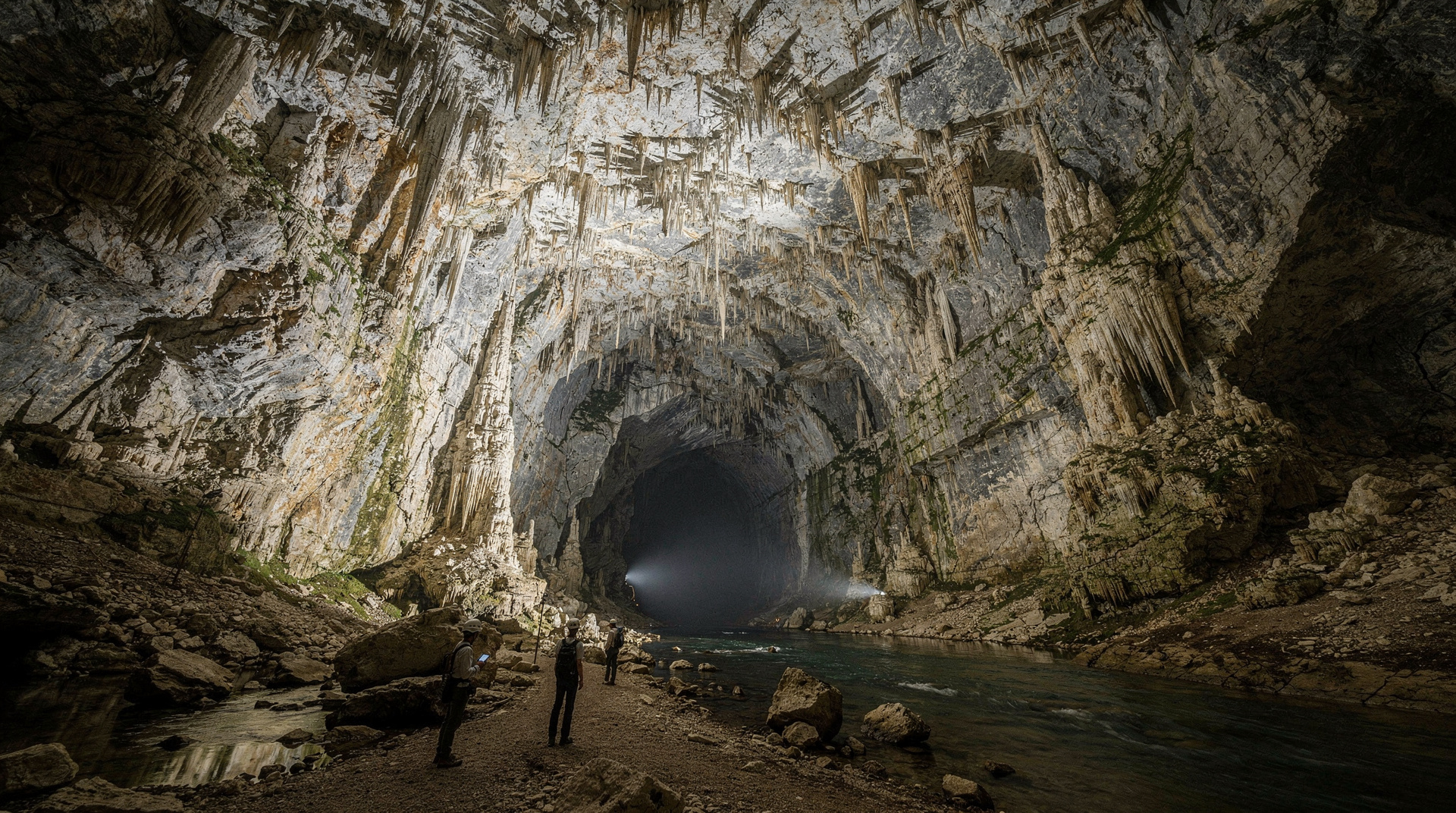
- An underground river canyon up to 150 metres deep — one of the most dramatic underground landscapes on earth
- UNESCO World Heritage Site status (1986) and UNESCO Biosphere Reserve
- A thundering underground waterfall
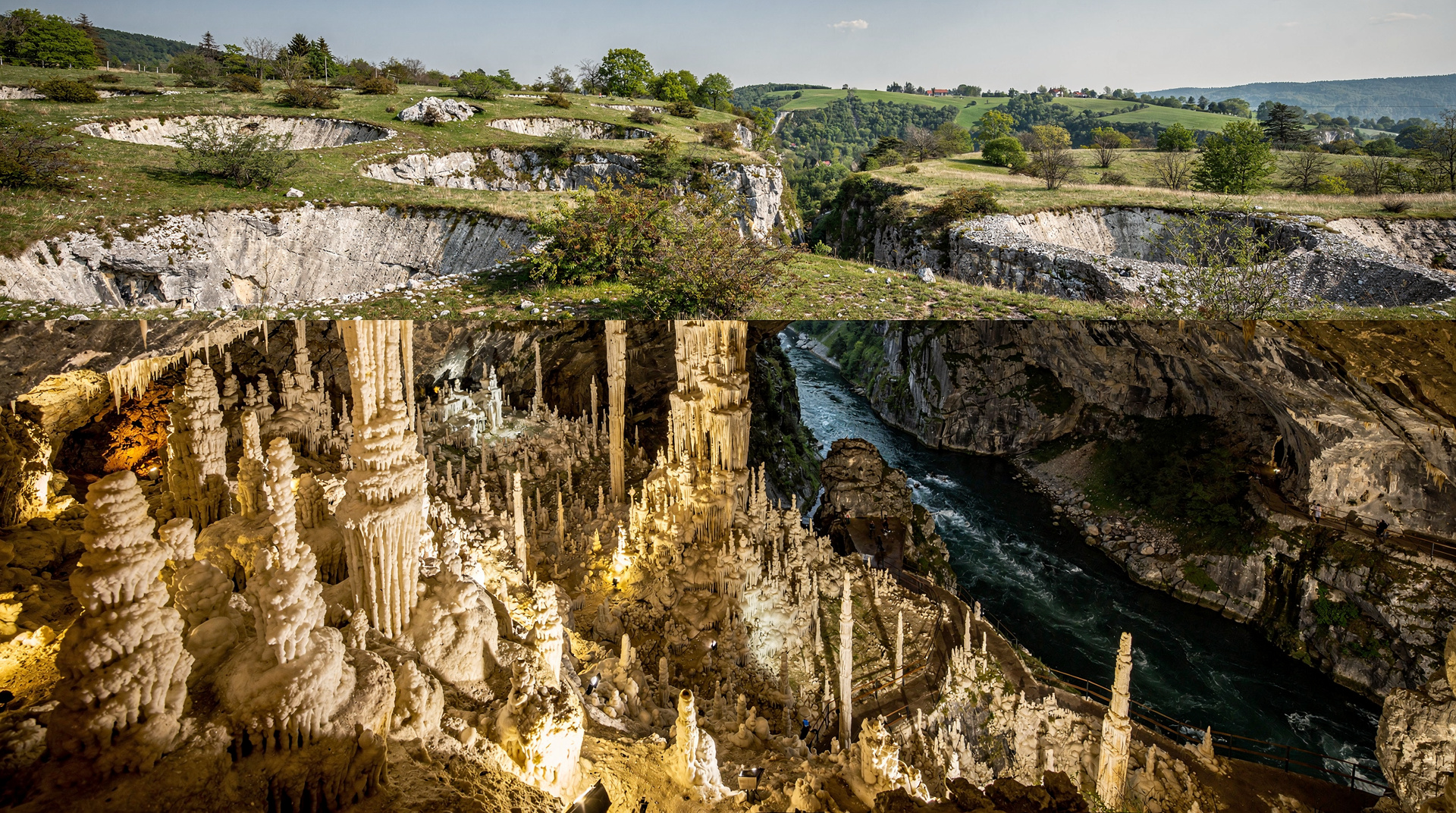
- Natural “dolines” — collapse valleys where the cave ceiling has fallen in
- About 100,000 visitors per year — significantly less crowded
Formation type: what you actually see
This is the key practical difference between the two caves.
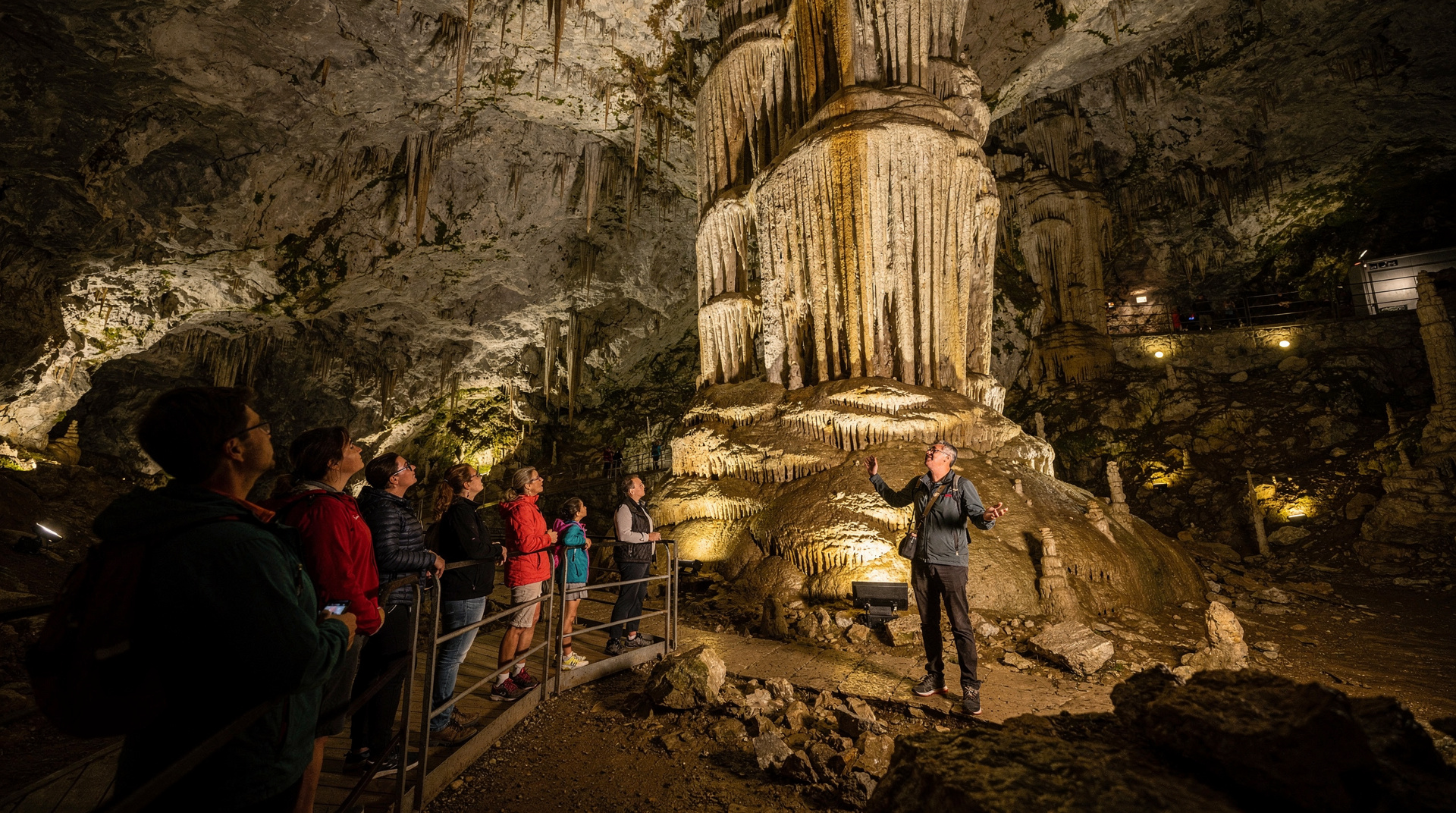
At Postojna, the formations are dense, varied and extraordinarily decorated. Stalactites, stalagmites, columns, flowstones, cave pearls, soda straw stalactites, crystal formations — the Brilliant Hall in particular is one of the most intensely decorated cave spaces anywhere. The experience is of underground ornamentation on a vast scale.
At Škocjan, the formations are secondary. The main experience is the canyon itself — the sheer scale of the underground void, the sound of the river 100 metres below the walkway bridge, the way the cave walls disappear into darkness above you. There are stalactites and stalagmites, but they’re not the point. The point is the gorge.
Some visitors describe Postojna as a “gallery” and Škocjan as a “wilderness.” This is broadly accurate.
Crowds and atmosphere
Postojna handles 700,000 visitors per year, with 1,500+ visitors per tour group in peak season. The infrastructure is accordingly large — a substantial entrance complex, restaurant, hotel and souvenir area. Tours run back-to-back in summer. You will share the cave with many people.
Škocjan handles about 100,000 visitors per year. The entrance is modest. Tour groups are smaller. Between tours, the cave returns to silence. There is no cave train, no restaurant complex, no souvenir hotel. It feels like visiting a geological site rather than a tourist attraction.
This is not an argument that Postojna is bad — it’s a world-class natural wonder with efficient visitor management. But if your preference is atmosphere over infrastructure, Škocjan wins clearly.
Price comparison
Postojna Cave adult ticket (2026): EUR 34.90 (tickets are sold only on the official site, postojnska-jama.eu, with date and time chosen online).
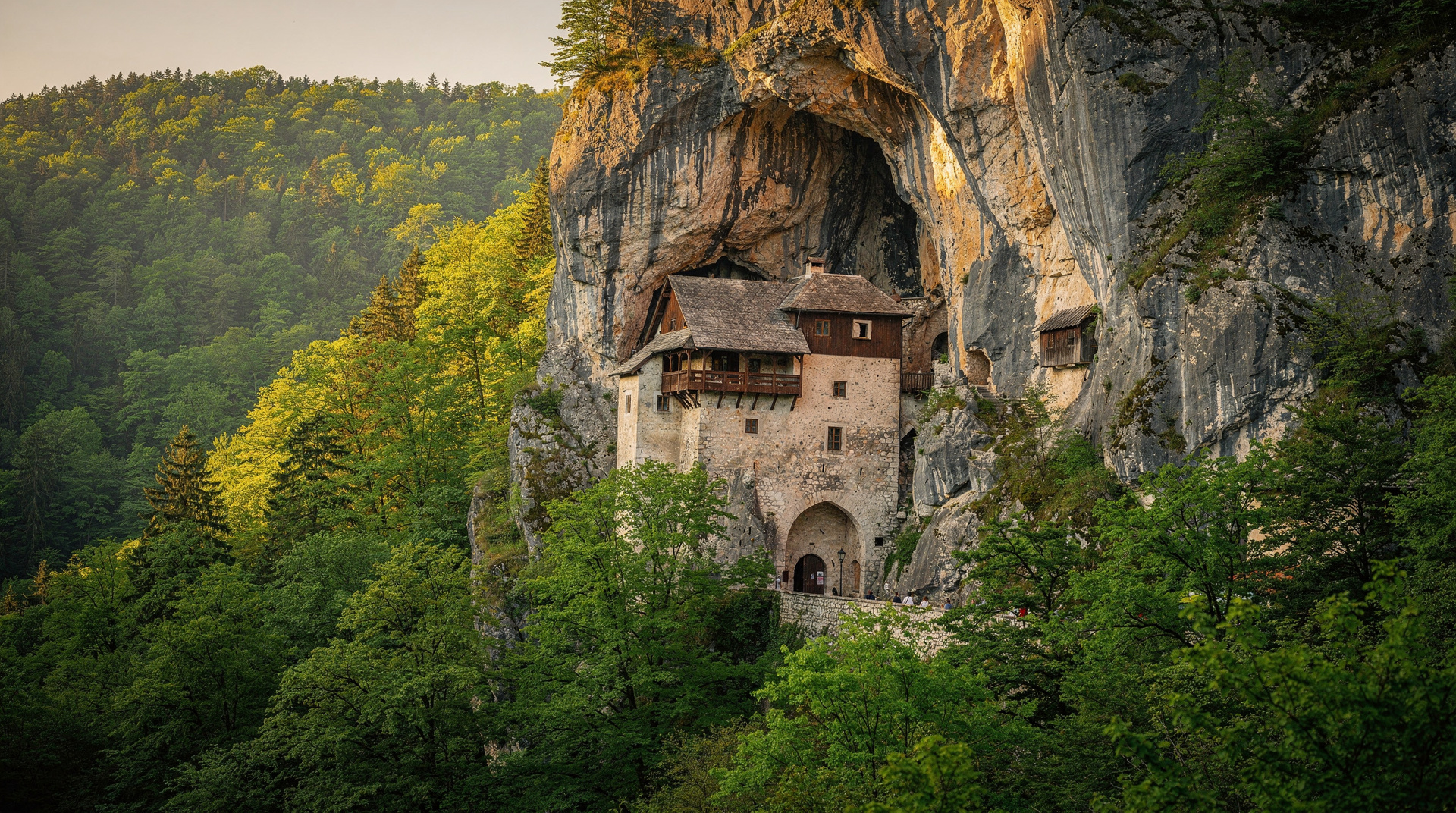
Postojna + Predjama Castle combo: EUR 49.90 (“Two Adventures” promotional price).
Škocjan Caves adult ticket (2026): EUR 18 (children aged 6–17 EUR 9, under 6 free, seniors and students EUR 14).
Škocjan is notably cheaper than Postojna for a longer and (geologically speaking) more significant experience.
Tour length and format
Postojna: approximately 90 minutes. Electric train for 3.7 km, then 1.5 km guided walk. Group sizes up to 70–80 on the train. The format is smooth and well-practised.
Škocjan: approximately 90–100 minutes. The entire tour is on foot — no train. 3 km underground including the canyon section, then 40 minutes outdoors through the collapse dolines. Group sizes limited to around 25–30 people.
For visitors with mobility limitations, Postojna’s train and flat walking sections are significantly more accessible than Škocjan’s uneven canyon paths and steps.
Temperature
Postojna: constant 8–10°C year-round. Cold — a jacket is essential.
Škocjan: approximately 12°C in the cave sections. Slightly warmer than Postojna.
Getting there
Postojna: 55 km from Ljubljana, well-served by motorway and direct bus. Easy to reach independently.
Škocjan: 85 km from Ljubljana, accessible by car (A1 to Divača exit) but less convenient by public transport — the train stops at Divača, 3 km from the cave. Guided day trips from Ljubljana are the most practical option for visitors without a car.
For getting to Škocjan specifically, the Škocjan Caves day trip from Ljubljana handles the logistics efficiently. For Postojna, the Postojna and Predjama tour from Ljubljana is the standard organised day trip.
Who should choose which cave
Choose Postojna if:
- You’re travelling with children under 12 (the cave train is genuinely exciting for children)
- You want to combine with Predjama Castle (10 km away, combo ticket)
- You want maximum stalactite spectacle in minimum time
- You’re arriving by public transport and want the easiest logistics
- You want to see the Proteus anguinus (not reliably visible at Škocjan)
Choose Škocjan if:
- You’re a serious nature or geology traveller
- You prefer a less crowded, more atmospheric experience
- You’re moved by scale and drama rather than formation density
- You’re combining with a coastal trip to Piran (Škocjan is 50 km from Piran)
- You’ve already done Postojna and want to see what you missed
Choose both if:
- You have a second day in the Karst region
- You want the complete picture of Slovenian cave country
- Both are within a day’s drive of each other — Postojna in the morning, Škocjan after lunch is achievable
Can you do both caves in one day?
Yes, but it requires planning. The caves are 30 km apart (35–40 minutes by car). A practical schedule:
- 09:00: Postojna Cave tour (arrives, finishes by 11:00)
- 11:30: Predjama Castle quick visit (optional — adds 1 hour)
- 13:00: Drive to Škocjan (30–35 minutes)
- 14:00: Škocjan Caves tour (finishes by 16:00)
- 17:00: Return to Ljubljana or continue to coast
This is a long day and slightly rushed at Predjama if you include it. Two dedicated half-days — one for Postojna+Predjama, one for Škocjan — is a more comfortable approach.
For a half-day version of Škocjan without a full day, the Škocjan half-day tour from Ljubljana allows combination with other Ljubljana-area activities.
The honest verdict
For pure geological significance and atmosphere: Škocjan wins. The UNESCO citation is deserved. The underground canyon is one of the most extraordinary things you can see in Slovenia, and the lack of crowds makes it feel like a real discovery rather than a managed experience.
For total tourist experience value — the train, the formations, the Proteus, the combination with Predjama: Postojna wins. It’s one of the most impressive visitor attractions in Central Europe, and the cave itself is genuinely world-class.
For the broader context of Slovenia’s cave landscape — Križna Jama, the Karst region and how to build a caves itinerary — see the Slovenia caves overview guide. And for day-trip logistics from Ljubljana covering both options, the cave tours from Ljubljana guide is the practical reference.
For a combined Škocjan visit with the Slovenian coast, the Škocjan Caves and Piran day trip from Ljubljana makes a logical pairing — the cave in the morning, the coastal town of Piran in the afternoon.
A note on the geology: why two such different caves exist 30 km apart
The difference between Postojna and Škocjan is ultimately a difference in geological history — specifically, in the type of water that formed each cave.
Postojna was formed primarily by phreatic processes — the cave passages developed below the water table, carved slowly by pressurised water dissolving the limestone from below. This produces the rounded, tubular passage shapes that are ideal for stalactite and stalagmite formation over millions of years of slow mineral deposition from dripping water.
Škocjan was formed by vadose processes — carved by the Reka River flowing through the limestone under the force of gravity, eroding the rock downward. This produces the steep-walled, V-shaped canyon character. The river is still there, still carving, still active. Stalactite formations exist in the drier sections, but the dominant character is the canyon, not the formations.
Understanding this difference helps explain why both caves can be outstanding while being completely different. Postojna shows what happens when groundwater dissolves limestone slowly over millions of years. Škocjan shows what happens when a river cuts through limestone over thousands of years. Neither is “better” — they’re chapters in different geological stories.
The Proteus anguinus comparison
The olm — Proteus anguinus, the “human fish” — is found in the underground waters of both cave systems, and this is worth addressing directly.
At Postojna, you are guaranteed to see Proteus anguinus. The cave management operates a dedicated vivarium with a captive breeding colony that has been in place since the 1950s. The animals are healthy, reliably visible through the glass walls, and well-described. This is the most reliable Proteus encounter in the world.
At Škocjan, Proteus populations exist in the underground water, but the tour does not include a vivarium and sightings are not guaranteed. Very occasionally, visitors on the canyon bridge see an olm in the river water below, but this is rare.
If seeing Proteus is a priority (especially with children), Postojna wins clearly on this point. The vivarium is a genuine highlight of the Postojna visit.
Souvenirs and the visitor experience outside the cave
At Postojna: the entrance complex has a large souvenir shop, a restaurant, a hotel, a children’s play area and a café. The surrounding area is effectively a dedicated tourist zone. This infrastructure is smoothly run and the restaurant is decent, but it’s unambiguously commercial.
At Škocjan: a modest reception building, a small shop with local products, a café. No hotel, no play area. The surrounding Karst landscape is the attraction — the walking trails in the dolines outside the cave are part of the experience rather than an afterthought.
The atmosphere outside the cave mirrors the atmosphere inside: Postojna is polished and managed; Škocjan is understated and naturalistic.
Accessibility comparison
Postojna: the most accessible cave in Slovenia. The electric train eliminates the need to walk the main passage; the walking section is on smooth, level paths; there are handrails throughout; wheelchairs can access most of the tour route. The cave is warm enough (8–10°C) for visitors who feel the cold keenly, provided they bring a layer.
Škocjan: less accessible. The canyon section involves steps, uneven paths and a steep descent into the gorge. The outdoor doline section is on reasonably good paths. Wheelchairs cannot access the main tour route. The cave is at 12°C and the outdoor section adds physical demand. Appropriate for fit adults and older children; not recommended for visitors with mobility limitations.
For the complete guide to each cave including logistics, tickets and what to see, read the Postojna Cave guide and the Škocjan Caves guide in full.
Planning the cave visit around other Slovenia highlights
The Karst region is compact enough that caves integrate well with other Slovenian highlights:
From Ljubljana: both caves are within 85 km. A three-day Ljubljana base can comfortably include a Postojna+Predjama day and a Škocjan+coast day without rushed logistics. See the cave tours from Ljubljana guide for the practical options.
From the Slovenian coast: Piran is an outstanding base for the Karst caves. Škocjan is 50 km from Piran; Postojna is 60 km. Combining a 2–3 night coastal stay with a day at each cave system creates an excellent Slovenian south itinerary.
From Bled: the Julian Alps lakes are 120 km from Postojna — too far for a comfortable same-day trip unless you have a car and are specifically making a long driving day. Most visitors treat the lakes and the caves as separate itinerary segments.
The family question: which cave works better with children?
For visitors travelling with children, the cave choice matters more than for adult-only groups.
Postojna wins clearly for children under 10: the cave train is one of those experiences that genuinely delights children in a way that adult attractions rarely do. The combination of a train journey through a cave, stalactites overhead, and then a vivarium with real cave salamanders is extraordinary for a child. The Postojna complex also has a café and toilets near the entrance, a large outdoor space and a manageable crowd system.
Škocjan works well for children aged 10 and above: the canyon bridge experience — standing above a 100-metre underground gorge with a river below — is viscerally dramatic and appropriately scary for older children and teenagers. The physical challenge of the uneven paths and steps makes it more of an adventure than Postojna. But it is not suitable for young children who need a pushchair, and the 12°C cave combined with cold outdoor air can chill small children quickly.
The cave bear bones at Križna Jama are a strong choice for curious children aged 10 and above who are interested in natural history, archaeology or palaeontology. The bones of actual animals that lived 20,000 years ago, seen in situ, can make a deeper impression than any museum display.
Cost comparison for a family of four
A useful practical comparison for families planning the cave visits:
Postojna Cave alone (2 adults): EUR 34.90 + EUR 34.90 = EUR 69.80, plus children’s tickets (see current prices on the official site, postojnska-jama.eu).
Postojna + Predjama combo (2 adults): EUR 49.90 + EUR 49.90 = EUR 99.80, plus children’s tickets (see current prices on the official site, postojnska-jama.eu).
Škocjan Caves (same family, children aged 6–17): EUR 18 + EUR 18 + EUR 9 + EUR 9 = EUR 54.
Križna Jama short tour (guided, booking recommended): see current prices on the official site, krizna-jama.si.
For total experience value, the Postojna + Predjama combo remains the most efficient single-day option.
Language and guide quality
All four major visitor caves offer English-language guided tours or audio guides. The quality varies:
Postojna: the cave’s own guides are generally excellent in English — they’re trained specifically in cave geology and are accustomed to international visitors. Tours in 16 languages are offered.
Škocjan: English-speaking guides are knowledgeable about the geology and UNESCO context. The guide’s commentary on the canyon’s formation adds significant value to the visual experience.
Predjama Castle: interpretation is primarily via information panels rather than a live guide. The panels are in English and are informative. A live guide is included in some organised tours.
Križna Jama: English-speaking guides are available for advance-booked visits. The guide’s personal knowledge of the cave (often from a family that has managed the site for decades) provides context that no panel can match.
Frequently asked questions about Postojna vs Škocjan
Is Škocjan cheaper than Postojna?
Yes. Škocjan's adult ticket runs EUR 18, against EUR 34.90 for Postojna alone (more with the Predjama combo). Škocjan is also less crowded for a similar or arguably more dramatic experience, which makes it the better value pick for travellers who aren't set on the cave railway or the olm vivarium.Which cave has better public transport access from Ljubljana?
Postojna, by far. It sits on a well-served motorway and direct bus/train corridor from Ljubljana, around 55 km away. Škocjan is 85 km out, with no direct bus and a train that only reaches Divača, 3 km short of the cave. Visitors without a car should book a guided day trip for Škocjan rather than relying on scheduled public transport.
Top experiences
Bookable activities with verified prices and instant confirmation on GetYourGuide.