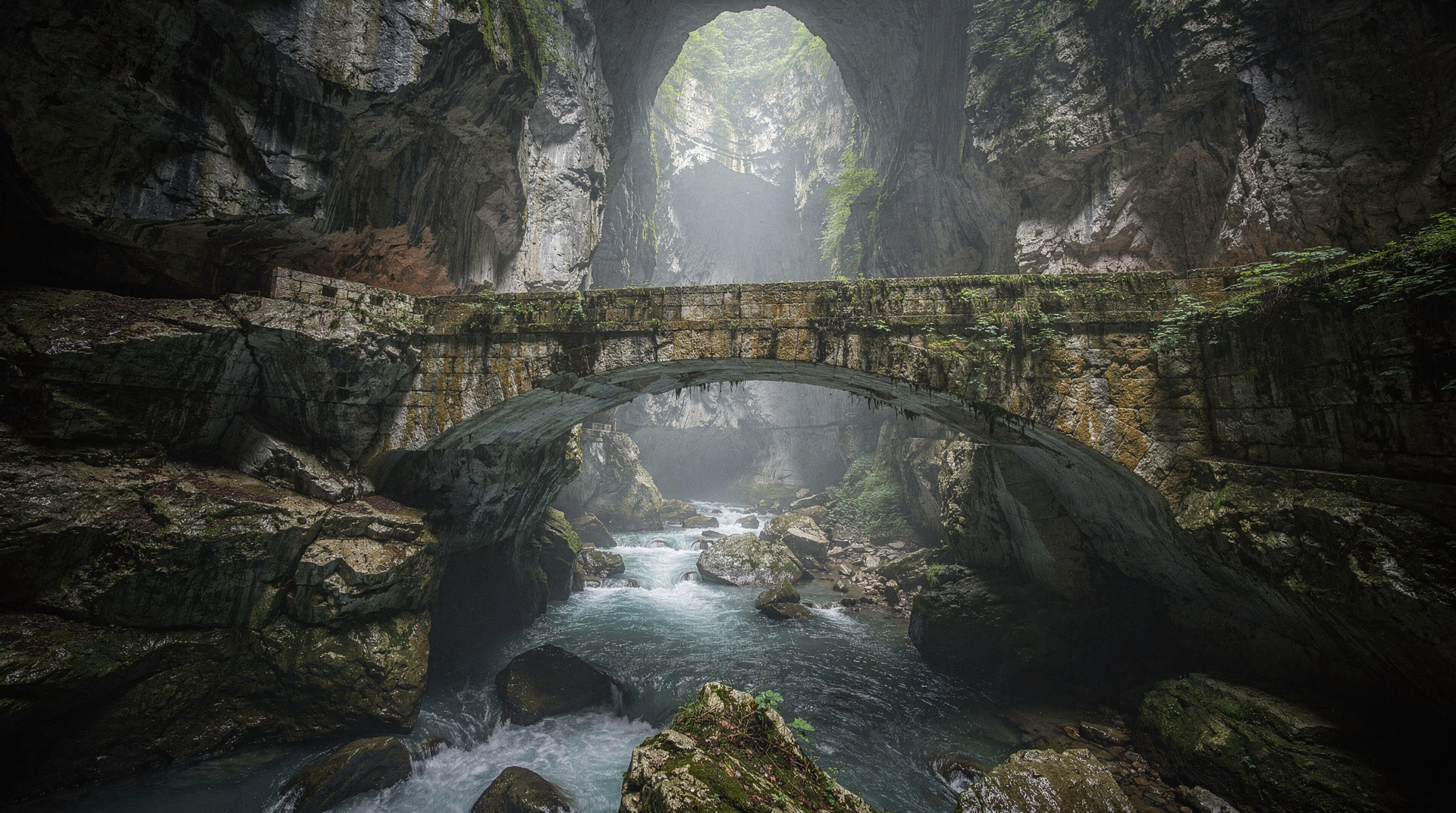
Slovenia's caves: a complete overview of the Karst region's underground world
From Ljubljana: Postojna Cave and Predjama half-day tour
How many caves can you visit in Slovenia and which are the best?
Slovenia has over 10,000 registered caves, of which around a dozen are open to visitors. The four main visitor caves are Postojna (the biggest and most visited), Škocjan (UNESCO, underground river canyon), Keresztna Jama (tiny groups, underground lakes, cave bear bones) and the cave under Predjama Castle. Most visitors see Postojna and/or Škocjan as day trips from Ljubljana.
Slovenia’s underground: why this small country has some of the world’s best caves
Slovenia lies almost entirely on karst geology. Roughly 44% of the country’s surface is underlain by limestone and dolomite — rock types that dissolve slowly in rainwater, creating the caves, sinkholes, springs and underground rivers that characterise karst landscapes. The classic karst terminology that geologists use worldwide — “karst,” “doline,” “ponor,” “polje” — is Slovenian in origin.
The result is a country with over 10,000 registered caves. The density of significant cave systems in the area south and southwest of Ljubljana is extraordinary by any international standard. Three of Europe’s most important show caves are within 90 km of Ljubljana. A UNESCO World Heritage Site is 85 km from the capital. A cave system with perfectly preserved ice-age bear bones is 65 km away.
This guide maps the whole picture — from the famous Postojna and Škocjan down to the obscure and extraordinary Križna Jama — and explains how to build a caves itinerary that makes the most of Slovenia’s underground geography.
| Main caves | Postojna, Škocjan, Predjama, Križna Jama |
| Cost range | EUR 18–35 per site depending on cave |
| Best single choice | Postojna (families) or Škocjan (atmosphere) |
| Best pairing | Postojna + Predjama Castle (10 km apart) |
| Getting there | Car, guided day trip, or train + taxi (Divača) |
The Karst region: geography and context
“Karst” (Kras in Slovenian) refers to the specific plateau region southwest of Ljubljana, between Ljubljana and the Adriatic coast. It is the type location for karst geology — the place where European scientists first studied and described the underground phenomena that now bear the region’s name.
The plateau sits at around 400–600 metres above sea level, mostly treeless (the deforestation happened centuries ago; reforestation is ongoing), covered with red soil (terra rossa) and characterised by closed depressions (dolines) where the ground has subsided into dissolved limestone below.
Beneath this plateau runs the underground world: rivers that appear on the surface, dive underground through “ponors” (swallets), travel underground for tens of kilometres, and emerge at springs near the coast. The Reka River disappears underground at Škocjan Caves and emerges 40 km later as the Timavo near Trieste. The Pivka River disappears underground to feed the Postojna Cave system.
This underground drainage system is both remarkable and, importantly, extremely vulnerable to pollution — the water that feeds the caves comes from the entire surface catchment, and anything that enters the soil eventually reaches the underground water. Slovenia’s cave management agencies are correspondingly strict about environmental protection.
The four main visitor caves
1. Postojna Cave
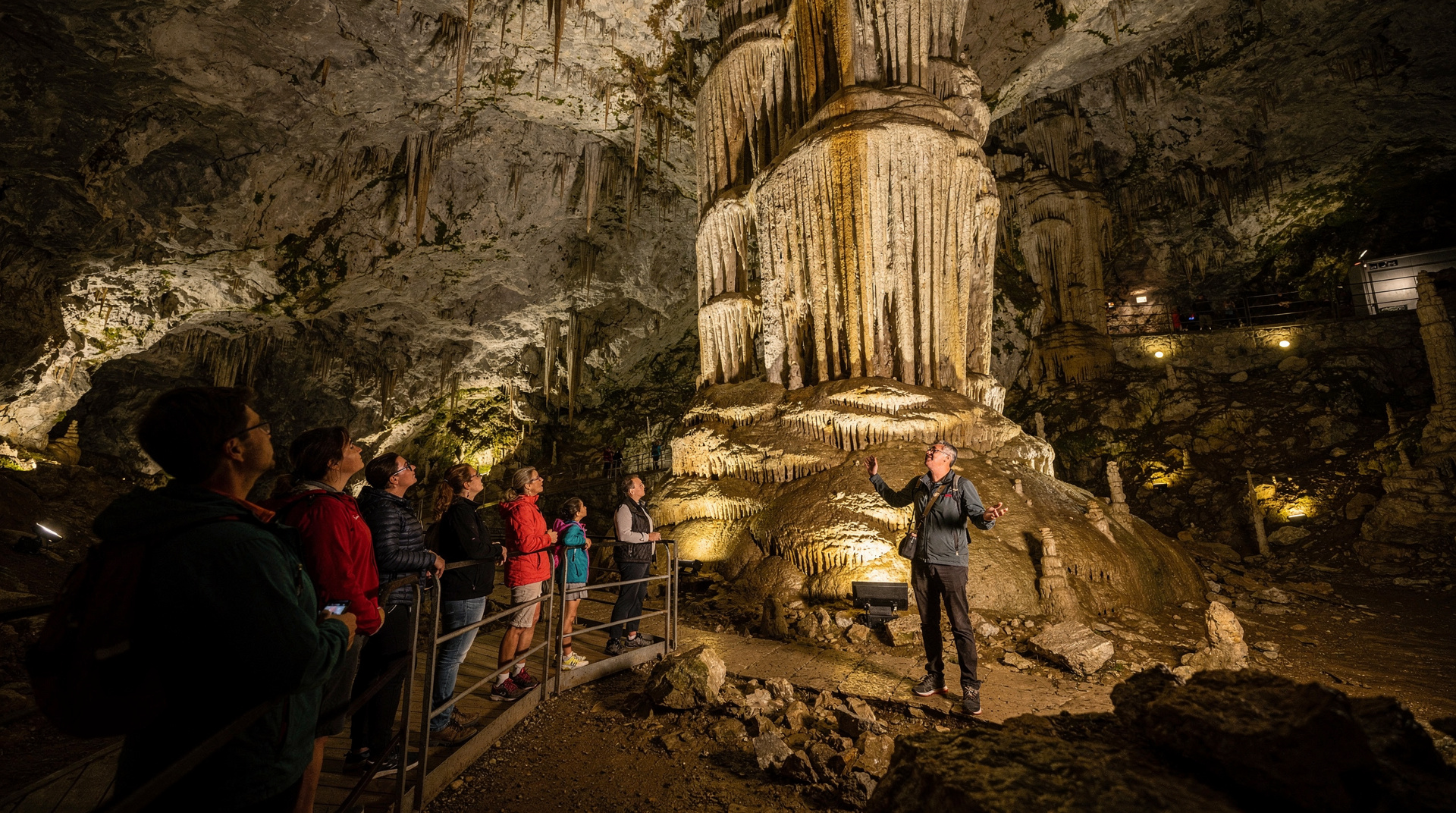
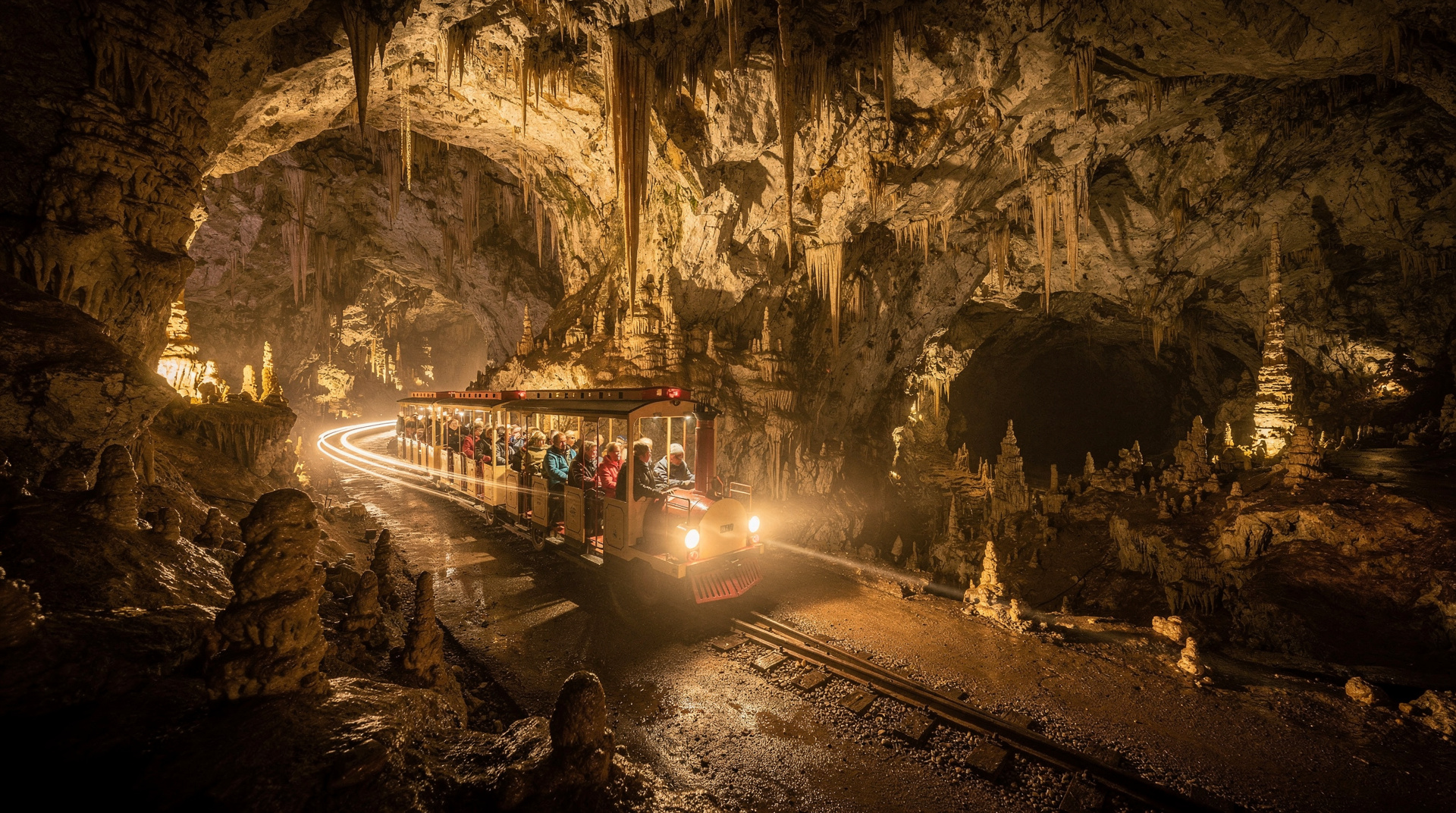
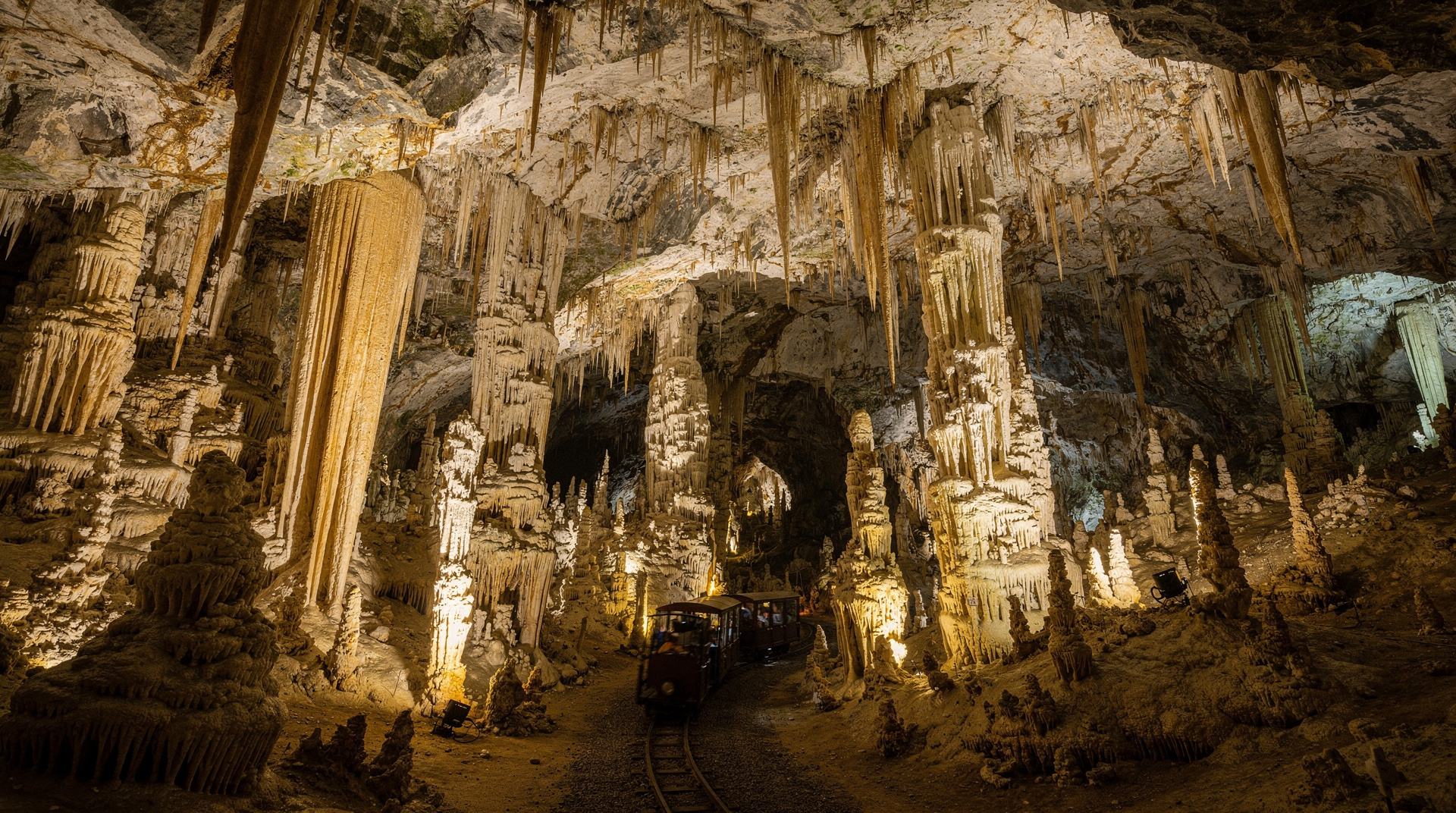
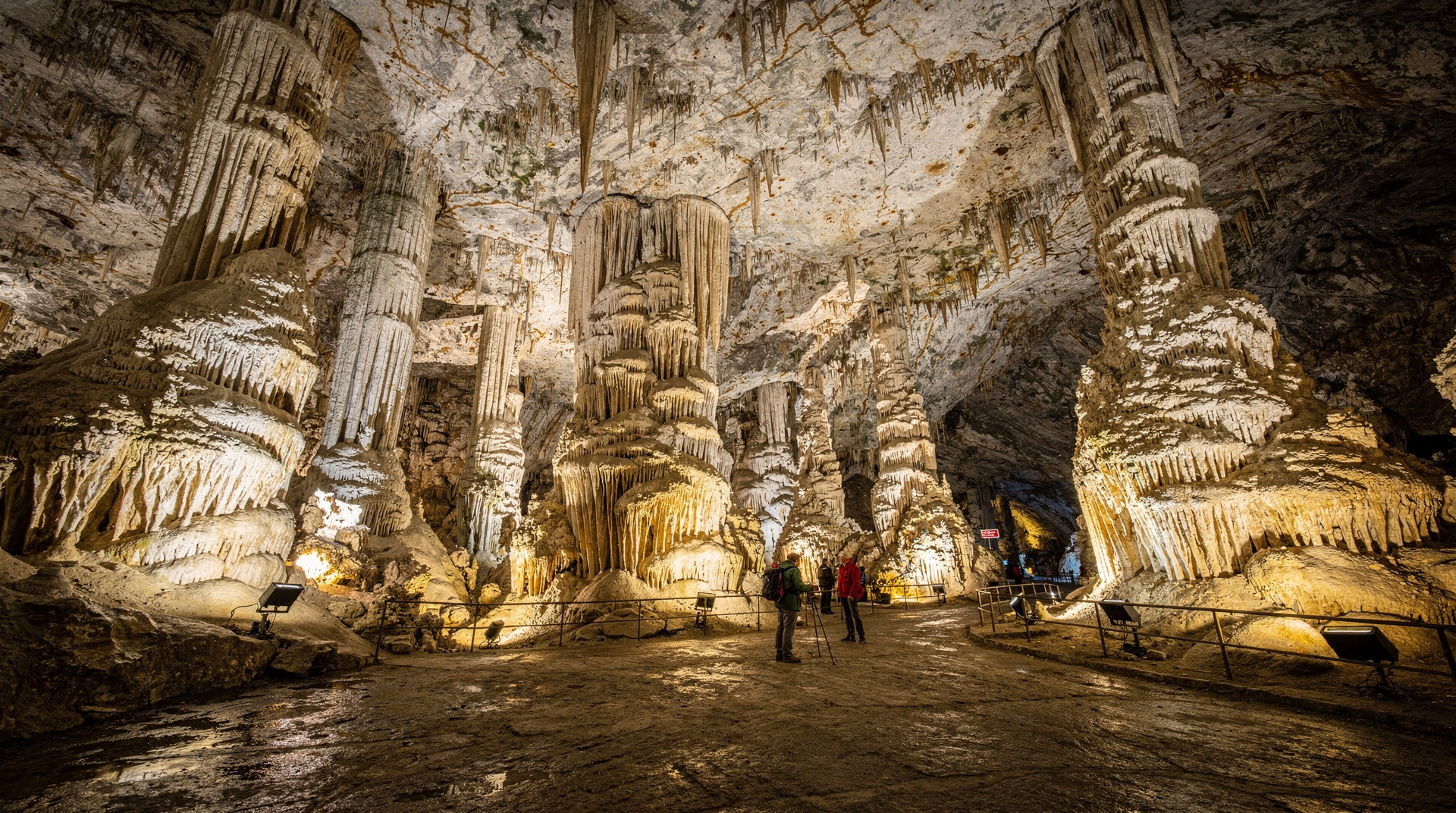
Postojna Cave is the headline attraction and the world’s most-visited show cave after Mammoth Cave in the USA. The statistics are impressive: 24 km of passages, 90-minute guided tours with a 3.7 km electric train ride, 700,000 visitors per year. The cave formations — dense, varied, spectacular — make it genuinely deserving of the crowds.
Who it’s for: families, first-time visitors to Slovenian caves, anyone who wants maximum impact with minimum effort.
Tickets: EUR 34.90 adult (tickets sold only on the official site, date and time chosen online). Often combined with Predjama Castle (combo ticket EUR 49.90).
Read more: Postojna Cave guide
2. Škocjan Caves
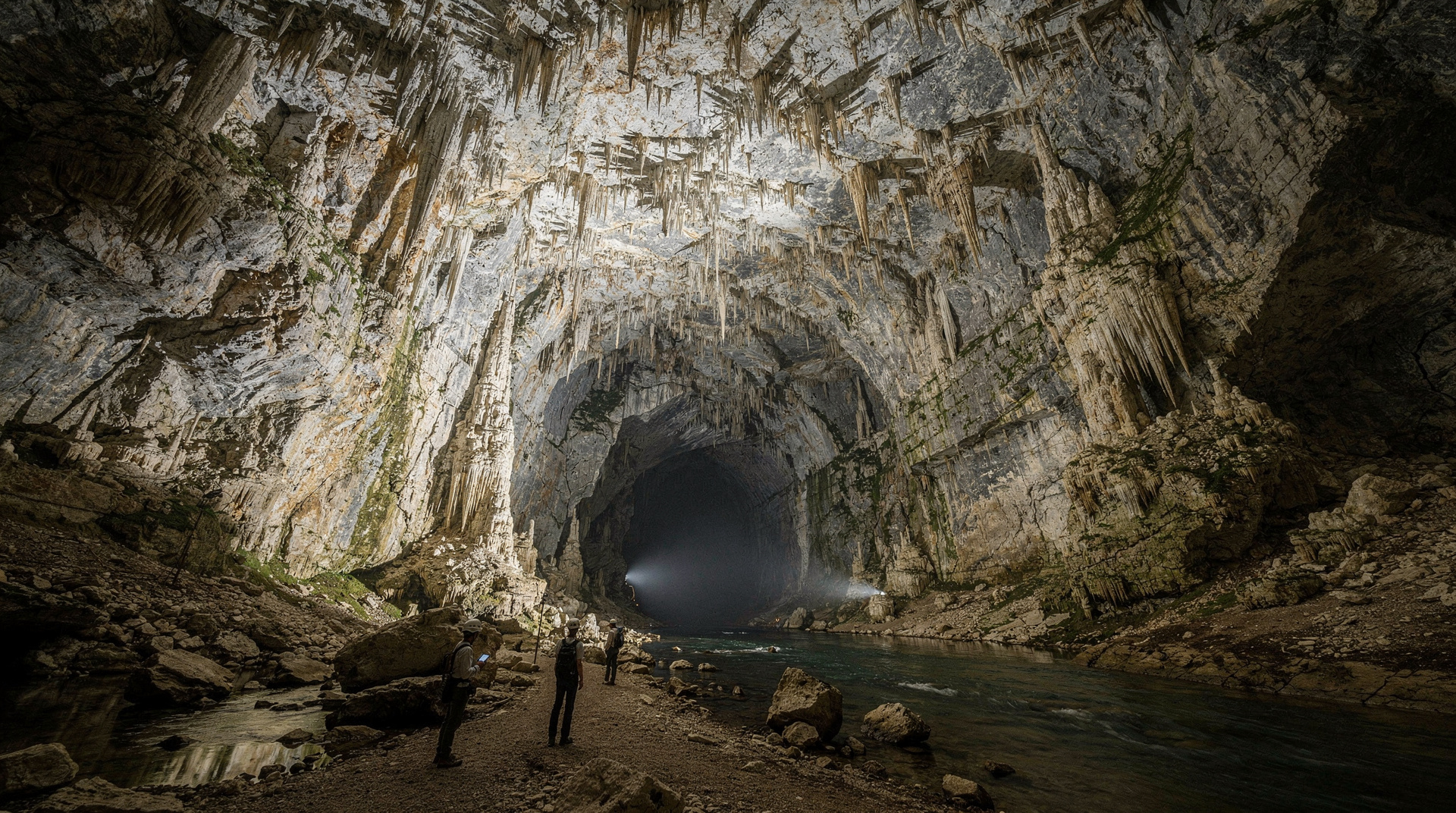
Škocjan Caves is a UNESCO World Heritage Site (1986) — the first karst site to receive this designation. The underground canyon carved by the Reka River, up to 150 metres deep, is one of the most dramatic underground landscapes on earth. About 100,000 visitors per year — a fraction of Postojna, which means a completely different atmosphere.
Who it’s for: nature and geology enthusiasts, experienced cave visitors, anyone who found Postojna crowded.
Tickets: EUR 18 adult. No combo ticket available.
Read more: Škocjan Caves guide
3. Križna Jama (Cross Cave)
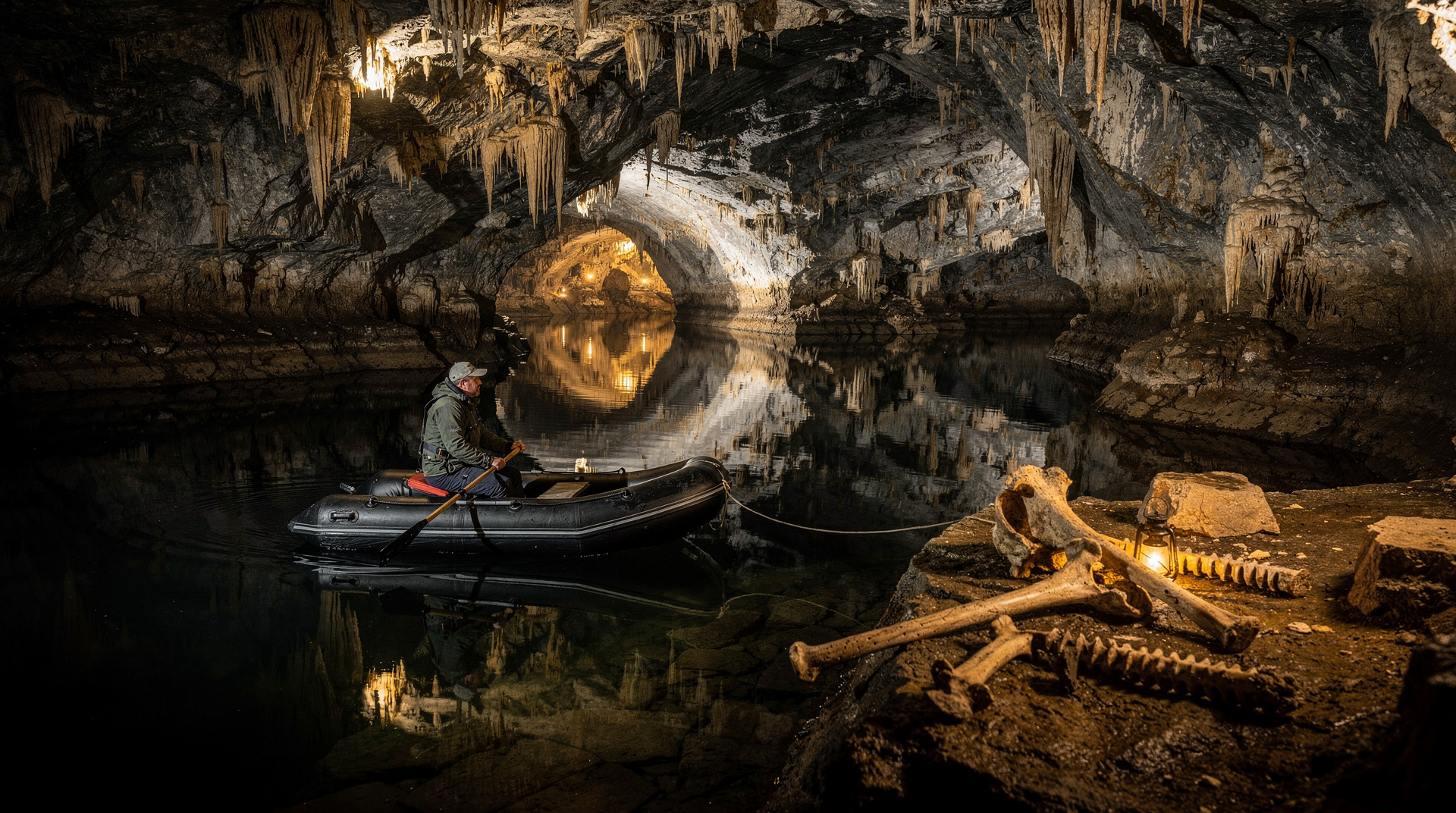
Križna Jama is the anti-Postojna: guided visits with a boat ride across underground lakes, cave bear bones in situ, no show lighting, no tourist infrastructure, booking recommended. One of the most intimate cave experiences in Europe.
Who it’s for: adventurous travellers, small groups, visitors who find the commercial atmosphere of major cave attractions off-putting.
Booking: directly with Notranjska Regional Park — not available through standard tour operators.
Read more: Križna Jama guide
4. Predjama Castle cave (Erazem’s cave)
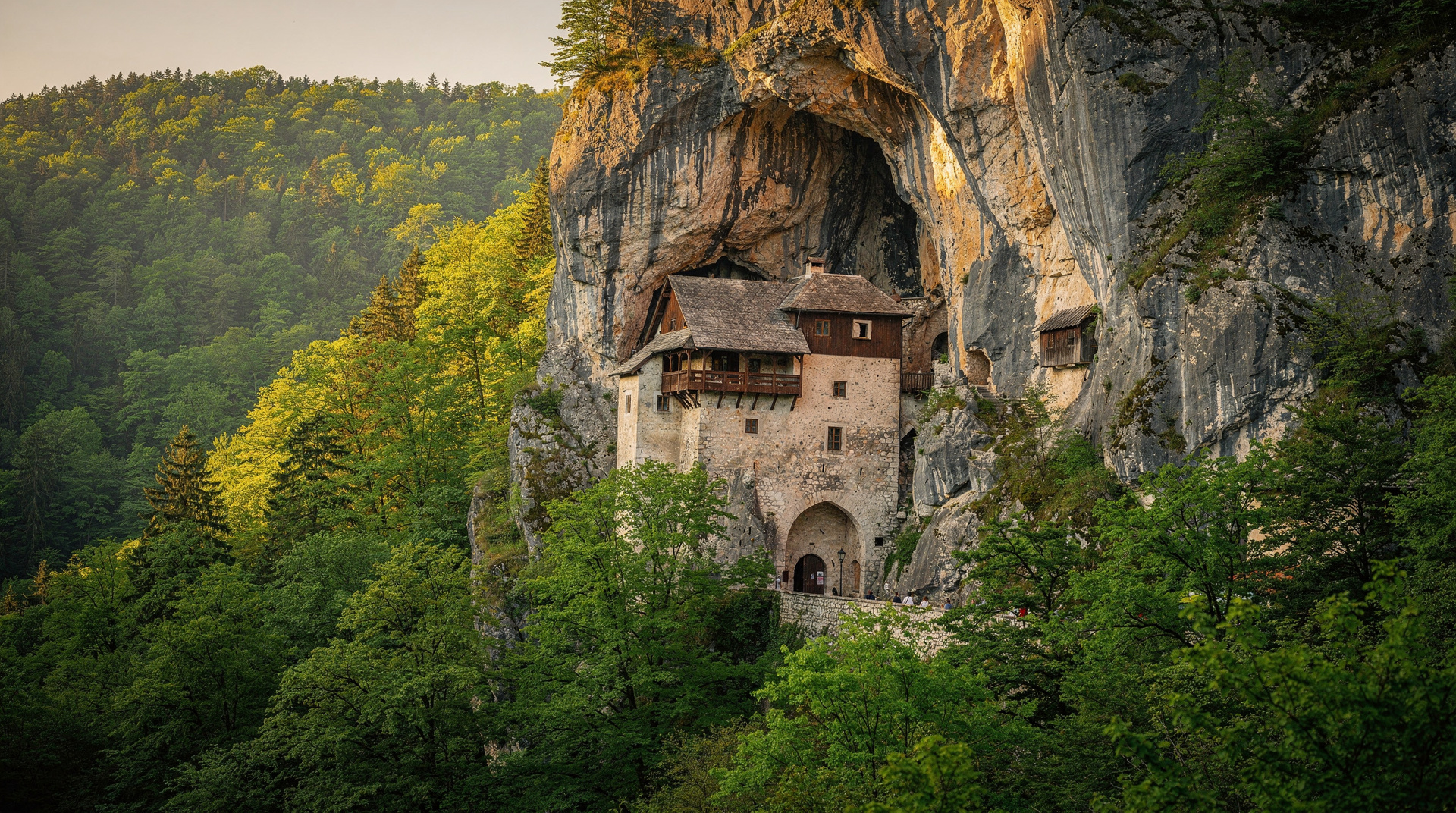
The cave beneath Predjama Castle is a separate attraction from the castle itself, accessible on a guided cave tour with strictly limited group sizes. The cave was used as a supply route during the famous 1484 siege by the robber knight Erasmus. Historically significant and atmospherically extraordinary.
Who it’s for: visitors already seeing the castle who want to go deeper.
Booking: through the Postojna Cave management system (Predjama castle cave tours are managed alongside the main cave and castle).
Read more: Predjama Castle guide
How Slovenia’s caves compare internationally
Placing Slovenia’s caves in a global context helps explain why they draw such a devoted following among serious cave enthusiasts. Postojna’s visitor numbers (700,000 annually) put it among the most-visited show caves anywhere outside the United States, and its underground railway, in continuous operation in some form since 1872, predates virtually every other cave tourism infrastructure on earth.
Škocjan’s UNESCO listing places it in company with a small number of karst sites recognised globally for scientific and scenic significance — the citation specifically references its combination of an active underground river canyon with exceptional biodiversity, a combination genuinely difficult to find replicated elsewhere at this scale and this accessible to ordinary visitors.
What makes the Slovenian case unusual is less any single cave and more the density: nowhere else in Europe, and few places worldwide, pack this many internationally significant karst features into such a small geographic radius. A visitor spending three days in the Karst region south of Ljubljana can see a UNESCO World Heritage cave canyon, the world’s most-visited show cave outside America, an intimate boat-cave with intact Ice Age remains, and a castle built into a cave mouth that withstood a year-long medieval siege — all within a 100 km radius and all reachable without specialist caving equipment or experience.
Comparable karst regions exist (parts of China’s Guangxi province, the Yucatán cenotes, the Mammoth Cave region of Kentucky) but none combine this level of accessibility, this density of distinct experiences, and this ease of independent travel.
The four main caves compared at a glance
| Cave | Distance from Ljubljana | Adult price (approx.) | Visitors/year | Best for |
|---|---|---|---|---|
| Postojna | 55 km | EUR 34.90 | 700,000 | Families, first-timers, accessibility |
| Škocjan | 85 km | EUR 18 | 100,000 | Atmosphere, geology enthusiasts, UNESCO |
| Predjama cave | 65 km | Combo with castle | Combined with castle | Castle visitors going deeper |
| Križna Jama | 65 km | See current rates on the official site (krizna-jama.si) | Very limited | Adventurous, intimate small groups |
Minor visitor caves worth knowing about
Pivka Cave (Pivka jama): directly connected to the Postojna system — you can see the underground Pivka River that feeds the main cave. Accessible via a separate guided tour from the Postojna Cave complex. Less visited than the main cave, more dramatic in places.
Black Cave (Crna jama): also connected to Postojna, this smaller cave can be combined with the Pivka Cave tour. More for serious cave enthusiasts than casual visitors.
Vilenica Cave: near Lipica, this cave hosts the annual Vilenica International Literary Festival — a unique combination of cave and culture. Limited to festival visitors during the festival period; check current opening status for regular visits.
Planinska Cave (Planinska jama): one of the largest cave halls in Slovenia, at the point where the Pivka and Rak rivers emerge from underground. Accessible by boat in high-water periods; on foot in summer. Contact the Notranjska Regional Park.
Organising a caves itinerary
The main caves cluster in a relatively small geographic area south and southwest of Ljubljana:
- Postojna: 55 km from Ljubljana (A1 motorway)
- Predjama: 65 km from Ljubljana (via Postojna, then 10 km north)
- Škocjan: 85 km from Ljubljana (A1 to Divača)
- Križna Jama: 65 km from Ljubljana (via Postojna, then 20 km northeast)
- Lipica: 90 km from Ljubljana (near Škocjan)
One cave day (most popular): Postojna Cave + Predjama Castle. Both on the Postojna Cave combo ticket. Full day from Ljubljana by bus or car.
Two cave days (recommended for cave enthusiasts):
- Day 1: Postojna + Predjama
- Day 2: Škocjan (+ Piran on the coast if you want a non-cave afternoon)
Three cave days (the complete picture):
- Day 1: Postojna + Predjama
- Day 2: Križna Jama (advance booking, self-drive)
- Day 3: Škocjan + coast
For organised day trips from Ljubljana, the following tours cover the main options:
Postojna Cave and Predjama Castle from Ljubljana — the standard day trip covering the two most popular sites.
Škocjan Caves day trip from Ljubljana — for the UNESCO cave experience with guided transport.
For private tours that can cover multiple caves in a customised itinerary, the private Postojna and Predjama tour allows flexibility in timing and route.
The Proteus anguinus: Slovenia’s most extraordinary cave creature
The olm (Proteus anguinus) is a cave-dwelling salamander found only in the underground waters of the Dinaric Karst — a region centred on Slovenia, with populations also in adjacent parts of Croatia, Bosnia and Italy. It is the longest-lived amphibian known (up to 100+ years), completely blind, pale pink-white in colour, and can survive for years without food.
The vivarium at Postojna Cave is the most reliable place to see them. Križna Jama also has a population in its underground water, though sightings are not guaranteed on standard tours. Škocjan’s river section also has populations.
The olm has become something of a Slovenian national symbol — “the human fish” (človeška ribica in Slovenian) appears on tourist merchandise, in natural history films and in geological papers. It is genuinely one of the most remarkable animals in Europe, and the caves of Slovenia are essentially the only place on earth where you can see them in their natural environment.
Practical considerations for visiting Slovenia’s caves
Cave temperature: all Slovenian show caves are cold:
- Postojna: 8–10°C
- Škocjan: 12°C
- Križna Jama: 8°C Always bring a warm layer, regardless of outside temperature.
Accessibility: Postojna is the most accessible (cave train, smooth paths, wheelchair-accessible). Škocjan involves uneven canyon paths and steps. Križna Jama requires physical fitness and comfort with low passages and boats.
Photography: permitted at all main sites except inside the Proteus vivarium at Postojna (no flash in the vivarium). Low-light capability is essential.
Combining with the coast: Škocjan is 50 km from Piran — a natural combination for a day that includes both cave and coast. For a guided combination, the Škocjan and Piran day trip from Ljubljana is an excellent option.
What makes Slovenia’s cave country unique globally
The phrase “world-class caves” is applied liberally to many destinations, but in Slovenia’s case it reflects a specific geological reality. The Dinaric Karst — the limestone plateau running from northeastern Italy through Slovenia, Croatia and into the Balkans — is the type location for karst geology worldwide. Slovenian scientists were the first to study and describe the phenomena that geologists now apply universally.
The density of significant cave systems in this small area is extraordinary by any international comparison. Within 100 km of Ljubljana you have:
- A cave (Postojna) with the world’s most developed underground tourist railway system, active since 1872
- A cave canyon (Škocjan) recognised by UNESCO as among the world’s most significant karst phenomena
- The only reliably accessible population of Proteus anguinus — the “human fish” cave salamander found almost nowhere else on earth
- A cave (Križna Jama) with intact Pleistocene cave bear bone deposits
- A castle (Predjama) built into a cave mouth and connected to an underground supply route that sustained a year-long medieval siege
No comparable 100 km radius anywhere in Europe contains this concentration of significant karst features. It is a genuine world destination for cave lovers, and it remains underappreciated relative to Slovenia’s other tourist attractions.
The history of cave tourism in Slovenia
Tourism to Slovenia’s caves predates mass tourism by centuries. The first documented visit to Postojna Cave by a tourist (as opposed to a scientist or local) was in 1213, when an Austrian bishop recorded his descent into the cave. By the 17th and 18th centuries, guided cave visits were common for educated travellers making the Habsburg Empire circuit.
The modern tourist infrastructure began in the early 19th century. Franz Josef Kanič and Ferdinand von Hochenwart developed the first systematic visitor infrastructure at Postojna in the 1820s — fixed paths, torchlight guides, a guest book. The cave train was introduced in 1872, predating most of the world’s underground railway systems.
Škocjan followed a different trajectory. The cave was known to local residents but not developed for general tourism until the 1890s, when Slovenian naturalists and the Austrian geographical society promoted it as a scientific site. The first fixed walkways in the canyon were installed around 1900.
Predjama’s tourism is more recent — systematic visits for non-researchers began in earnest in the mid-20th century, following the Yugoslav-era restoration of the castle.
The Slovenian cave tourism tradition is therefore very old — older, in some respects, than the convention of recreational travel itself. The expertise in managing underground visitor experiences, the multilingual guide traditions and the conservation frameworks all reflect this long history.
Conservation challenges
The major Slovenian caves face conservation pressures that their management teams deal with continuously:
Water quality: all the cave systems depend on rainwater and snowmelt percolating through the surface limestone. Agricultural chemicals, road runoff and other surface pollutants can reach the cave water. The Notranjska Regional Park and the Škocjan Caves management area have strict rules on surface land use in their catchment zones.
CO2 and visitor impact: large numbers of visitors exhaling CO2 inside the caves changes the atmospheric chemistry of the cave air. At Postojna, with 700,000 visitors per year, CO2 monitoring is conducted continuously and visitor flow is managed to keep concentrations within safe levels for both the cave formations and the cave fauna.
Formation damage: stalactites and stalagmites grow at rates of 1–3 mm per decade or slower. A single touch deposits skin oils that change the chemistry of the formation surface and can stain it permanently. The rules against touching formations at all Slovenian show caves are enforced seriously.
Microbial contamination: visitors bring in microbes on their clothes and equipment. Cave management at all major sites requires certain clothing standards for staff. Križna Jama’s tiny visitor numbers minimise this impact significantly compared to Postojna.
The Karst region beyond the caves
The caves are the headline attraction of Slovenia’s Karst region, but the area above ground has its own considerable interest:
Traditional architecture: the Karst farmhouses (kraška hiša) are built from local limestone in a distinctive style — high walls, relatively few windows (protection from the bora wind), internal courtyards. Several villages in the Sežana area retain original examples.
Teran wine: the Karst region produces Teran, a red wine made from the Refosco grape grown in the iron-rich terra rossa soil. It has an intensely deep colour and a slightly austere, high-acid character. The wine has PDO status and is genuinely tied to the local geology — the same soil chemistry that gives the cave limestone its reddish colour contributes to the wine’s mineral character.
The bora wind: the karst plateau receives the bora (burja in Slovenian) — a fierce downslope wind from the northeast that can reach 200+ km/h in extreme conditions. Most Karst visits are not affected by the bora, but when it blows, driving on the motorway and visiting cliff-exposed sites like Predjama is best postponed.
The Notranjska Regional Park: the landscape that holds the caves
The Postojna Cave, Predjama Castle and Križna Jama all sit within or adjacent to the Notranjska Regional Park — a protected landscape covering 222 km² of the Inner Carniola plateau. The park was designated in 2002 and protects one of the richest karst surface landscapes in Slovenia.
Above the cave entrances, the park surface is a mosaic of hay meadows, mixed forest (beech-fir dominant), peat bogs and the seasonal Lake Cerknica (Cerknišk jezero) — one of the largest periodic lakes in Europe, which floods in spring and autumn and partially dries in summer.
The park is managed jointly with the Škocjan Caves Regional Park (for the Škocjan area) and the broader Karst area protections. The entire region between Ljubljana and the Adriatic coast, from the Postojna gate to the Trieste hinterland, forms one of Europe’s most coherent and protected karst landscapes.
Bird life in the Notranjska Park: the flooded Lake Cerknica attracts significant waterfowl concentrations in spring and autumn. White stork nest in the villages around the lake; black stork breed in the forest patches. The hay meadows support corncrake, quail and grasshopper warbler — increasingly rare birds across Western Europe that still breed here in significant numbers.
Walking in the Notranjska Park: the park has a well-maintained trail network covering both the karst surface landscape and the approaches to the cave entrances. The 10 km loop around Lake Cerknica (when it’s flooded) is one of the most unusual walks in Slovenia — you’re essentially walking around a temporary lake that will be dry field in three months.
For visitors combining a cave day with a walk in the regional park, the Park’s visitor centre in Cerknica has current trail conditions, maps and information on the lake level. The visitor centre is 10 km from Križna Jama.
Further reading
For the complete breakdown of which cave to choose, see the Postojna vs Škocjan comparison guide. For logistics and tour options from Ljubljana, see the cave tours from Ljubljana guide. And for Predjama Castle — usually combined with Postojna but worth a full guide on its own merits — see the Predjama Castle guide.
Frequently asked questions about Slovenia's caves
Can you visit more than one cave in a single day in Slovenia?
Yes, and it's common. The most popular single-day combination is Postojna Cave and Predjama Castle, which are 10 km apart and often sold as a combo ticket. Adding a third cave (such as Škocjan, 30 km from Postojna) in the same day is possible but tiring — most visitors who want to see both Postojna and Škocjan properly spread them across two separate days.Which Slovenian cave is best for someone who can only visit one?
For most first-time visitors, Postojna Cave is the safer single choice — it's the most accessible, has the underground train, and pairs easily with Predjama Castle. For visitors prioritising atmosphere over convenience, or who dislike crowds, Škocjan Caves is frequently rated the more memorable single visit despite requiring more effort to reach.
Top experiences
Bookable activities with verified prices and instant confirmation on GetYourGuide.