Škocjan Caves guide: the UNESCO canyon that puts Postojna in perspective
Škocjan Caves day tour from Ljubljana
What makes Škocjan Caves different from Postojna and is it worth visiting?
Škocjan Caves has something Postojna doesn't: an underground canyon up to 150 metres deep, carved by the Reka River, with a thundering underground waterfall and a sense of geological drama that makes Postojna's stalactite chambers feel tame by comparison. It's UNESCO-listed, smaller in visitor numbers and longer as a walk. Most serious cave visitors rate it higher than Postojna — it just requires more effort to reach.
Škocjan Caves: the underground canyon that earns its UNESCO status
Škocjan Caves (Škocjanske jame) is one of Slovenia’s two great cave experiences, and in strictly geological terms it may be the more impressive. Where Postojna Cave overwhelms with scale and decorated chambers, Škocjan overwhelms with something more primal — a full underground canyon carved by the Reka River, with walls 150 metres high, an active underground waterfall, and a sense that the earth has simply opened and swallowed a river whole.
The site is a UNESCO World Heritage Site (inscribed in 1986) and a UNESCO Biosphere Reserve. It’s listed alongside places like the Grand Canyon and the Waitomo Caves as one of the world’s most significant karst phenomena. It deserves all of it.
Visitor numbers are significantly lower than Postojna — roughly 100,000 per year compared to Postojna’s 700,000 — which means a visit here feels more like a serious cave experience and less like a theme park. The group sizes are smaller, the guides have more time for each group, and the silence in the chambers between tours is actual silence.
| Where | Matavun, near Divača — 85 km / ~1hr from Ljubljana |
| Cost | EUR 18 adult, EUR 9 child (6–17), free under 6 |
| Time needed | 2–2.5 hours including orientation |
| Getting there | Car (A1 to Divača), train + taxi/walk, or guided tour |
| Best time | May–June or September–October |
What you see at Škocjan
The standard guided tour covers approximately 3 km underground and lasts 90–100 minutes. The route falls into two distinct sections, each very different in character.
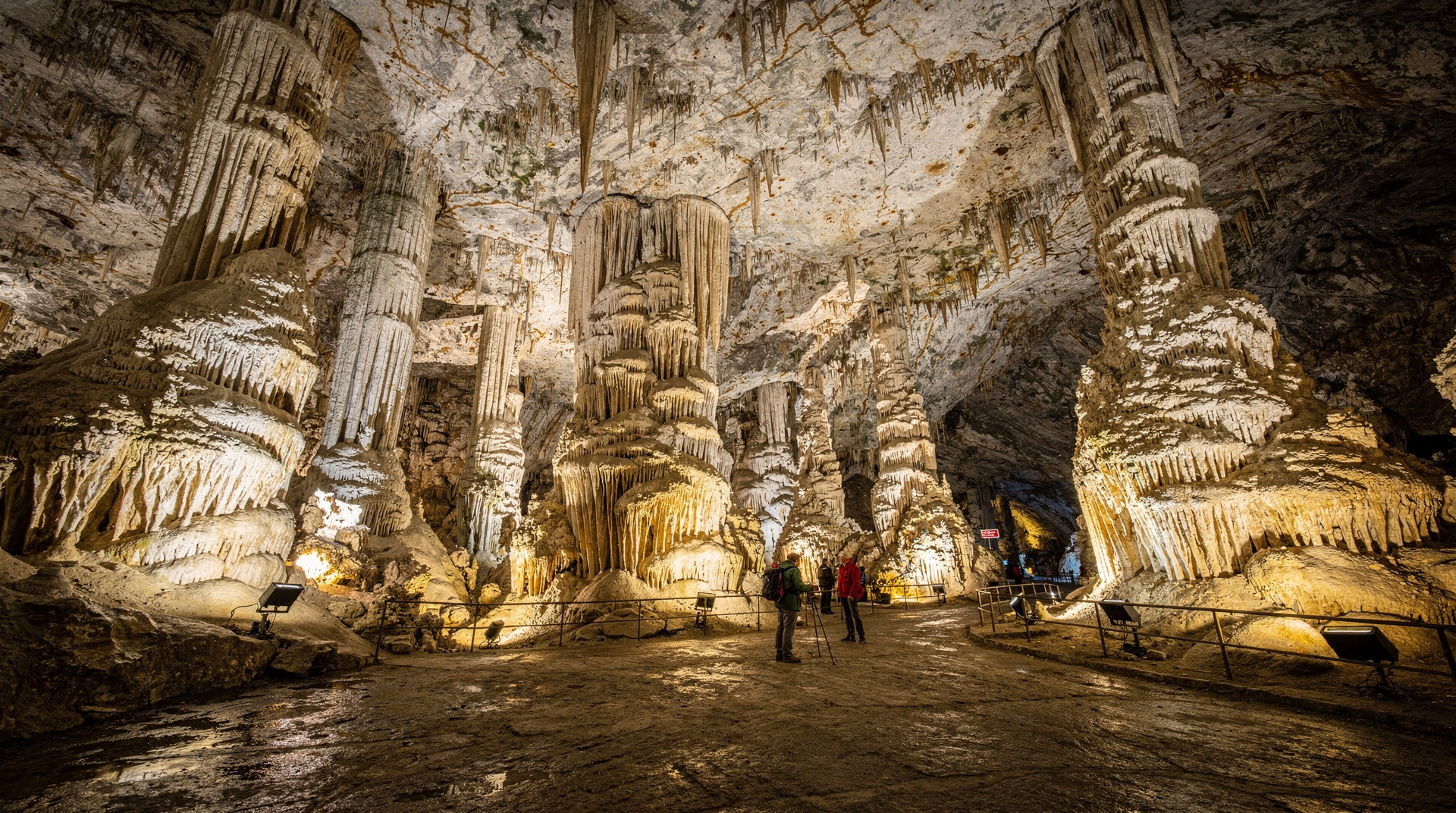
The silent caves (Tihe jame): the first section of the tour passes through the “Silent Caves” — chambers with the kind of stalactite and stalagmite formations that dominate Postojna. These are excellent but not the main event. Noteworthy formations include a 15-metre stalagmite column and cave pearls formed in shallow pools.
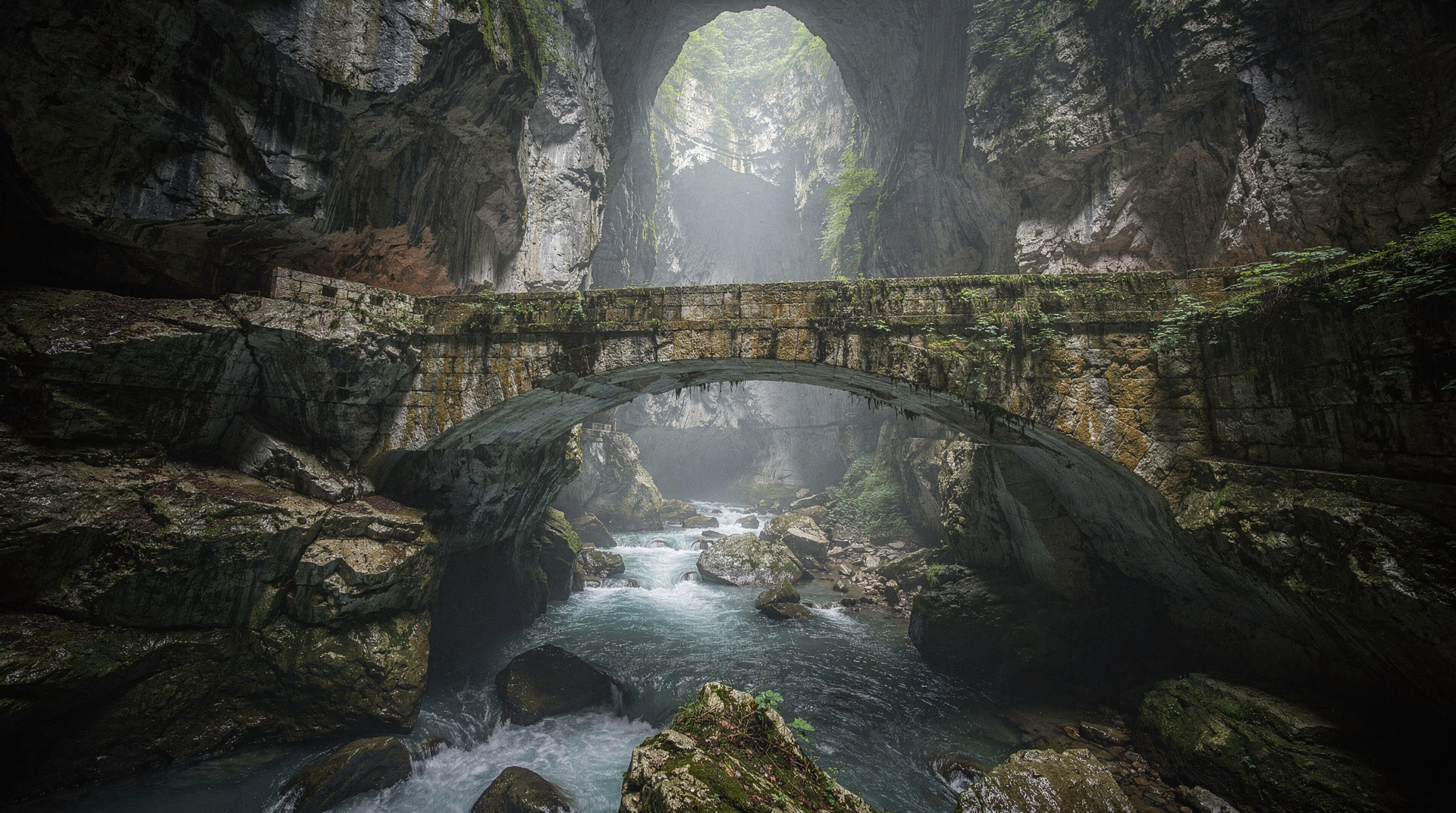
The Murmuring Cave and Hanke Channel (the big experience): the route then enters the Murmuring Cave — the active underground canyon where the Reka River flows. The transition from the Silent Caves into the canyon is one of the most dramatic moments in any European cave tour. The sound of rushing water becomes audible, then the path descends and suddenly opens onto a view of a canyon that is approximately 2 km long and in places 150 metres from the river surface to the cave roof above.
The guided path follows the canyon wall via a series of walkways, bridges and tunnels. The main bridge crosses the Reka River at a point where the canyon is 50 metres wide and more than 100 metres deep. Looking down from the bridge at the river below, with the cave roof invisible in the darkness above you, is genuinely vertiginous.
At the deepest point of the tour, the river disappears into a sump — where it goes underground and continues for another 30+ km before emerging at the Adriatic coast near Trieste. The cave management area has a lookout over the sump pool and the underground waterfall above it.
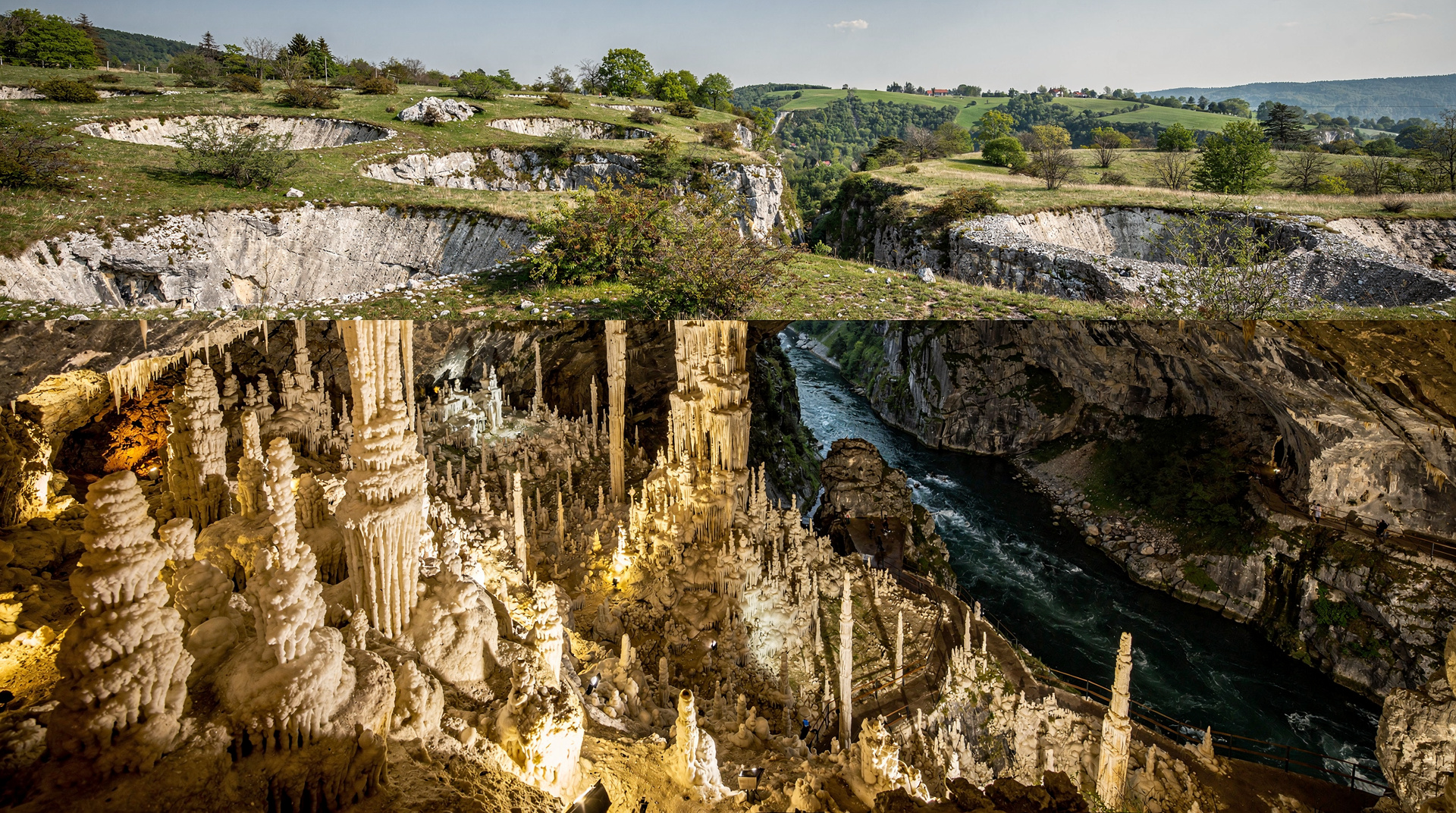
The tour exits not through the cave entrance but via a natural skylight — a collapse doline (uvala) where the cave roof has fallen in, creating an open-air canyon. Walking out into daylight through this natural exit is an extraordinary way to end the underground section.
Outdoor section: the tour continues for about 40 minutes through the collapse valleys (the Globočak and Sokolak dolines) that were once cave chambers, now open to the sky. The vegetation in these sheltered valleys is lush and subtropical relative to the surrounding Karst plateau — fig trees, walnut, various Mediterranean species survive here because the valley walls protect them from the bora wind.
Ticket prices and booking
Adult ticket (2026 approximate): EUR 18 for the standard guided tour (seniors and students EUR 14). This is cheaper than Postojna for a longer and (many would argue) more impressive tour.
Children: EUR 9 for ages 6–17, free under 6.
Combined tickets: Škocjan is sometimes combined with other sites by tour operators (Piran, Lipica stud farm) but there is no official combo ticket with Predjama or Postojna.
Booking: advance booking is recommended in July and August, though Škocjan rarely sells out as quickly as Postojna. Online booking available through the official Škocjan Caves website.
Tour languages: tours in Slovenian, English, Italian, German and other languages depending on demand. Check current schedule when booking.
For a day trip from Ljubljana that takes in Škocjan specifically, the Škocjan Caves day trip from Ljubljana handles transport and timing efficiently — useful since the cave is 85 km from Ljubljana and slightly less straightforward to reach by public transport than Postojna.
For a half-day version that focuses on the cave only, the Škocjan Caves half-day tour from Ljubljana allows the morning to be spent in Ljubljana and the afternoon at the cave — or vice versa.
Getting to Škocjan Caves
Škocjan is slightly harder to reach independently than Postojna, which is one reason it gets fewer visitors.
By car from Ljubljana: 85 km southwest of Ljubljana. The A1 motorway takes you to the Divača exit, from which it’s a further 3 km to the cave entrance. Total drive: 1h–1h10. Well-signed from the motorway.
By car from Piran/coast: 50 km, about 45 minutes.
By train from Ljubljana to Divača: trains run roughly every 1–2 hours from Ljubljana to Divača station. Journey time about 1 hour. From Divača, the cave is 3 km away — accessible by local taxi or a 40-minute walk. No direct bus service from the train station to the cave.
By bus: buses from Ljubljana to Koper or Piran stop at Divača. From Divača, see above. Less convenient than Postojna for public transport visitors.
For visitors without a car wanting a day trip specifically to Škocjan, the guided day trip from Ljubljana is the most practical option.
When to visit Škocjan
Year-round: the cave is open throughout the year, though hours vary by season. Summer (July–August): tours every hour from 10:00 to 17:00. Spring/autumn: every 1–2 hours. Winter: fewer tours, typically at 10:00 and 13:00 on weekdays, more frequently on weekends.
Best time: May–June and September–October for weather, crowds and access. The outdoor doline section is particularly beautiful in spring (green, flowery) and autumn (golden).
Summer: the cave is noticeably quieter than Postojna. Even in July and August, arriving 30 minutes before your tour time is usually sufficient.
Winter: the cave remains a constant 12°C (slightly warmer than Postojna’s 8–10°C) and the winter light in the collapse dolines is dramatic. A good off-season option.
The honest comparison with Postojna
This guide covers Postojna separately — see the Postojna Cave guide — and a full side-by-side comparison is in the Postojna versus Škocjan guide. The short version:
Choose Postojna if: you’re travelling with young children who will love the cave train, you have limited time and want the most efficient “cave spectacle” experience, or you’re combining with Predjama Castle.
Choose Škocjan if: you’re a serious nature/geology traveller, you want a less crowded experience, you’re moved by underground landscape drama rather than formations, or you’re combining with the coast.
Best of all: visit both. They’re 30 km apart and offer genuinely different experiences. See the caves overview guide for the full picture.
Combining Škocjan with nearby attractions
Lipica stud farm (15 km): the original home of the Lipizzaner horses, bred here since 1580. The white horses of the Spanish Riding School in Vienna trace their lineage to this farm. Guided tours of the stud farm and riding performances available (check schedules). A pleasant combination with Škocjan for a full day in the Karst region.
Piran and the Slovenian coast (50 km): Piran is one of Slovenia’s most atmospheric towns — a compact Venetian-influenced harbour town on the Adriatic. Combining Škocjan (morning) with Piran (afternoon/evening) makes for an outstanding day. The Škocjan Caves and Piran day trip from Ljubljana combines exactly this itinerary with guided transport.
Postojna Cave (30 km): see both caves in a single day if you have energy — Škocjan in the morning (tour at 10:00) and Postojna in the afternoon (tour at 14:00 or 15:00). Possible but tiring.
What to bring
Temperature: the cave is approximately 12°C year-round (warmer than Postojna). A light jacket is sufficient rather than the heavy layer needed at Postojna. The outdoor doline section can be warm in summer.
Footwear: the cave paths are uneven and can be wet. Walking shoes or trainers with grip are appropriate. Sandals and flip-flops are not suitable.
Camera: photography is permitted. The canyon sections are very dark — a phone camera may struggle. A proper camera with low-light capability will give much better results. No flash is required and the ambient lighting in the canyon is relatively good (the management uses spotlights effectively).
Practical information
Address: Matavun 12, Škocjan (follow signs from the A1 Divača exit).
Official website: skocjanske-jame.si for current tour times, prices and booking.
Time needed: 2–2.5 hours for the full guided tour including the outdoor doline section. Add 30 minutes for the ticket queue and orientation at the entrance.
For a broader overview of Slovenia’s cave landscape and where Škocjan fits in relation to Postojna, Predjama and the lesser-known options like Križna Jama, see the Slovenia caves overview and the cave tours from Ljubljana guide.
The geology of the Škocjan canyon
The Škocjan underground canyon is one of the most significant karst features on earth, and understanding a little of the geology makes the visit considerably more interesting.
The Reka River originates in the mountains near Snežnik in the Dinaric Alps and flows northwest across the Karst plateau. At the Škocjan sink — where the river disappears underground — the Reka encounters a thick sequence of limestone and simply drops through the bedrock, having dissolved and eroded a passage over millions of years.
The canyon you walk through is called the “dead canyon” and the “active canyon.” The dead canyon (the first section of the tour, with the Silent Caves) was carved when the river ran at a higher level — millions of years ago. The river has since eroded its way deeper, leaving the upper passages dry and suitable for stalactite formation. The active canyon (the dramatic section with the river) is where the erosion is still happening.
The vertical scale — up to 150 metres from river to ceiling — reflects both the original elevation of the river and the depth to which it has since eroded. This is one of the deepest underground gorges accessible to visitors anywhere in the world.
The Reka disappears at the Škocjan sump (visible from the tour’s lowest point) and resurfaces after travelling through approximately 40 km of underground passages to emerge as the Timavo River near Trieste. This underground journey has never been fully mapped — some sections remain unexplored.
Wildlife at Škocjan
The cave system supports several notable animal populations:
Cave cricket (Troglophilus neglectus): a large, long-antennae cricket found in the cave’s transitional zones. Not dangerous, and fascinating to see on the cave walls in the entrance sections.
Bats: several bat species roost in the upper sections of the cave, including the lesser horseshoe bat (Rhinolophus hipposideros). The cave is an important hibernation site. Numbers vary by season.
Proteus anguinus: the olm (cave salamander) is present in the underground water system below the cave. Unlike at Postojna, there is no vivarium — sightings on the tour are rare but occasionally reported from the bridge over the active river.
The collapse dolines (outside section): the outdoor part of the tour passes through the Globočak and Sokolak dolines — former cave chambers that have collapsed and are now open to the sky. The microclimate in these protected valleys supports plants that are otherwise uncommon on the Karst plateau: fig, walnut, black locust and various Mediterranean species that survive in the sheltered warmth.
Škocjan as a UNESCO site
Škocjan Caves received UNESCO World Heritage status in 1986 — one of Slovenia’s four UNESCO inscriptions (the others being the Ljubljana region’s heritage sites, the Idrija mercury mining heritage and the Stari trg v Framu heritage site).
The UNESCO citation specifically recognises the site as “one of the world’s most outstanding natural sites” and notes its importance as a karst phenomenon of global significance. The citation covers not just the cave system itself but the surface landscape above — the karst plateau, the dolines and the traditional agricultural landscape that surrounds the site.
This means that the visitor experience at Škocjan is embedded in a wider protected landscape. The walk from the entrance reception down to the cave entrance passes through this surface karst — dolines, red-soil farming, dry-stone walls — which is itself part of what UNESCO sought to protect. Understanding this context enriches the visit considerably.
After the cave: the wider Škocjan area
After the 2–2.5 hour cave experience, several options exist for the immediate area:
Škocjan village: a small traditional Karst village above the caves, with old stone houses and a peaceful atmosphere. Worth a brief walk.
Lipica stud farm (15 km): the ancestral home of the Lipizzaner breed. Guided tours of the farm and stables, plus occasional riding performances (check schedules). An excellent combination with Škocjan for a longer Karst day.
Sežana and the Karst wine route: the Karst region produces a distinctive red wine — Teran, made from the Refosco grape — that is unique to this area. Several wineries in Sežana and surroundings offer tastings. The wine’s intense colour (from the high tannin Refosco grape grown in iron-rich terra rossa soil) and the dry, slightly austere taste are an acquired pleasure but genuinely interesting.
Piran (50 km): if the day allows, continuing to Piran after Škocjan creates an outstanding combined experience — underground dramatic landscape in the morning, Venetian coastal town in the afternoon. The Škocjan and Piran day trip from Ljubljana combines exactly this, with guided transport managing the logistics.
The Škocjan research station and scientific significance
Škocjan is not just a tourist attraction — it is one of the most studied karst systems on earth. The Karst Research Institute of the Slovenian Academy of Sciences has maintained a research presence at or near the site for decades. The studies conducted here have shaped the global scientific understanding of karst processes, cave meteorology, underground hydrology and speleobiology.
The cave’s role as a research site means that large sections remain off-limits to visitors and that the management takes environmental protection unusually seriously. The fact that visitor numbers are managed carefully (unlike Postojna’s mass-market operation) is partly a reflection of this research mandate — the cave management must balance tourism income with the preservation of a site of genuine scientific importance.
For visitors with a specific interest in karst science, the Karst Research Institute (based in Postojna) occasionally offers specialist programmes including researcher-led cave tours and lectures on karst processes. These are aimed at academic visitors but can be arranged for serious enthusiasts through the institute’s contact page.
The Reka River above the cave
The Reka River that creates the Škocjan canyon can be traced upstream from the cave entrance to its origins in the mountains near Snežnik — a drive of about 45 km on Slovenian country roads. The upper Reka valley is a beautiful, quiet agricultural landscape almost unknown to international visitors.
In the upper valley, the river is a normal mountain stream — clear, cold and fast over limestone gravel. Below the Škocjan sink it disappears underground entirely. Walking the section above the sink, where the river approaches the cave entrance from the valley above, gives an extraordinary perspective on the moment of disappearance — you can stand at the ponor (sinkhole) and watch surface water enter the cave system in real time after rainfall.
This “approach from above” is not a formal tourist attraction — there are no facilities or signs specifically for it — but it is accessible on foot from the cave reception area via a path that follows the Reka upstream.
What the tour doesn’t show you: the parts of the system off-limits to visitors
The guided tour covers roughly 3 km of the mapped 6+ km of accessible passage within the visitor area, and the total surveyed cave system extends to 24 km — most of it permanently off-limits due to safety and conservation concerns. Understanding this helps set realistic expectations: what you see is deliberately the most dramatic and stable section, selected and engineered for safe visitor passage over more than a century of development.
The unexplored and partially explored sections continue beyond the Škocjan sump, following the Reka’s underground course toward the Italian border — cavers and researchers have mapped substantial portions of this route using specialist equipment, but it is not part of any visitor product and never will be, both for safety reasons (the passages flood unpredictably after heavy rain) and to protect an active research site.
This matters practically in one specific way: after sustained heavy rainfall, the visitor tour itself can be temporarily suspended or shortened if water levels in the Reka rise beyond safe operating thresholds. This is rare but not unheard of, particularly in spring snowmelt periods or after major autumn storms. If your visit falls during or just after a period of significant regional rainfall, it is worth checking the park’s current operating status before travelling, especially if you are combining the visit with a tight onward schedule.
Škocjan for visitors with limited time
If you only have one day in the Karst region and want to decide fast: choose Škocjan over Postojna if you value atmosphere and drama over polish and convenience, and choose the Škocjan and Piran combination if you want to pair the cave with a coastal town rather than another cave. For a broader comparison of every cave option in the country — including the smaller, lesser-known Križna Jama — the Slovenia caves overview lays out the full decision tree.
Frequently asked questions about Škocjan Caves guide
Is Škocjan Caves suitable for a first cave visit in Slovenia, or should I go to Postojna first?
Either order works, but if you can only choose one for a first visit and want the more accessible, family-friendly introduction, go to Postojna. If you want the more atmospheric, less crowded and arguably more geologically dramatic experience — and are comfortable with stairs, bridges and a longer walk — go straight to Škocjan. Serious cave enthusiasts and repeat Slovenia visitors tend to rate Škocjan higher.How far in advance should I book Škocjan Caves tickets?
A few days ahead is usually enough outside July and August. In peak summer, book at least a week ahead for your preferred time slot, since the 70-person cap per tour does fill on the busiest days. Shoulder-season visitors (May–June, September–October) can often book the same day or arrive as a walk-up.
Top experiences
Bookable activities with verified prices and instant confirmation on GetYourGuide.