Ljubljana and Lake Bled 3-day itinerary
From Ljubljana: Lake Bled day tour
The classic Slovenia opener — no rental car needed
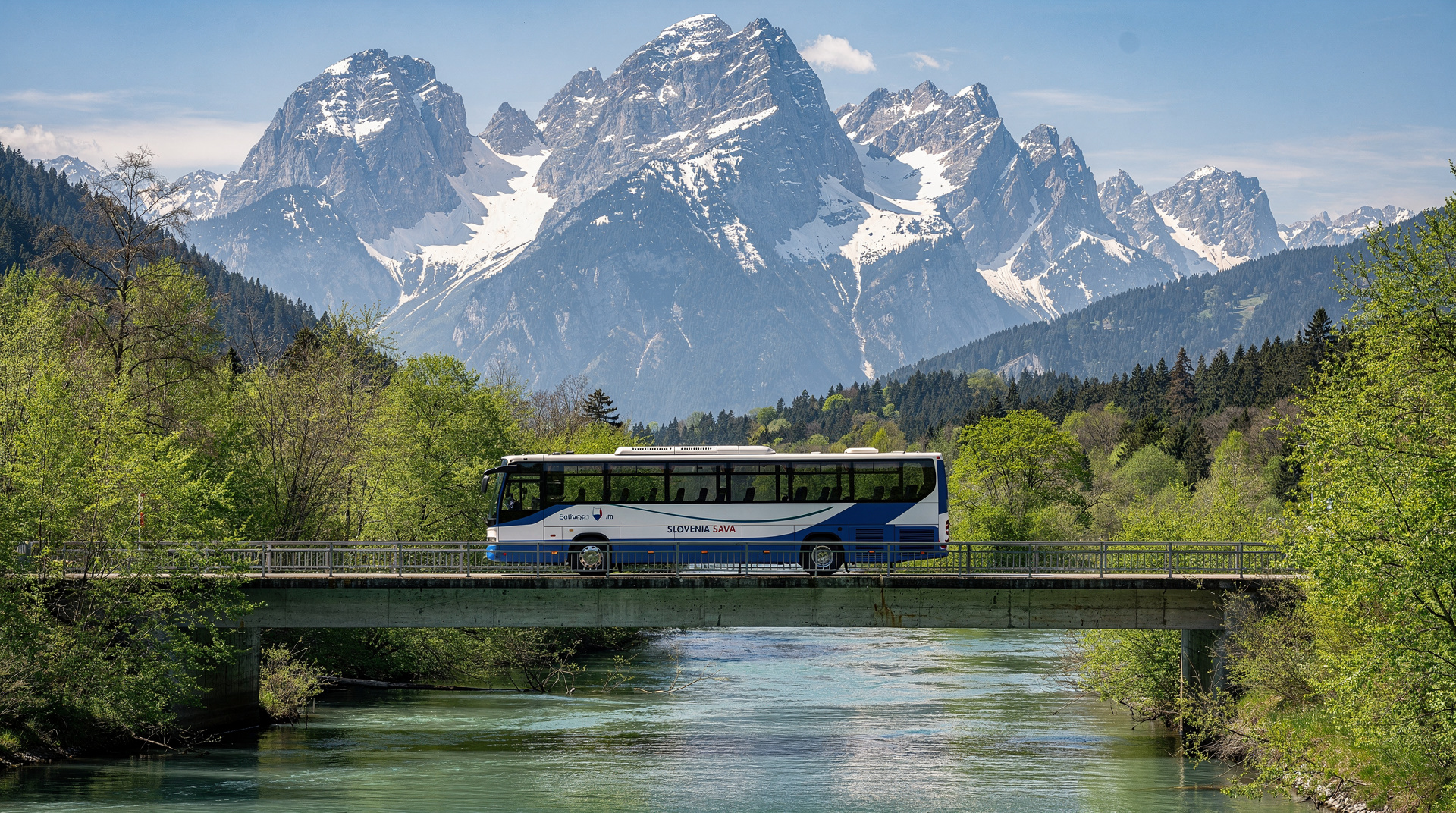
Three days is enough to taste Slovenia’s headline act: a compact, café-lined capital that punches well above its size, and a mountain lake so perfectly framed it almost feels theatrical. The good news for car-free travellers is that both are straightforward by public transport — Ljubljana’s central bus station sends buses to Bled every hour or two, and the 1-hour 15-minute ride costs around €8 each way.
This itinerary is designed for first-timers who want a genuine taste of Slovenia without the commitment of a week on the road. It pairs beautifully with a wider Balkans or Alpine trip: fly into Ljubljana Airport (€4 shuttle bus to the centre), spend three days here, then continue by bus or train to Zagreb, Vienna or Venice.
One honest caveat before you start: Lake Bled is one of the most photographed places in Europe, and in July and August the lakeside can feel like a theme-park queue by mid-morning. The itinerary below front-loads your Bled time to beat the crowds.
Slovenia itself is a country that routinely surprises first-time visitors. Most people arrive expecting a scaled-down version of Austria or a minor Central European capital and a pleasant lake — they leave having visited what they will later describe as one of the most naturally beautiful countries they have ever seen. The combination of Ljubljana’s walkable character, the Julian Alps rising directly north of the city, and the cultural mix of Italian, Austrian and Slavic traditions creates something genuinely distinctive.
For context: Ljubljana was the Roman city of Emona, founded in the first century AD. The medieval city grew over Roman foundations, was rebuilt after the 1895 earthquake in an elegant Art Nouveau style, and then redesigned in the 1920s–1950s by Jože Plečnik, a Viennese-trained architect who treated the entire city as a single design project. The result is a city with unusual visual coherence — and a very specific set of things to understand and look for that transform the experience from “pleasant” to “extraordinary”.
| Where | Ljubljana → Lake Bled → Ljubljana |
| Transport | Arriva bus, around €7.60–8 each way, 1 h 15 min |
| Best time | May–June, September–October for lighter crowds |
| Car needed | No — the whole trip is doable by bus |
| Biggest cost | Pletna boat to Bled Island (around €19–25) |
Day-by-day snapshot
| Day | Base | Focus |
|---|---|---|
| 1 | Ljubljana | Old town, castle, riverside evening |
| 2 | Bled | Island, pletna boat, Vintgar Gorge |
| 3 | Bled or Ljubljana | Alpine tour, Radovljica, or museums and food tour |
For a longer version of the same idea with an extra Ljubljana day built in, see the Ljubljana long weekend 4-day itinerary; to add the karst caves without renting a car, the Ljubljana and caves 4-day itinerary is the natural next step.
Day 1 — Ljubljana: old town, castle and the river
Arrive the night before if possible, or take the morning shuttle from the airport. Drop your bags at a hotel near the old town — Vander Urbani Resort (from €120/night) is directly on the river, while the Grand Hotel Union (from €110/night) on Miklošičeva street offers Art Nouveau grandeur at a reasonable price.
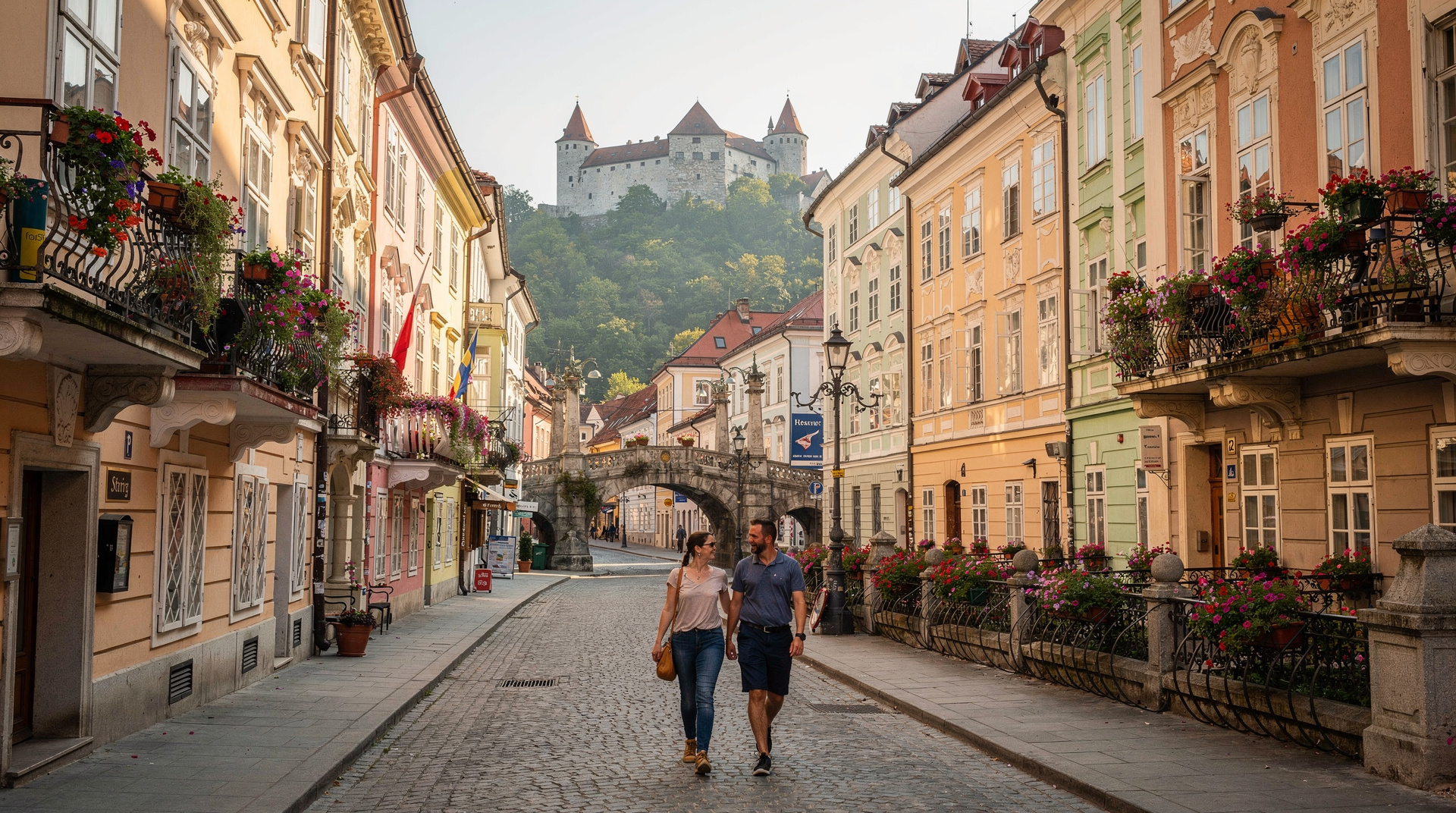
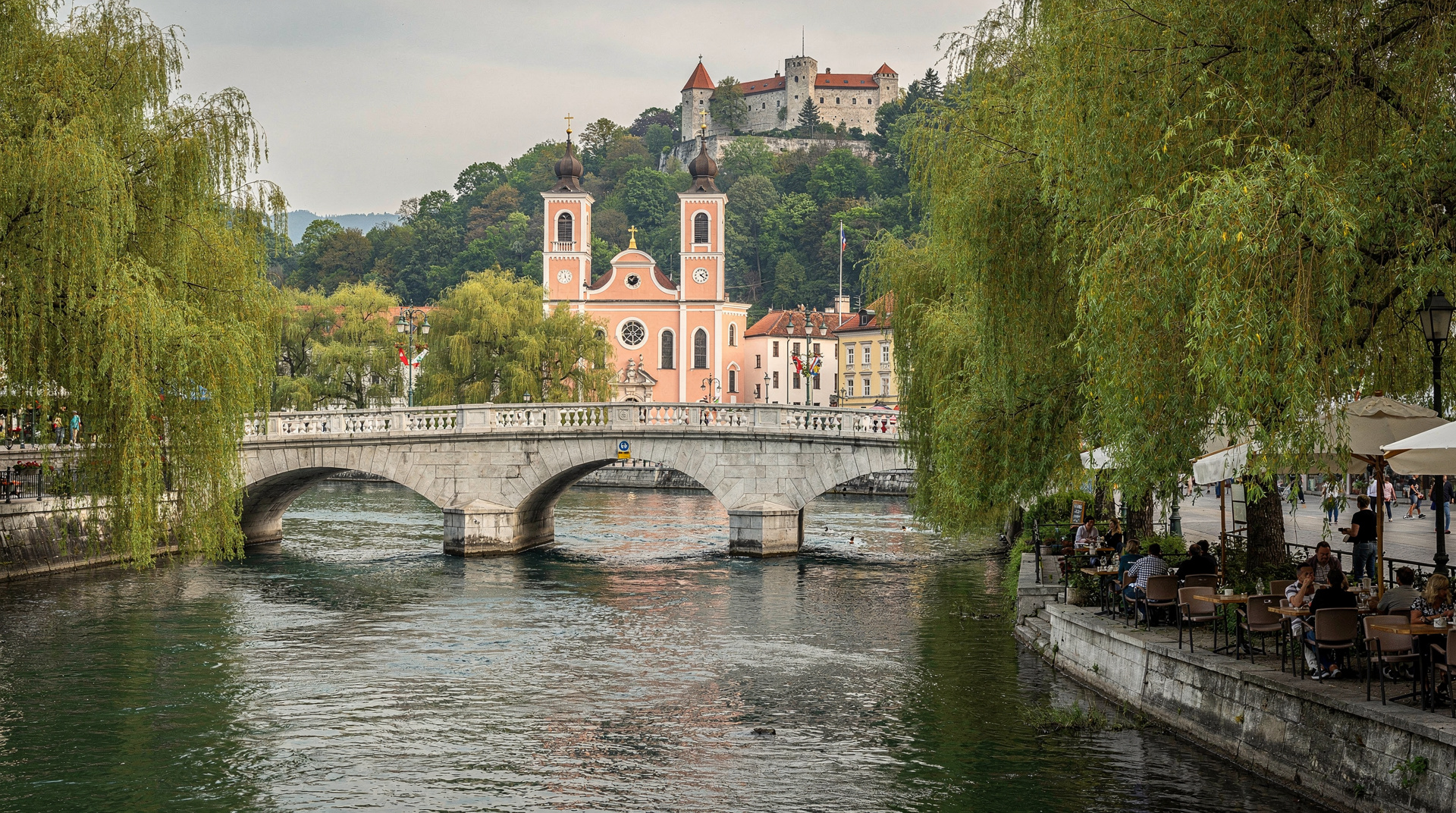
Spend the morning on foot in Ljubljana. Start at Prešeren Square, the city’s living room, where the pink Franciscan Church of the Annunciation frames one end and the Triple Bridge (Tromostovje) leads south across the Ljubljanica into the medieval old town. The three bridges are Plečnik’s signature — the central bridge dating from 1842, the two flanking pedestrian bridges added by Plečnik in 1932, creating a complex that turns a river crossing into an urban event.
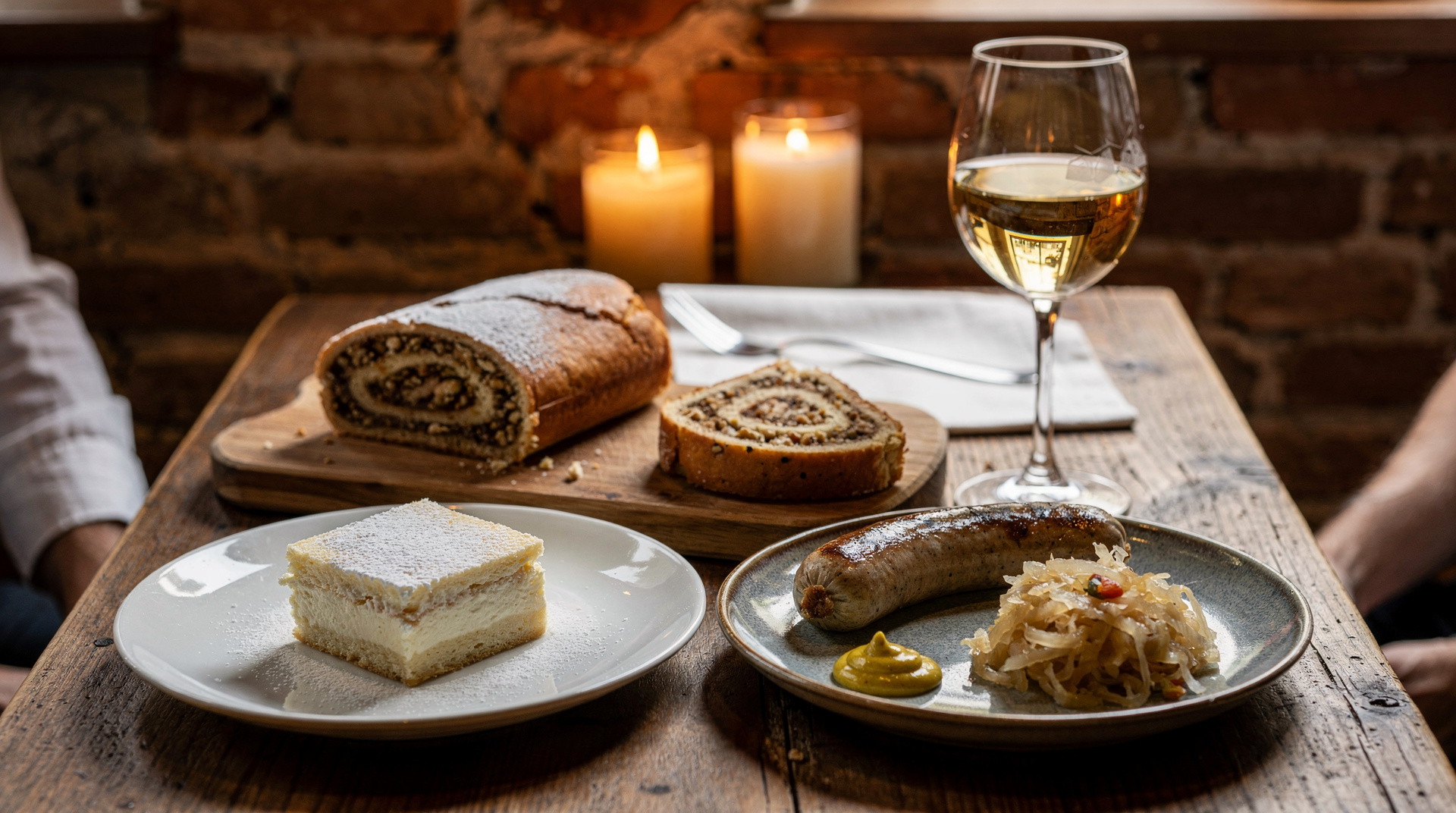
Walk south along the Ljubljanica riverside market — the open-air stalls run every day except Sunday and sell local honey (Slovenia has over 40 registered honey types), artisan cheese, charcuterie and seasonal produce. The covered market hall nearby (designed by Plečnik) sells prepared food from several good stalls. Grab a kremna rezina (vanilla-cream slice) from a bakery before heading up to Ljubljana Castle.
The castle funicular (€6 return) is quicker, but the 15-minute walk up through the old town via the castle lane is free and far more atmospheric. The cobbled path rises steeply through layers of medieval architecture — the oldest surviving section of Ljubljana’s urban fabric. The castle itself is mildly interesting (from €17.10 online for the castle ticket), but the panoramic terrace costs nothing extra and delivers the best view of the city. Honest assessment: if the castle fee makes you hesitate, skip it — the terrace walk and view are the real draw.
From the castle terrace, the Alps are visible on clear days — the snow-capped Julian Alps to the northwest, the Karavanke range to the north, and the lower Kamnik–Savinja Alps to the northeast. The Ljubljana Basin lies at 298 metres elevation and the mountains begin immediately beyond the city limits.
For lunch, aim for one of the gostilne (traditional inns) a few streets back from the main tourist strip. Gostilna Šestica on Slovenska cesta does a three-course set lunch for around €12 and has been open since 1776 — it survived the French occupation, the Habsburg era, two world wars and the Yugoslav period, and its beef goulash with buckwheat is essentially unchanged. After lunch, cross the Dragon Bridge (the Art Nouveau landmark built in 1901, beloved for its four corner dragon sculptures) and explore Metelkova — Ljubljana’s squat-turned-arts-complex, a converted Yugoslav army barracks now covered in murals and home to several small clubs and galleries — before heading back to Prešeren Square for the classic evening passeggiata.
Dinner on the old town terrace is atmospheric but overpriced. Instead, try Restavracija 2053 (contemporary Slovenian, locally sourced, €20–30 for a main) or Gostilna pri Škofu, both around a 10-minute walk from the centre, for honest Slovenian cooking at €15–20 for a main.
Book a private old-town walking tour with a Ljubljana-born guide — the context on Jože Plečnik’s architectural legacy transforms what looks like a medium-sized European city into something far more interesting. Guides point out the deliberate references to ancient Athens in the market design, the hidden geometry of the Triple Bridge, and the political constraints that shaped every public commission Plečnik received.
Day 2 — Lake Bled: the island, the castle, the gorge
Take the 8:00 or 8:30 bus from Ljubljana’s central station to Bled (from €7.60, 1 h 15 min). The route climbs northwest through the Sava gorge and arrives at the lake from the east, giving a first glimpse of the water as the bus descends into the Bled basin. Arrive early — Bled village has roughly 1,800 residents and receives several million visitors a year. The lakeside path is genuinely peaceful before 9:30; by 11:00 it is a parade.
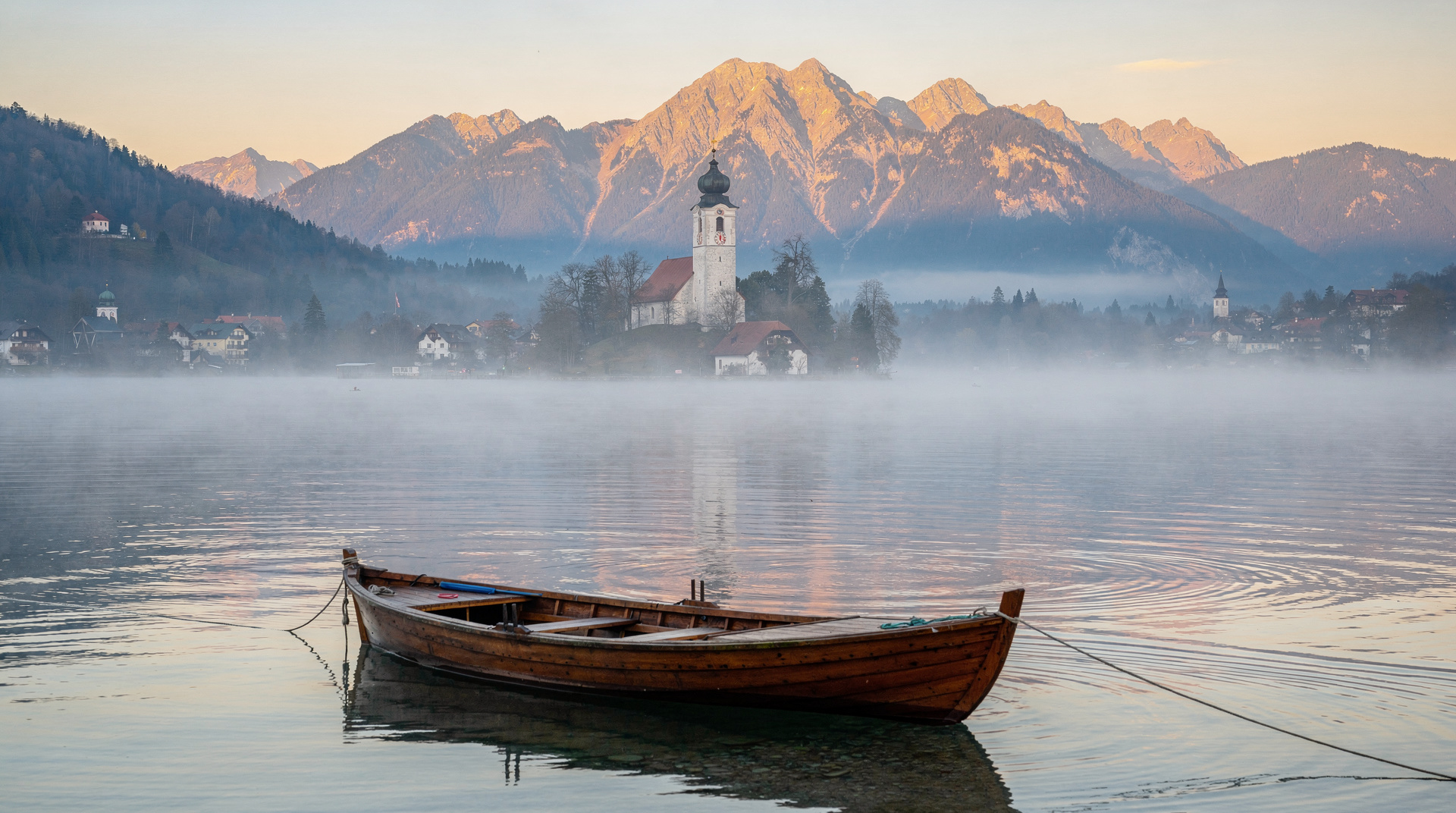
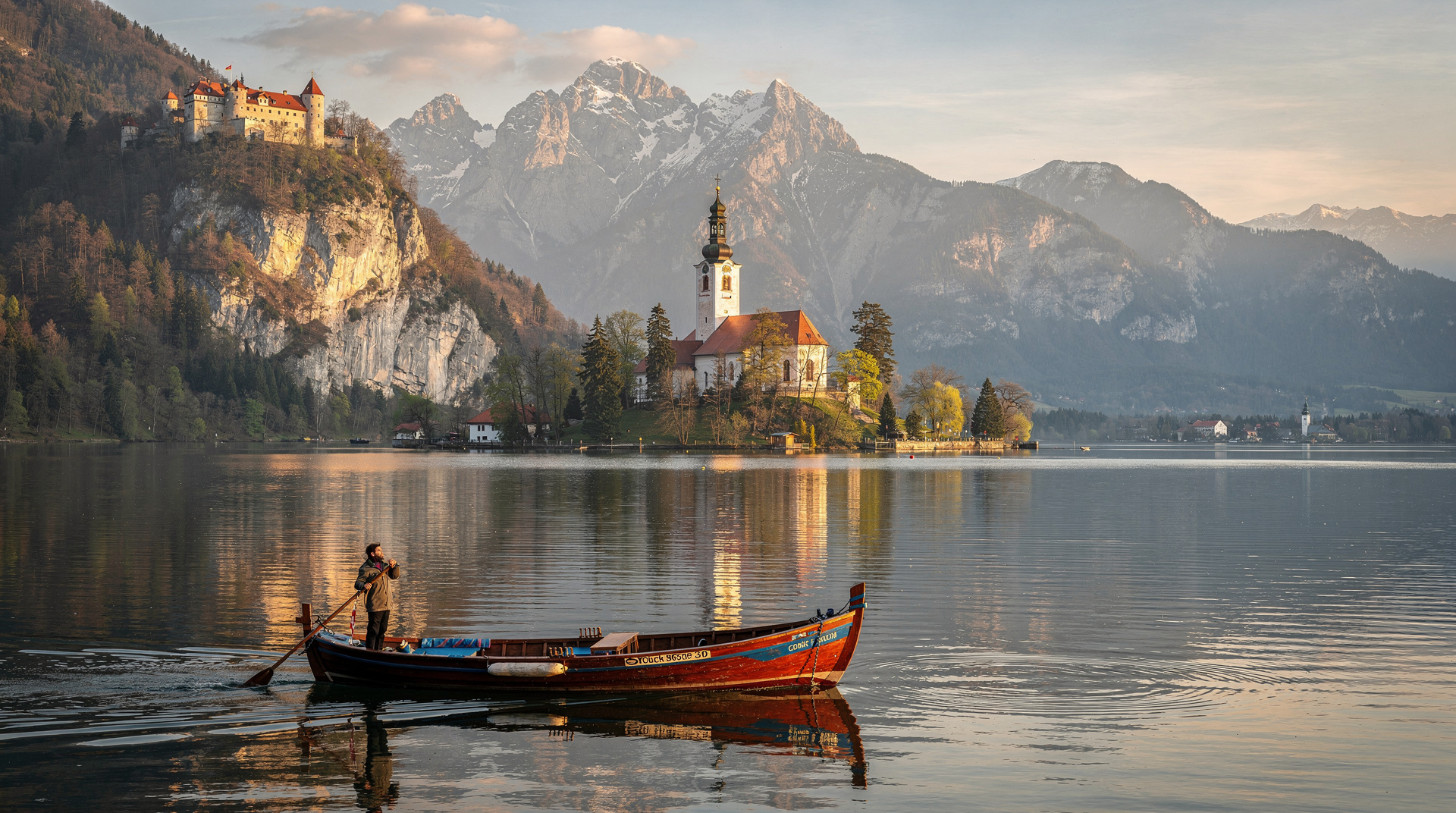
Walk the full 6 km lakeside circuit before doing anything else. The route is mostly flat, well-surfaced and takes about 90 minutes at a leisurely pace. The view from the north shore — with the island church framed by the 100-metre castle cliff and the snow-capped Karavanke range — is the one on every postcard, and it costs absolutely nothing. From the north shore, continue west to the Ojstrica viewpoint above the south shore (a 20-minute uphill walk that repays the effort with the best elevated view of the lake and island). The Mala Osojnica viewpoint just above offers an even more dramatic angle — 40 minutes up a steep forest path, free, and worth it.
Rent a rowing boat (€20/hour from the Camping Bled shore) if you want to reach the island under your own steam, or take the traditional pletna boat for the full historical experience.
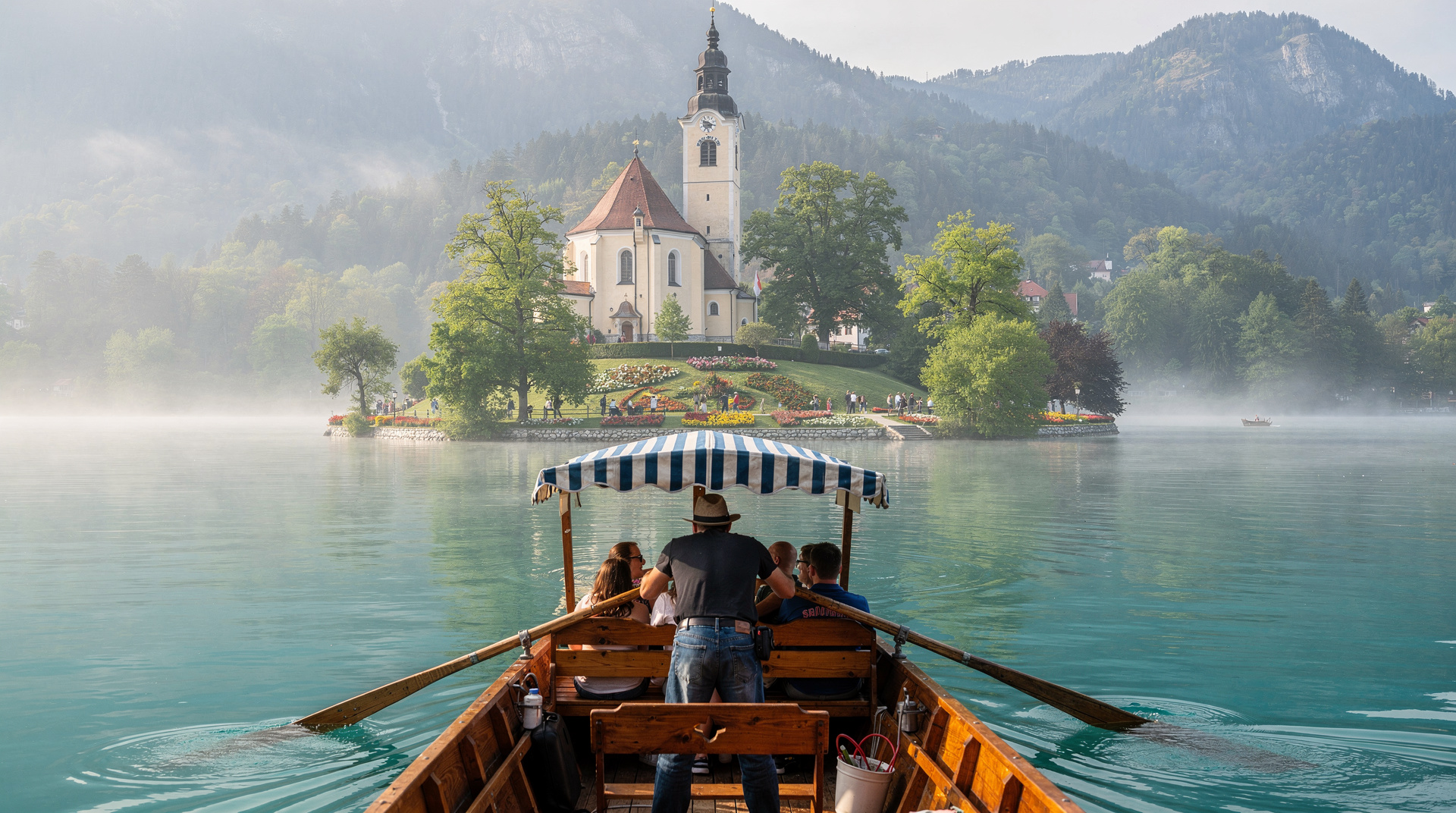
The pletna ride to Bled Island with a guide and Bled cream cake costs around €19–25 and includes a local guide who explains the 99 steps up to the church — worth the money for the stories rather than the transport. The pletna boat itself is a remarkable piece of cultural heritage: flat-bottomed wooden boats rowed standing up by boatmen from hereditary families who have held the concession since at least 1590. The island Church of the Assumption has a bell that visitors ring and are said to have their wishes granted.
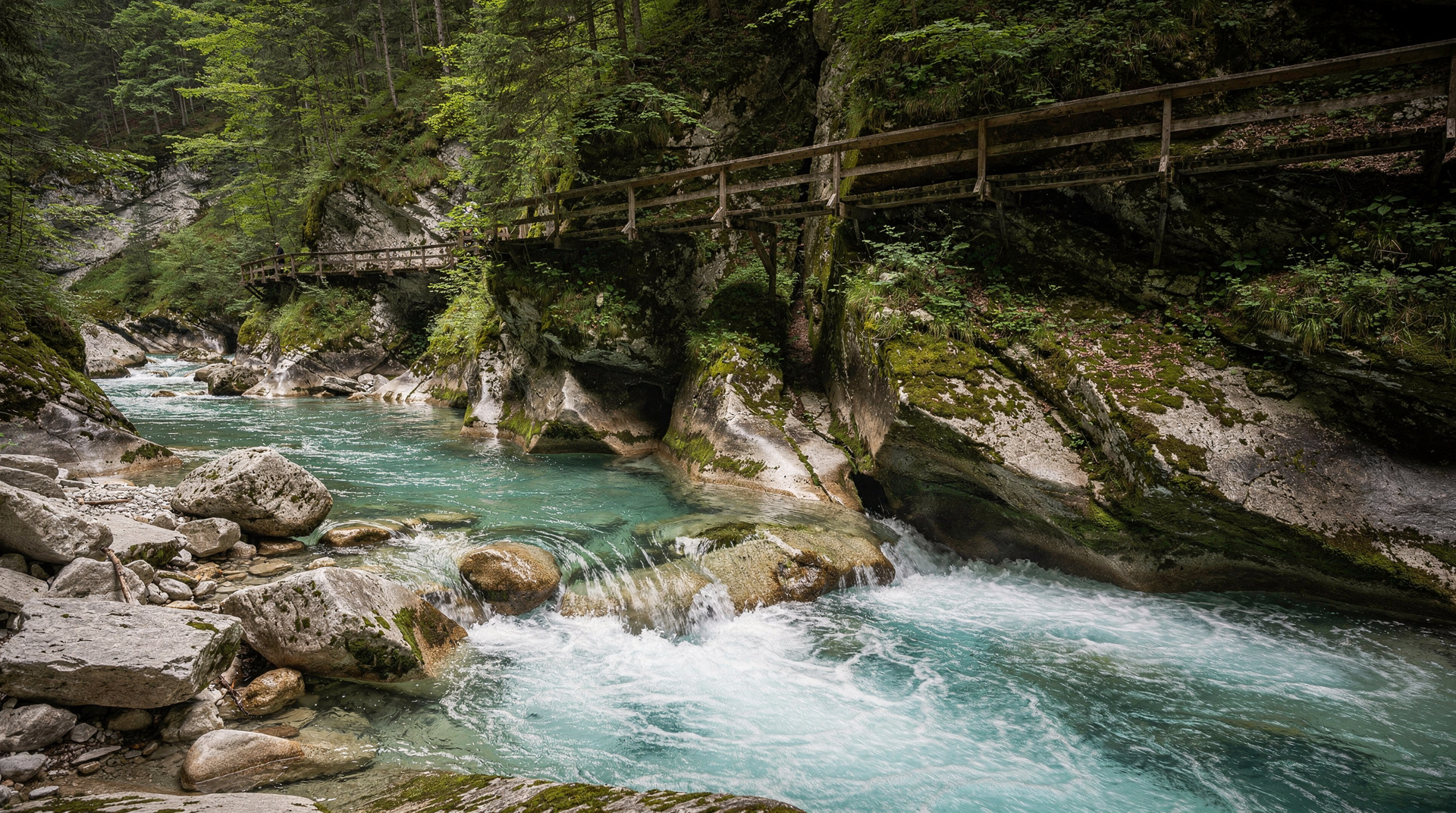
After the island, walk or take a short taxi to Vintgar Gorge (roughly 4 km from Bled centre, or free shuttle bus in season from the Bled bus station). Entry is €15; the boardwalk above the rushing Radovna River takes about 45–60 minutes to walk at a steady pace. The gorge is 1.6 km of carved limestone walls with pools of extraordinary clarity below, cascades, and at the end a 16-metre waterfall. Note: Vintgar closes for the winter (the 2026 season opens in April) — check vintgar.si before heading over. The gorge can also be busy in peak summer from around 10:00; arriving before 9:00 means a near-private experience.
For lunch, the most rewarding option near Bled is the Gostilna Lectar in Radovljica (a 15-minute bus ride or 10-minute drive). This medieval-themed inn in the middle of Radovljica’s beautifully preserved old town serves local honey-based dishes, venison stew and local trout. Back in Bled, the cake café Slaščičarna Šmon on the main square is the right place to try a kremšnita (the Bled version of vanilla cream cake, €3–4) — Bled residents take this cream cake extremely seriously and rate Šmon above all other bakeries.
Spend the late afternoon at Lake Bled — the light on the water in the late afternoon is far better than midday for photos and for swimming. The water temperature in July–August reaches 22–24°C. There is a small free beach at the western end near Camping Bled (gravel, natural, slightly wild) and a larger lido (€8 entry) with lifeguards and changing facilities.
Bled Castle at dusk is worth a visit if you are staying the night — the cliff-top fortress built in the 11th century is floodlit after dark and the walk down through the medieval lanes is atmospheric. Return to Ljubljana by bus in the evening (last service around 20:00 — check the Arriva website), or stay the night in Bled at Penzion Mayer (from €100, family-run, garden) or the Rikli Balance Hotel (from €160, lake-facing rooms).
Day 3 — Bled surroundings or Ljubljana food and culture
Option A (if based in Bled): Take a half-day guided tour into Triglav National Park or join a morning circuit of the gorge and surrounding alpine villages before catching a midday bus back to Ljubljana for the return flight.
The Alpine fairytale day tour from Bled covers the gorge, the Pokljuka plateau at 1,300 m and Triglav viewpoints in one loop — a worthwhile way to pack the morning before departure. The tour typically ends at noon, leaving time for the afternoon bus back to Ljubljana.
If you have the morning free in Bled without a tour: the walk to the Mala Osojnica viewpoint (40 minutes up, 20 minutes down, free) remains the single best thing you can do with a spare morning. The elevated view over the entire lake, with the island below and the Karavanke ridge behind, is the image that makes Bled famous — and you can have it almost entirely to yourself before 9:00. Take it as the final image of the trip.
The town of Radovljica (15 minutes by bus from Bled) is worth an hour on any morning. The medieval town square (Linhartov trg) is one of the most beautifully preserved in Slovenia — 16th-century burgher houses, the apiculture museum (devoted entirely to Slovenian beekeeping history, €5 entry) and Gostilna Lectar for a coffee or a full lunch.
Option B (if based in Ljubljana): Use the morning for what you missed on day one. Ljubljana’s National Museum of Slovenia on Muzejska ulica (€8 entry, closed Mondays) has a well-curated permanent collection covering prehistoric Slovenia — including the famous Vače situla, a decorated bronze bucket from the 6th century BC that is essentially the emblem of pre-Roman Slovenian culture — through Roman Emona and into the medieval period. The Roman section includes fragments of the original city wall, floor mosaics and everyday objects recovered from the excavations under the modern city.
The Modern Gallery on Cankarjeva ulica (€6 entry) is worth an hour for Slovenian 20th-century art. The permanent collection spans from early-20th-century Impressionism through socialist realism to contemporary installation art, and the building itself is a late Habsburg-era palace that gives the works an interesting architectural context.
The best food experience in Ljubljana is not a single restaurant but a guided tasting tour through the covered market and back streets.
The Ljubljana food tour with 10 authentic local tastings runs 3 hours and costs around €65 — you will try local charcuterie (air-dried Kraški prsut from the Karst plateau), multiple honey varieties, local wine, aged cheese, štruklji (rolled dumplings stuffed with walnut or cheese), and the kremna rezina. The guide provides context on Slovenian food culture that makes every subsequent meal on the trip more interesting.
Afternoon: the Metelkova arts district is worth a second look in full daylight — the murals and the individual buildings each have a story. Alternatively, grab a Bicikelj public bike (€1/hour from any of the 36 docking stations across the city) and cycle south along the Ljubljanica towpath to the Trnovo district — the student neighbourhood that functions as the city’s second living room. Plečnik’s Trnovo Bridge over the Gradaščica Canal is one of his finest small works. Coffee at Kavarna Rog on the river terrace, then the airport shuttle from the central station.
Practical notes
Getting there: Ljubljana Airport (LJU) is 27 km from the city. The Goopti/Markun shuttle bus costs around €4 and runs to the central bus station, stopping at several points in the city centre. Buses run approximately every 60 minutes; the journey is 50–55 minutes. Private transfers are around €35–45. The airport is compact — passport control and luggage are quick.
Transport between Ljubljana and Bled: Flixbus and local Arriva buses run every 1–2 hours from around €7.60 one way. Journey time is 1 h 10 min–1 h 30 min depending on route. The bus timetable is on the Arriva website (arriva.si/en/bus-station-Ljubljana). No need to book far in advance except in peak summer weekends. Buy tickets from the driver or from the ticket window at the central station.
Getting around Bled: The village centre, the lakeside path and the pletna boarding points are all within walking distance. The free shuttle to Vintgar Gorge runs from the Bled Bus Station in season (check bled.si for times). Taxis are available from the main square.
Where to stay: In Ljubljana, Hostel Celica (a converted Austro-Hungarian prison in Metelkova, dorms from €30, private rooms from €80) is the cult choice — each cell has been designed by a different artist. Hotel Cubo (from €130, excellent design hotel near the old town) is the best mid-range option. For the special-occasion budget, Vander Urbani Resort (from €120–180, directly on the Ljubljanica) is perfectly positioned. In Bled, Penzion Mayer (from €100) is family-run with a garden and genuine hospitality, or the Rikli Balance Hotel (from €160) has direct lake access and is reliably comfortable.
Budget guide: Allow €100–150/person/day for mid-range comfort covering accommodation, food and one paid activity per day. Entry fees for the pletna boat, Vintgar Gorge and Ljubljana Castle funicular add roughly €60–70 over the trip for two people. The food tour at €65/person is the single largest discretionary expense and is worth it.
Best time: May–June and September–October offer the most balanced combination of weather, daylight and manageable crowds. Summer (July–August) is hot and scenic but busy — arrive at Bled by 8:30 to beat the first wave of day-tripper coaches (which typically arrive from 9:30 onwards). Avoid Bled on the weekend of the Bled Days festival (usually late July) unless you actively want the crowds and the fireworks.
Packing for three days: You need very little. Comfortable walking shoes for both destinations, one layer for the castle climb in the evening, and a jacket for the Bled morning. The bus and the old town are both temperate. Swimming kit if visiting May–September. A small daypack for the Vintgar Gorge walk (water, waterproofs for the spray).
Honest tips:
- The island church bell is said to grant wishes to those who ring it. However, the climb involves 99 stone steps with a steep section near the top, the church interior is very small, and on busy August days you will be queuing to ring a bell with 200 other tourists while the boat waits. Manage expectations — the charm is in the pletna ride and the guide’s stories, not the church itself.
- The Bled Castle interior (€19 entry) is moderately interesting — a small museum on medieval life and printing, and a panoramic view. The terrace view is included. Worth the money for dedicated history visitors; skip it if pressed for time.
- Ljubljana’s most Instagrammed café (directly on the Triple Bridge) charges 30% more than the identical coffee 100 metres away. Move two streets back from the main tourist axis and prices are consistently better.
- Triglav National Park is visible from both Ljubljana and Bled and can be explored more deeply if the three-day itinerary expands to five — see the Julian Alps 7-day itinerary for a full Alpine loop.
Extending beyond three days
If the trip stretches to five or six days, the most natural additions in either direction are Lake Bohinj (30 minutes past Bled, quieter and better for swimming) or Postojna Cave and Škocjan Caves south of Ljubljana. Both extensions keep the same car-free logic — organised day trips or buses reach all of them without a rental — and both are covered in more detail by the Ljubljana and caves 4-day itinerary if the karst becomes the priority over a second Alpine lake.
What three days without a car actually feels like
Solo travellers and first-time visitors to the Balkans region often ask whether Slovenia requires a rental car at all, and this itinerary is the clearest possible answer: no. Every leg — the airport shuttle, the Ljubljana old town, the Bled bus, the lakeside path, the pletna boat and the gorge — is designed around public transport and walking, and none of it feels compromised for the lack of a car.
Travellers used to renting a car by default in Europe are often surprised how little it is missed on this specific route. Ljubljana’s old town is pedestrianised and best on foot regardless of whether you drove there, and the Bled bus deposits you close enough to the lakeside path that a car would mostly sit in a car park all day. The one place a car genuinely helps is reaching Vintgar Gorge quickly on a tight schedule — without one, budget an extra 30–40 minutes each way for the walk from Bled village, or use the seasonal shuttle bus if it is running. For everything else on this three-day loop, public transport is not a compromise; it is arguably the more relaxing choice.
Should you compare Bled with Bohinj first?
First-timers on a strict three-day budget often ask whether they are seeing “the right lake.” The honest answer: Bled is the correct choice for a first, short visit — it has the island, the castle-on-a-cliff view and the easiest transport connection of any Slovenian lake. Lake Bohinj, 30 minutes further west, is quieter and arguably more beautiful for swimming, but it adds a bus change and a half-day you don’t have on this itinerary. The Bled vs Bohinj guide breaks down the trade-off in full if a future trip has room for both; for now, Bled is the right call on three days.
Connectivity and money for a car-free three days
Cards are accepted everywhere on this route — hotels, restaurants, the pletna boat operators and Vintgar Gorge’s ticket booth all take contactless payment. Carry perhaps €30–40 in cash for the bus driver (tickets can be bought on board, though the ticket window is more reliable in peak season) and for smaller market stalls in Ljubljana. EU roaming or a local eSIM both work fine for checking bus times on the Arriva app, which is worth installing before you land since schedules shift seasonally. The getting around Slovenia guide has the fuller public transport picture if this three-day trip is your springboard into a longer, car-free Slovenia trip.
Top experiences
Bookable activities with verified prices and instant confirmation on GetYourGuide.