Postojna Cave day trip from Ljubljana: what to expect and how to plan
From Ljubljana: Postojna Cave day trip
How long is the Postojna Cave tour and how far is it from Ljubljana?
Postojna Cave is 55 km from Ljubljana — about 50 minutes by car on the A1 motorway. The guided tour inside the cave takes approximately 1.5 to 2 hours, including an underground train ride of 3.7 km. Combined with Predjama Castle (9 km away, about 1.5 hours to visit), you need a full day. Allow 5–6 hours on the ground plus travel time.
Visiting Postojna Cave from Ljubljana: a practical guide
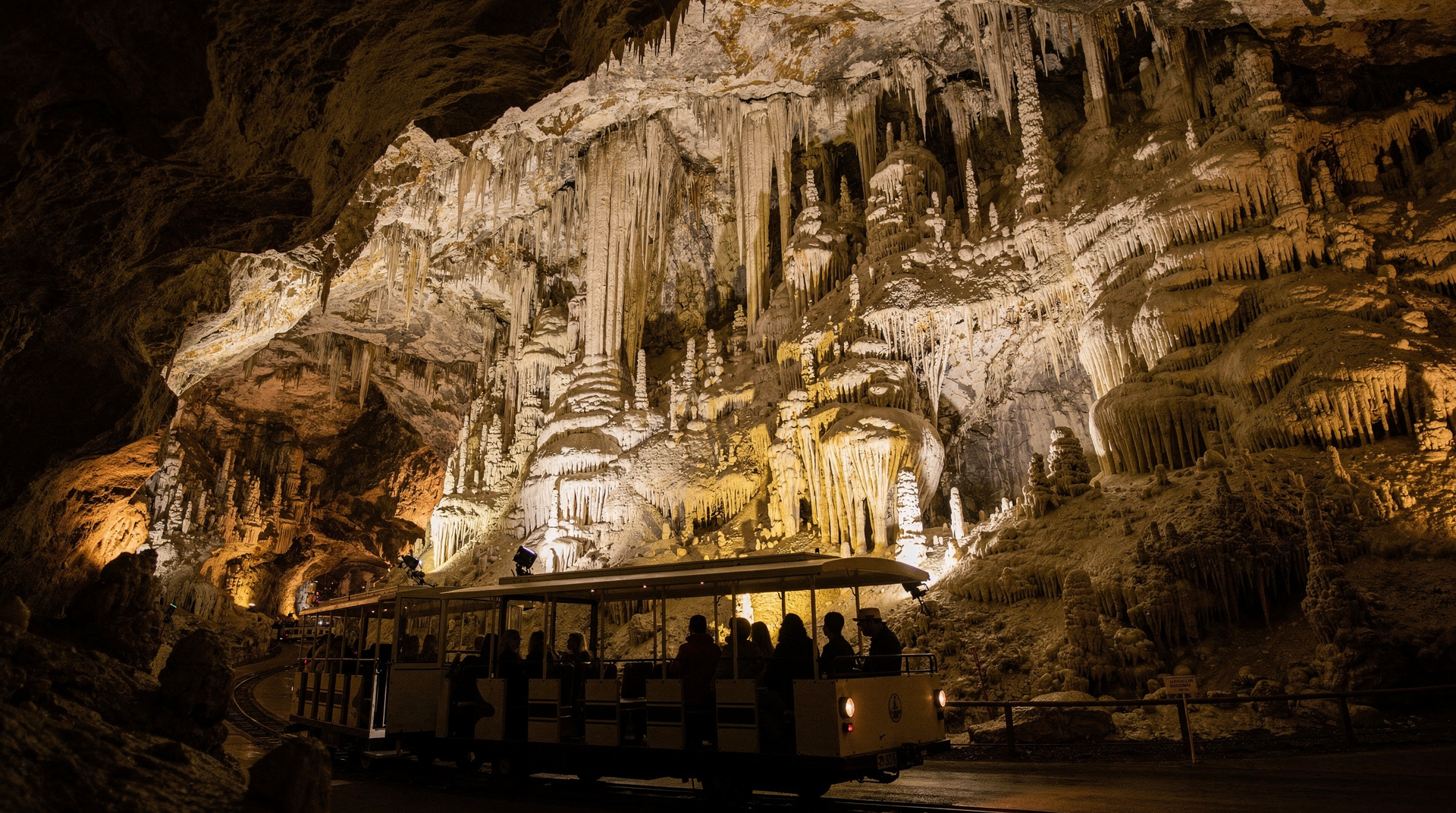
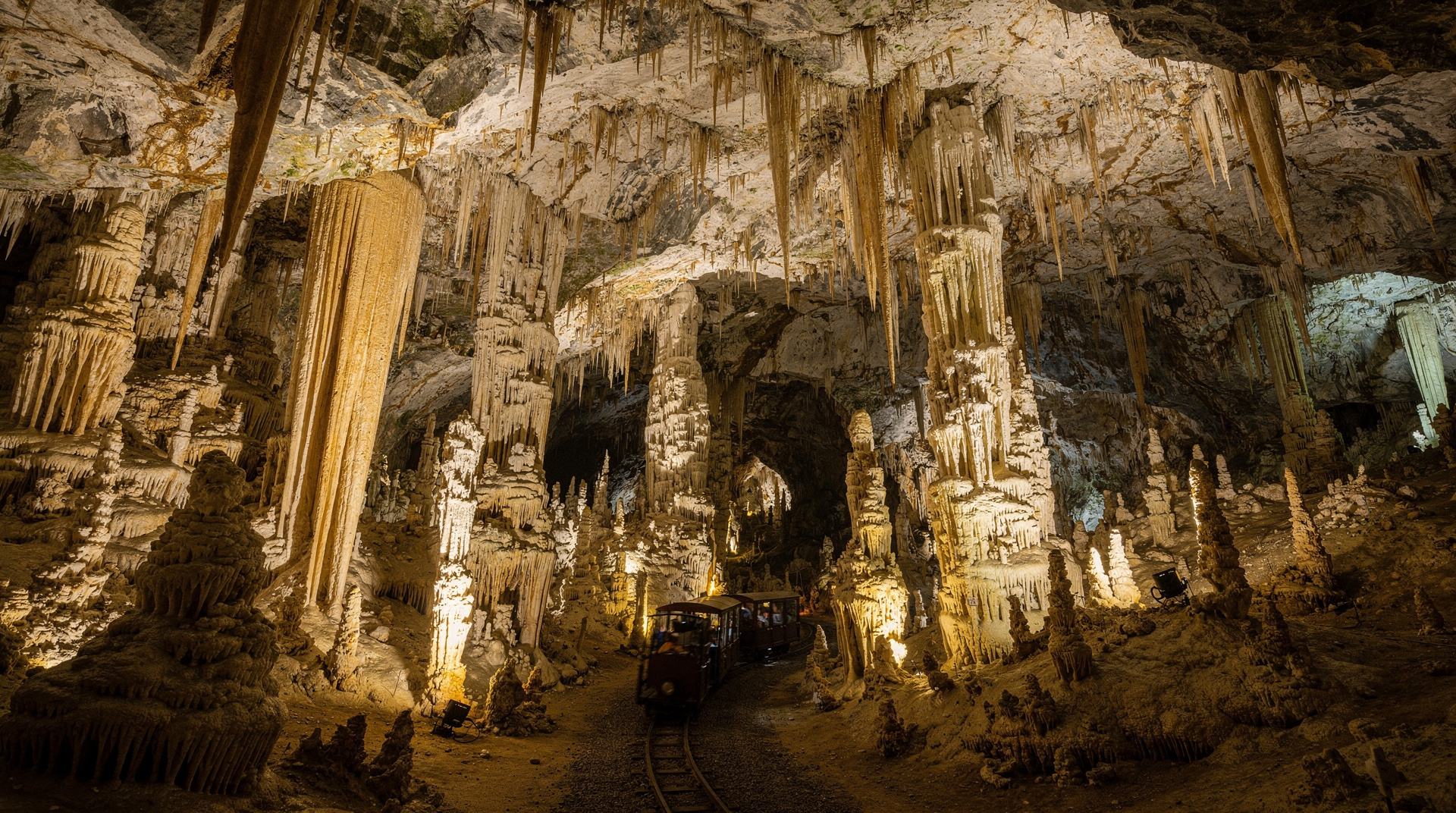
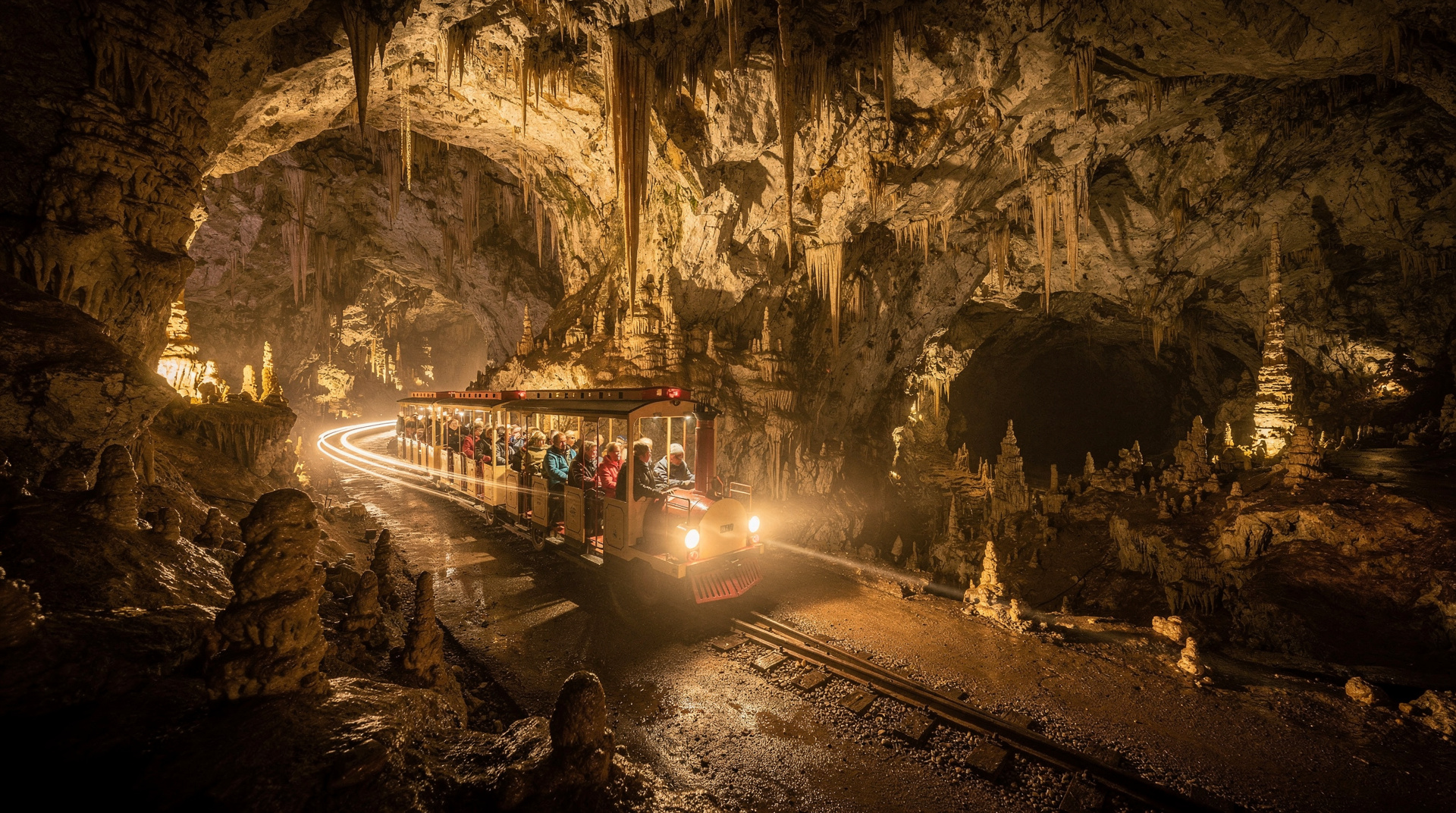
Postojna Cave is Slovenia’s most-visited attraction, and with good reason. At 24 km of mapped passages, it is one of the longest cave systems in Europe. The guided tour covers about 5.5 km total — beginning with a small underground train that carries you 2 km into the mountain, followed by a 1.7 km guided walk through some of the most spectacular karst formations on the continent.
The cave is 55 km from Ljubljana on the A1 motorway. The drive takes about 50 minutes. A day trip here can be entirely independent, or you can book a guided tour from the capital that handles all the logistics.
| Where | Postojna Cave, 55 km south of Ljubljana |
| Cost | EUR 34.90 cave only, EUR 49.90 combined with Predjama Castle |
| Time needed | 5–6 hours on the ground; full day with Predjama |
| Getting there | A1 motorway (~50 min by car) or Arriva bus (~1h, ~EUR 5) |
| Best time | First tour of the day (09:00–10:00), any season |
Getting from Ljubljana to Postojna Cave
By car: Take the A1 motorway south from Ljubljana towards Koper and exit at Postojna. Follow signs to Postojna jama (cave). The drive takes 45–55 minutes depending on Ljubljana traffic. Parking at the cave complex is free and large.
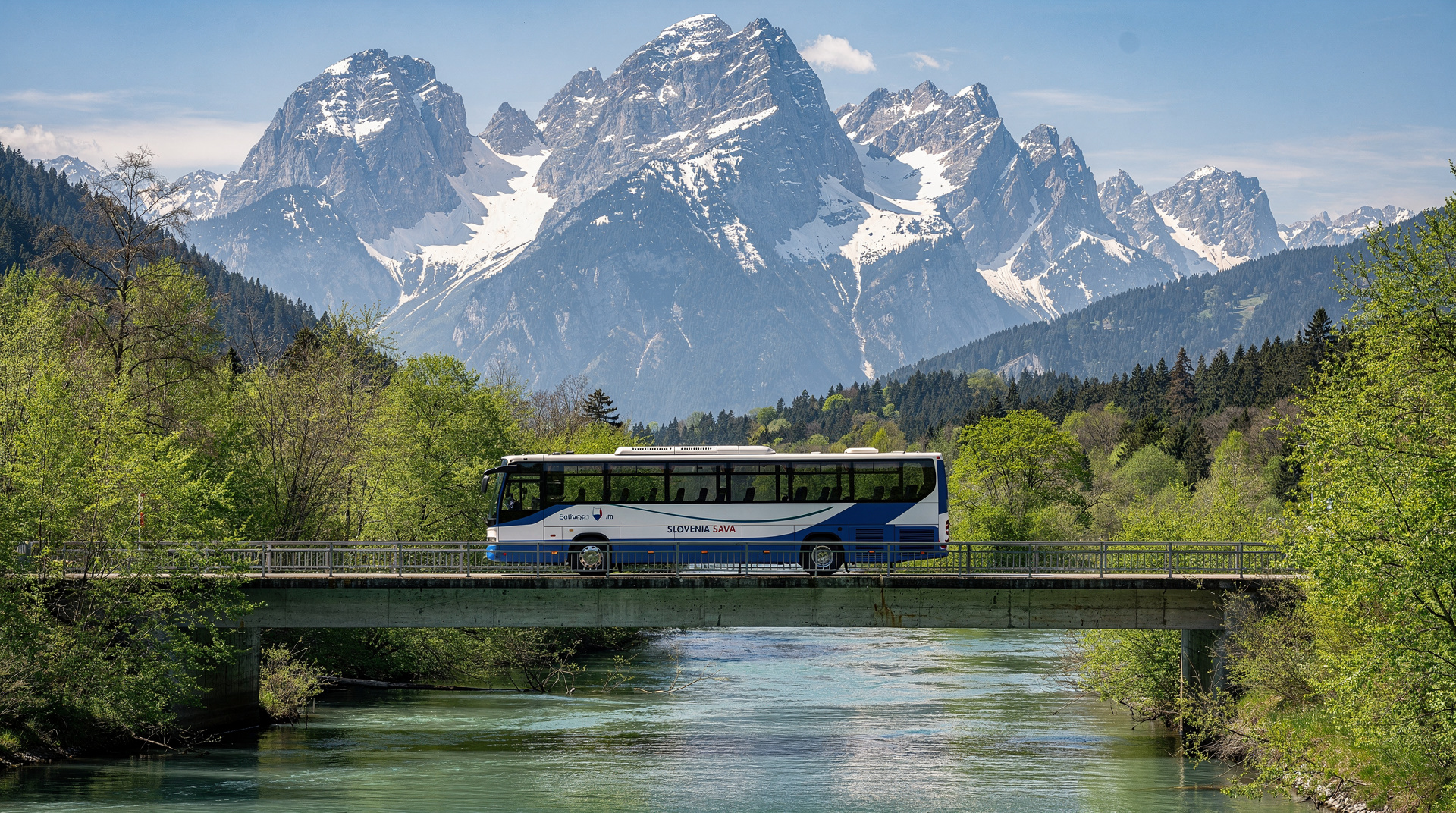
By bus: Arriva buses from Ljubljana Bus Station run to Postojna town several times a day; the journey takes about 1 hour and costs approximately EUR 5 each way. From Postojna bus station, the cave entrance is 1.5 km — a flat 20-minute walk or a short taxi ride.
By guided tour: Guided day trips pick you up from central Ljubljana, include admission and often combine the cave with Predjama Castle. This is the easiest option for travellers without a car who also want to visit Predjama.
Guided day trip to Postojna Cave from LjubljanaWhat to expect inside the cave
Tours run every hour on the hour from roughly 10:00 to 17:00 in peak season, with fewer departures in winter. Arrive 15–20 minutes before your booked tour time.
The experience begins at the cave mouth, where temperature drops immediately to 10°C — bring a light jacket. A small train carries groups 2 km into the mountain through a tunnel blasted in the 19th century; this section alone passes through cavern after cavern, with stalactites rushing past at speed.
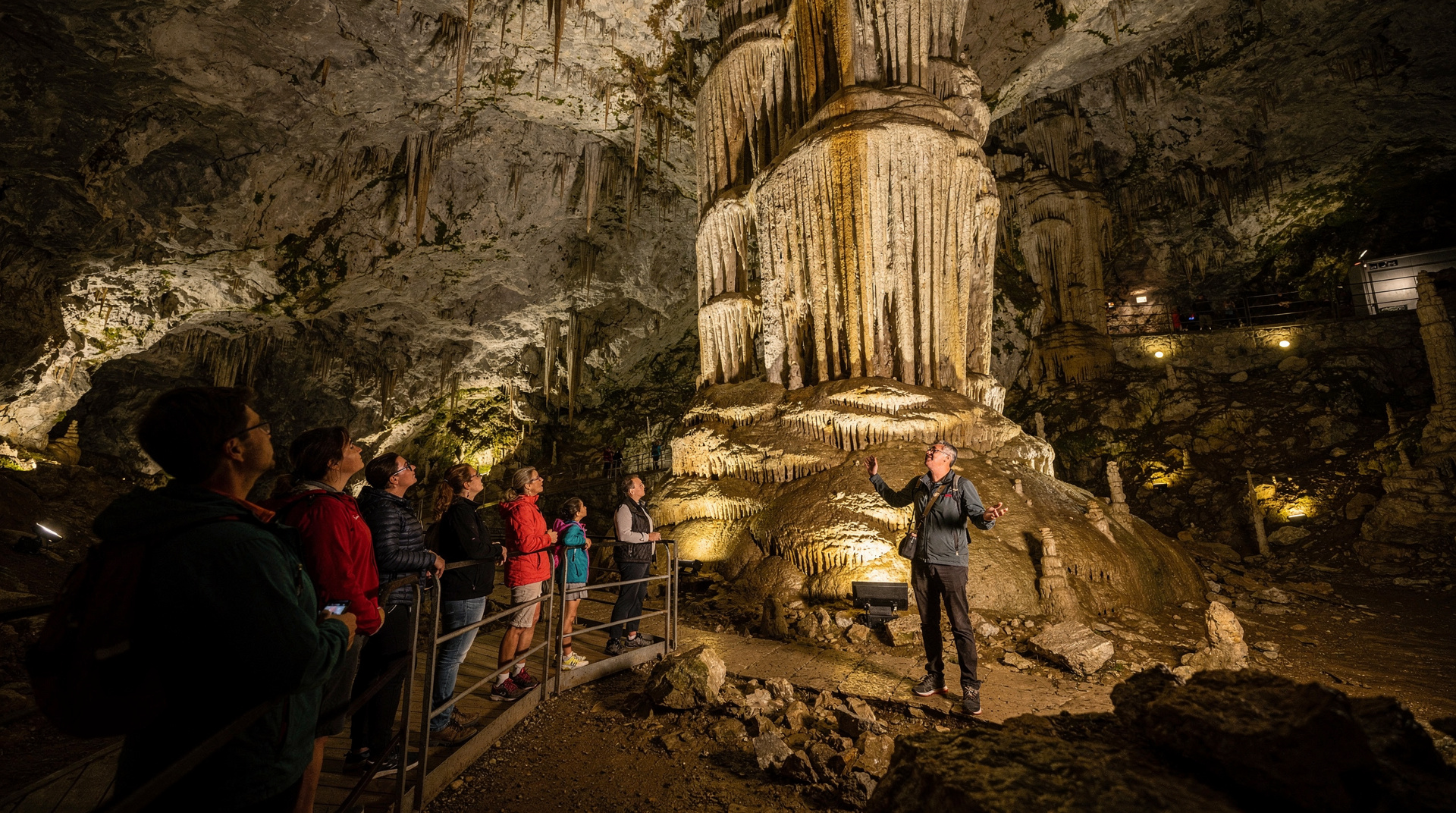
The guided walk covers 1.7 km through five main sections:
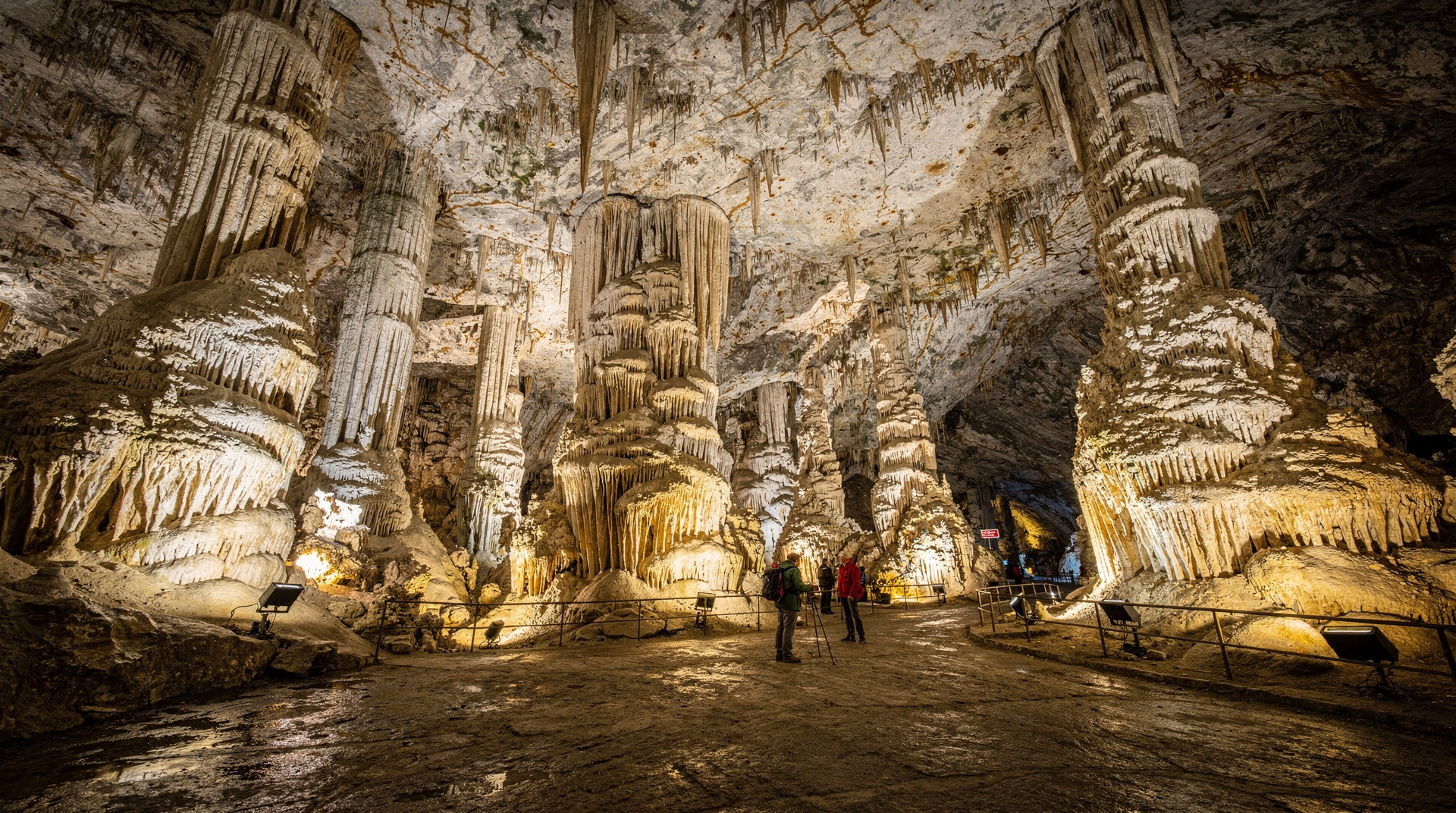
- The Beautiful Caves — the most densely decorated section, with thousands of stalactites, stalagmites and cave pearls
- The Concert Hall — an enormous chamber used for actual concerts; its acoustics are remarkable
- The Spaghetti Gallery — thin, delicate stalactites like pasta hanging from the ceiling
- The White Passage — brilliant white calcite formations in extraordinary density
- The olm vivarium — the resident Proteus anguinus, the “human fish”, a pale cave salamander that lives entirely in underground water. It can survive without food for years and lives for up to a century.
Honest assessment of crowds: Postojna handles up to 5,000 visitors per day in peak season. Groups of 50+ move through together with a guide and a headset. The experience is well-organised but not intimate. If you prefer a smaller, more atmospheric cave visit, Škocjan Caves or Križna Jama (a cave with no tourist infrastructure, guided visits with a boat ride, booking recommended) offer a completely different experience.
Predjama Castle: the essential add-on
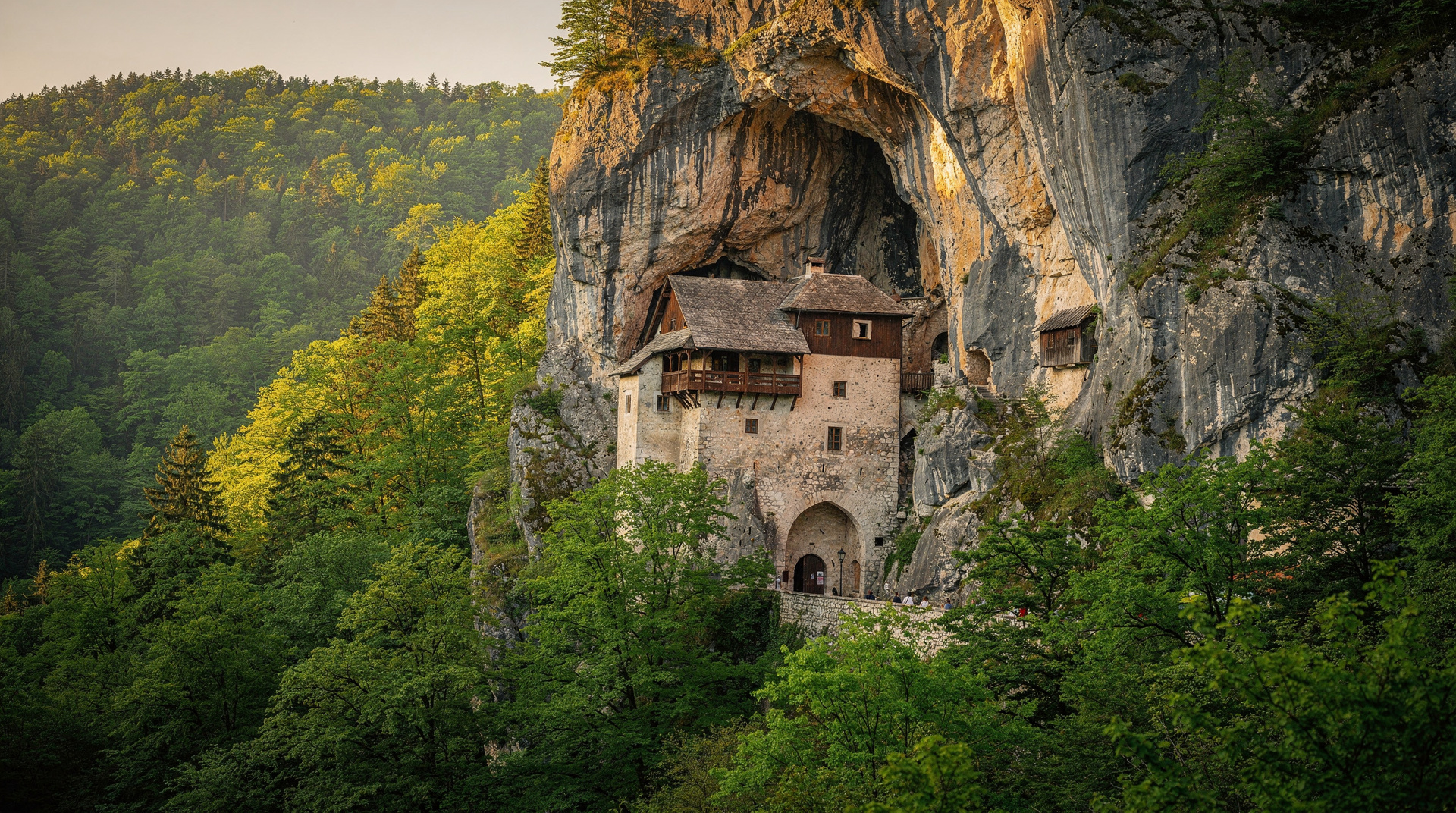
Predjama Castle is 9 km from Postojna Cave and is, frankly, extraordinary. Built directly into the mouth of a cave in a vertical cliff, it is one of the most dramatic castle locations in Europe. The castle was home to the outlaw knight Erazem of Predjama in the 15th century — his siege story, including how he was supplied through a secret cave passage for over a year, is genuinely compelling.
The interior tour (included in admission) takes about 1.5 hours and covers the history of the castle through multiple floors, with views across the valley from the battlements. The cave behind the castle can be visited separately in summer — an additional EUR 7 for 45 minutes of low-lit passages.
Guided tour: Postojna Cave and Predjama Castle from LjubljanaCombined admission (cave + castle): EUR 49.90 adults (promotional price). For child prices, see the up-to-date rates on the official website, postojnska-jama.eu. This saves around EUR 9 compared with buying separately.
Itinerary for the day
Full day from Ljubljana (car):
- 08:30 — Depart Ljubljana
- 09:30 — Arrive Postojna Cave, explore the visitor complex, buy tickets
- 10:00 — Cave tour begins (1.5–2 hours)
- 12:00 — Lunch at the cave complex restaurant (basic but serviceable) or pack your own
- 13:30 — Drive to Predjama Castle (15 min)
- 14:00 — Castle tour (1.5 hours)
- 15:30 — Optional: Predjama cave (45 min, summer only)
- 17:00 — Return drive to Ljubljana (arrive ~17:50)
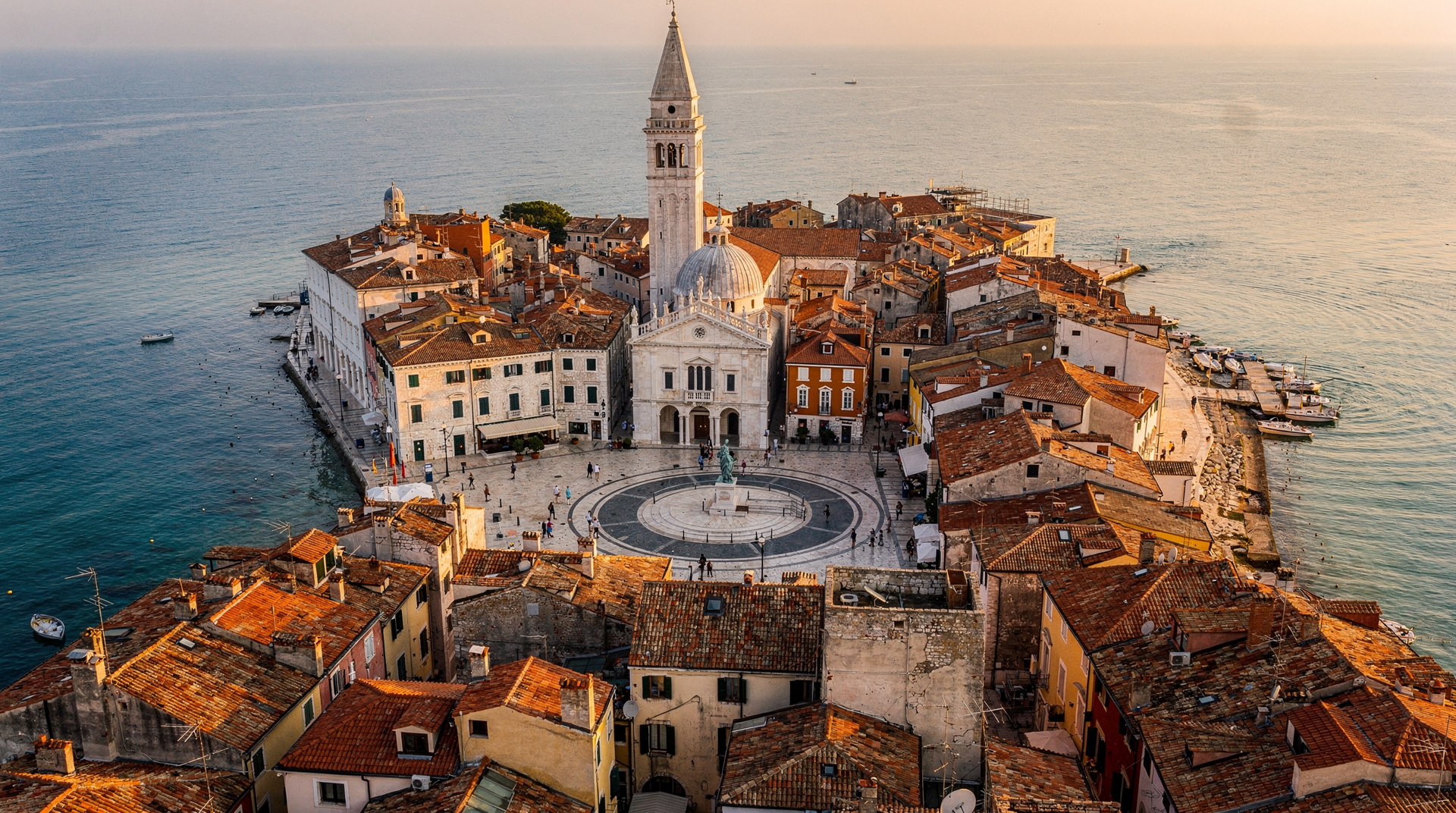
Extended day (car, adding Piran): If you start early, it is possible to add Piran on the coast to the itinerary. Piran is 65 km from Postojna, about 45 minutes. Doing Postojna Cave in the morning, Predjama Castle, and then driving to Piran for a late afternoon and early evening on the coast makes an exceptionally full day.
Guided tour: Postojna Cave, Predjama and Piran in one daySeasonal considerations
Postojna Cave is open year-round and the constant 10°C temperature inside makes it equally valid in January as in August. In summer, the exterior complex is busy and the queue can be long for walkers-in; booked tickets jump the queue. In winter, the cave itself is the main attraction and crowds are thin.
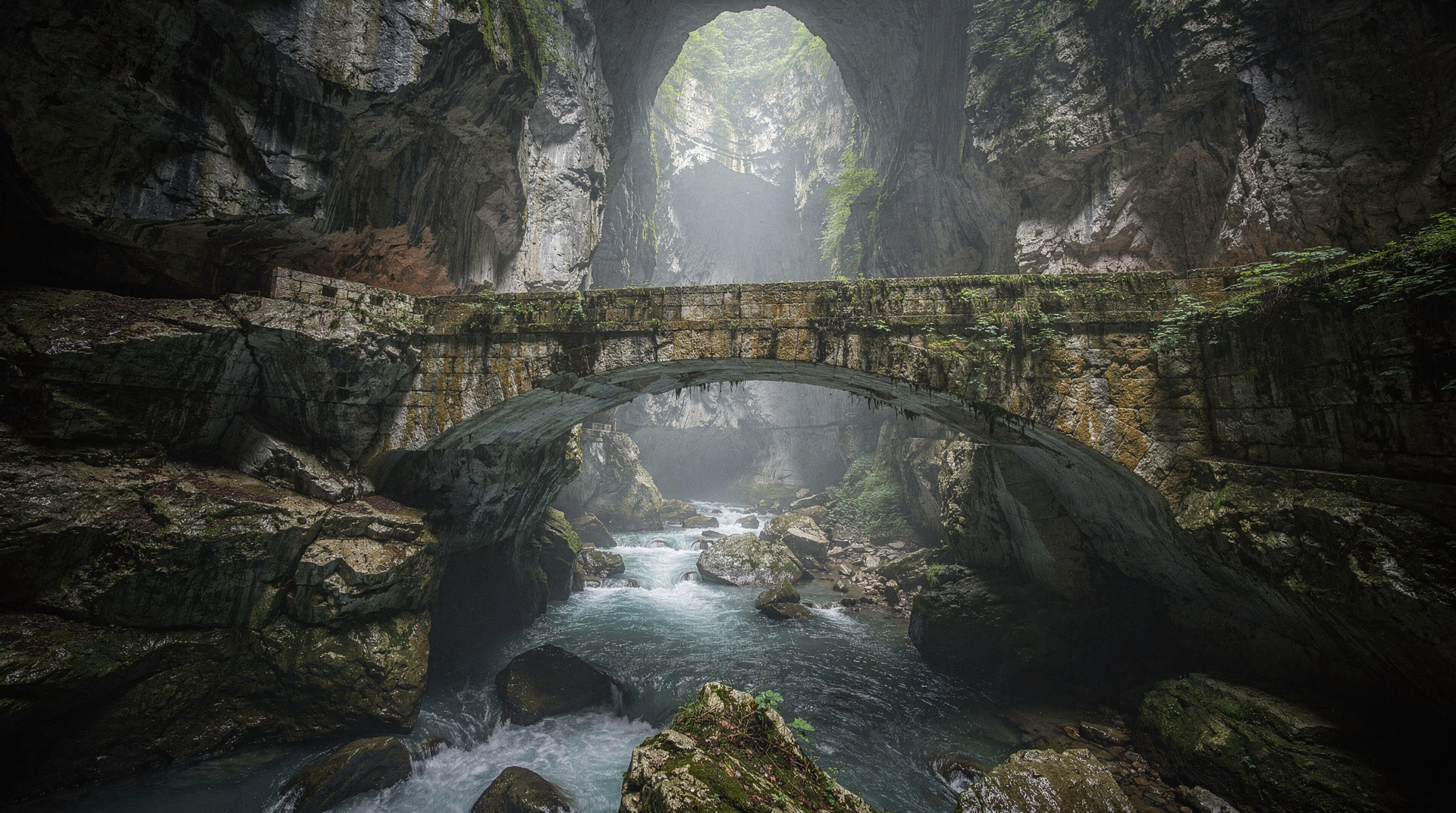
The outdoor karst landscape around Postojna is worth a brief look regardless of season. The dramatic valley, the karst sinkholes (called dolinas) and the native vegetation give you a sense of the unusual geology that makes Postojna possible.
What to bring
- A layer or light jacket: 10°C in the cave is noticeably cold if you arrive in summer shorts
- Comfortable walking shoes: 1.7 km on paved paths, some slightly uneven
- Camera: Photography is permitted in the cave; tripods are not
- Booked tickets: Print or have them on your phone
Alternatives to Postojna
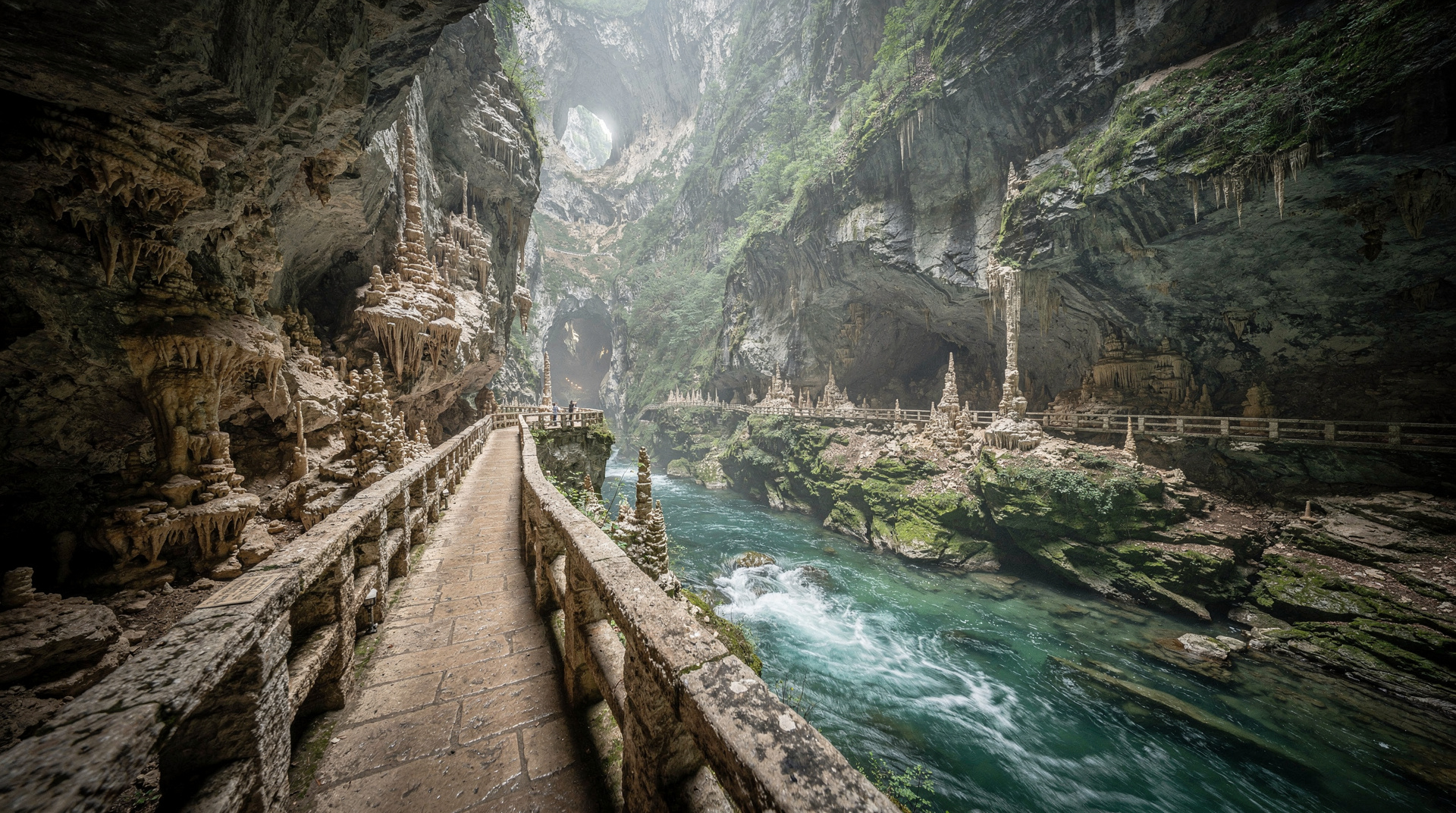
Škocjan Caves (25 km away) offer a completely different experience — a UNESCO-listed underground canyon that is arguably more dramatic. The guide to Škocjan has full details. If you’re weighing up which to visit, the Postojna vs Škocjan comparison guide sets out the differences clearly. Crossing them both off in a single day is possible if you move efficiently.
For a complete overview of Slovenia’s cave system and all the options, see the Slovenia caves overview.
Getting there as part of a larger circuit
One popular route combines Ljubljana, Bled and Postojna in a single long day. This is ambitious but doable: Bled in the morning (arrive 08:30, leave by 12:00), Postojna in the afternoon (arrive 14:00, cave tour 14:00, leave by 16:30), back in Ljubljana by 17:30.
Guided tour combining Ljubljana, Lake Bled and Postojna in one dayThe honest verdict is that this combination is slightly rushed. If you value both destinations, spreading them across two days gives a much better experience. But for travellers with a single full day to spare and a desire to see the best of Slovenia, it is a legitimate choice.
The karst landscape around Postojna
The cave visit does not need to be the whole story. The Karst region around Postojna is a landscape defined by its geology — a flat limestone plateau riddled with sinkholes, caves and disappearing rivers. The surface landscape looks deceptively ordinary until you understand what is happening underground.
Pivka Basin: Immediately south of Postojna, the Pivka River sinks underground near Postojna Cave and re-emerges 44 km away at the Timavo springs in Italy — a journey entirely through underground passages that has never been fully mapped. Walking in the valley above gives a peculiar sensation once you know this.
Predjama Valley: The drive from Postojna to Predjama Castle winds through a hidden valley of farmhouses, limestone pastures and orchards that is entirely off the tourist circuit. The castle appears around a bend in the road — initially a small grey smudge that resolves, as you get closer, into a proper castle embedded in a cliff face.
Karst food culture: The Karst region around Postojna is one of the best areas in Slovenia for traditional food. Kraški pršut (Karst prosciutto) — air-cured ham dried in the bora wind — is a regional speciality; you can buy it at any local shop in the villages. Teran wine, a tannic red from the Refosco grape grown in the iron-rich terra rossa soil, is the characteristic accompaniment.
For families: maximising the Postojna visit
Postojna Cave is consistently rated one of the best family day trips in Slovenia. A few suggestions for travelling with children:
Pre-book times: Book the 10:00 tour in summer — children’s energy and attention are best in the morning. Avoid the 13:00–15:00 tours which fall in the afternoon slump.
Dress warmly: The cave is 10°C. Children often underestimate how cold this feels in summer shorts. A light fleece and a hat are worth carrying even if the exterior temperature is 30°C.
The olm vivarium: The resident Proteus anguinus is in an aquarium near the cave exit — easy to miss in the crowd. Make sure children get a chance to see it properly. The olm is genuinely extraordinary: pale pink, blind, up to 30 cm long, can live 100 years and go a decade without food. It is the cave’s living mascot and one of the strangest vertebrates in Europe.
Post-cave energy burn: After the cave tour, the Postojna complex has a small play area and a large outdoor terrace. Alternatively, the drive to Predjama (15 minutes) lets children burn energy running around the castle grounds before the interior tour.
When to avoid Postojna Cave
The cave is busiest in July and August, particularly from 10:00 to 15:00 on weekdays and all day on weekends. If you cannot avoid these times:
- Book online and arrive 20 minutes early to beat the walk-in queue
- 11:00 or 16:00 tours are typically less crowded than the 10:00, 12:00 and 14:00 slots
- Shoulder season (May–June and September–October) is dramatically more relaxed
For the broader context of the day trips from Ljubljana, the pillar guide ranks all twelve major excursions by type and season.
The olm: Slovenia’s underground emblem
The Proteus anguinus — known as the “human fish” (človeška ribica) for its pale, pinkish skin and vaguely humanoid proportions — is one of the most extraordinary vertebrates in Europe. It is the only purely cave-dwelling vertebrate on the continent, living entirely in the underground waters of the Dinaric Karst from Slovenia to Bosnia-Herzegovina.
The olm is blind (its eyes are vestigial, covered by skin in adults), albino-pale, and adapted to the complete dark of cave water. It has feathery external gills, four small limbs and a long, eel-like body reaching 25–30 cm. Its metabolism is extraordinary: it can go up to ten years without food, and individuals can live for over a century.
At Postojna Cave, a small population of olms is kept in a large aquarium near the cave exit. They are genuinely fascinating to observe — moving slowly through the clear water, occasionally surfacing to breathe, entirely adapted to a world without light. This is one of the few places in the world where you can see a live olm reliably; in Škocjan or in the wild, they are present but almost impossible to observe.
The olm is on Slovenia’s 10-cent euro coin — an appropriate symbol for a country whose most unusual inhabitants live underground.
Pre-booking your Postojna visit
The Postojna Cave ticket system is well-organised and online booking is genuinely worth doing, especially in peak season. How it works:
- Visit postonjska-jama.eu and select your date and time
- Choose cave only, or cave + Predjama, or cave + cave vivarium (additional exhibition)
- Pay by card; receive a PDF ticket
- Arrive 15 minutes before your tour; scan your ticket at the entrance
The combined cave + Predjama ticket is significantly better value than buying separately. The cave + Vivarium Proteus (an additional exhibition on cave biology and the olm) adds EUR 12.80 to the cave price and is worth it if you have an interest in natural history.
Tours depart promptly on the hour; latecomers are turned away. The train for the underground journey boards in the large departure hall — arrive with time to find your boarding group.
Accessibility at Postojna Cave
Postojna Cave is one of the most accessible cave sites in Europe for visitors with mobility limitations. The underground train operates on conventional rails and has wheelchair spaces. The walking section (1.7 km) is on paved paths with relatively gentle gradients; it is accessible for wheelchairs and those with limited mobility, with assistance. Strollers/prams can enter but require careful management on some sections — contact the cave in advance.
The cave temperature of 10°C and the humidity near 100% are worth noting for visitors with respiratory conditions — the damp, cool air is invigorating for most but may be uncomfortable for those with certain health conditions.
Predjama Castle (9 km away) is less accessible — the interior involves stone stairs and uneven medieval floors. The exterior and courtyard are accessible; the upper levels are not.
Postojna day-trip budget at a glance
| Item | Approximate cost |
|---|---|
| Cave + Predjama combo ticket | EUR 49.90 adult |
| Fuel (round trip from Ljubljana) | EUR 10–15 |
| Bus alternative (round trip) | ~EUR 10 |
| Lunch at the complex or Postojna town | EUR 12–20/person |
| Predjama cave add-on (summer) | EUR 7 |
Is Postojna Cave overrated?
It’s a fair question given how commercialised the entrance complex feels, and the honest answer is no — the cave itself is not overrated, but the surrounding infrastructure is unmistakably mass-market. The formations, the scale of the passages, and the underground train are genuinely among Europe’s best cave experiences, and no amount of gift-shop clutter changes that.
What can feel overrated is the idea of Postojna as an intimate or wild experience — it is neither, and visitors expecting Škocjan’s dramatic solitude will be disappointed. Go for the geology and the olm, accept the crowds and the commercial trappings as the cost of that access, and you’ll leave satisfied. For the more atmospheric alternative, see Škocjan Caves or, for something genuinely small-scale, Križna Jama, a cave with no tourist infrastructure and guided visits with a boat ride (booking recommended).
Frequently asked questions about Postojna Cave day trip from Ljubljana
How much does Postojna Cave cost?
Adult admission is EUR 34.90 for the cave alone. Predjama Castle is EUR 24 separately, or EUR 49.90 for a combined ticket. For child prices, see the up-to-date rates on the official website, postojnska-jama.eu. The combined ticket is better value if you plan to visit both, which most visitors do. Tickets are sold only on the official website, with your date and time chosen online, so book ahead.Should I book Postojna Cave in advance?
Yes, in July and August. Tours run every hour but slots fill up, especially at the most popular times (10:00–14:00). Tickets are sold only online with a chosen date and time, so book ahead; in shoulder season (May–June and September–October) slots are easier to find, but weekends still fill up.What is the temperature inside Postojna Cave?
A constant 10°C year-round, regardless of the season outside. This is one of the appeals in summer — a cool underground escape. Bring a light jacket or layer even in August. The humidity is around 95%, so the air feels damp and cool the moment you enter.Can I visit Postojna Cave without a car?
Yes. Arriva buses from Ljubljana Bus Station to Postojna run several times a day; the journey takes about 1 hour and costs around EUR 5 each way. From Postojna town the cave entrance is 1.5 km — walkable or there is a local bus. Predjama Castle (9 km from the cave) is difficult to reach without a car or guided tour.Is Postojna Cave suitable for children?
Excellent for children aged 5 and above. The underground train, the vast caverns, the stalactites and the olm (the pale cave salamander) are genuinely thrilling for young visitors. The walking section is 1.7 km on paved paths — manageable for most children. Prams and wheelchairs can use parts of the tour; contact the cave in advance.What is the difference between Postojna Cave and Škocjan Caves?
Postojna is larger, more polished and better served by transport — it handles 700,000 visitors a year and the experience is efficient but somewhat theme-park-like. Škocjan is UNESCO World Heritage-listed, more dramatic (an underground canyon 150m deep) and more atmospheric. Postojna suits families and first-time visitors; Škocjan suits those who want something wilder. If you can only do one, visit both in spirit by reading the guide — they are different enough that many visitors do both.
Top experiences
Bookable activities with verified prices and instant confirmation on GetYourGuide.