Waterfalls in Slovenia: the best falls to visit and how to reach them
From Bled: Triglav National Park and Soča small-group day trip
What is the most impressive waterfall in Slovenia?
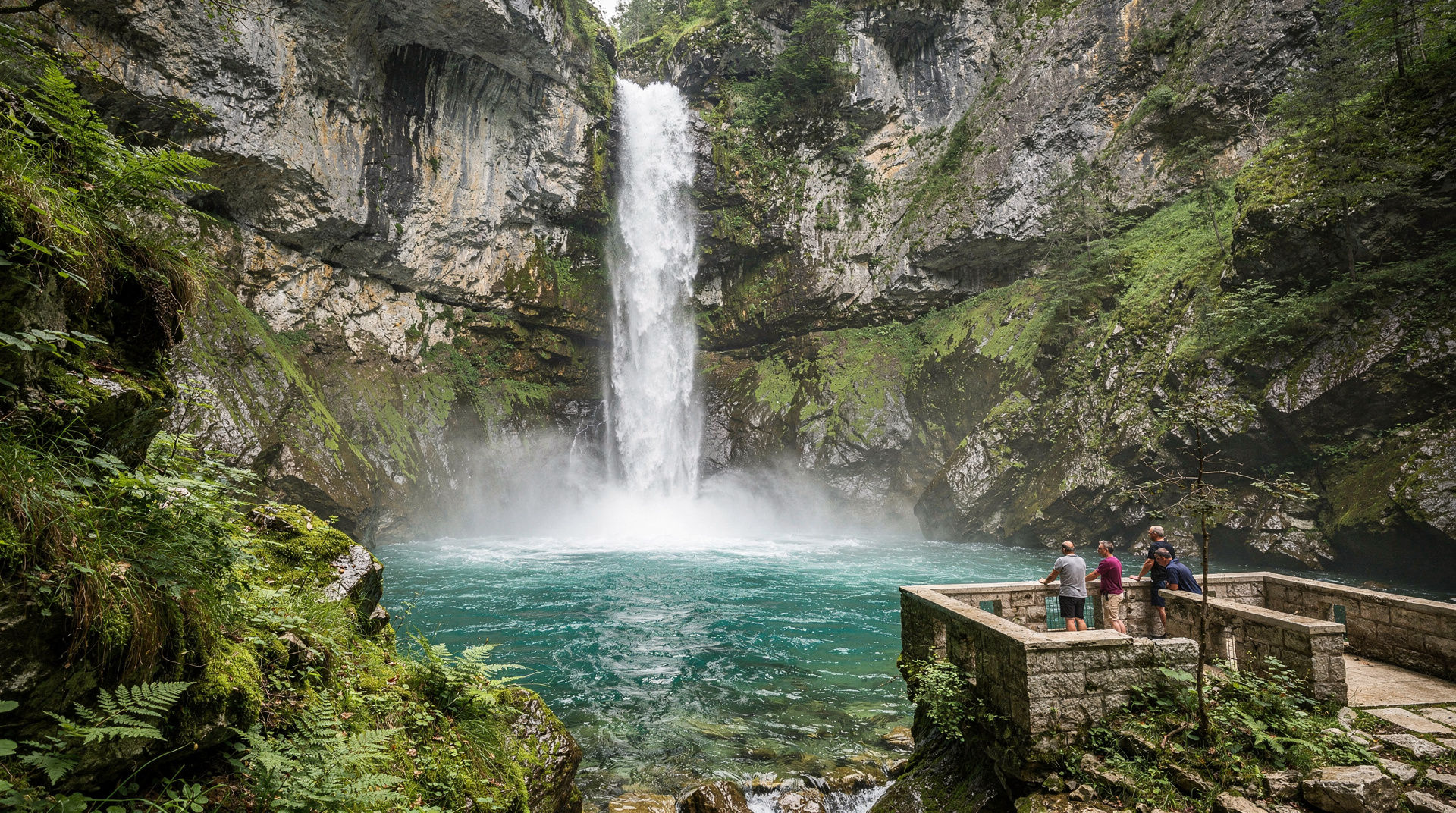
Boka Waterfall in the Soča Valley is Slovenia's highest at 106 metres — a single dramatic plunge off a limestone cliff that is visible from the valley road. The Savica Waterfall above Lake Bohinj is the most visited and most beautiful in context — a 78-metre fall at the head of a narrow gorge. Peričnik near Mojstrana is unique for allowing you to walk behind the curtain of water.
Slovenia’s best waterfalls: a field guide
Slovenia’s exceptional waterfall landscape is a direct consequence of its geology.
| Waterfall | Region | Height | Access |
|---|---|---|---|
| Boka | Soča Valley | 106 m | 15–45 min walk from valley road |
| Savica | Lake Bohinj | 78 m | 25–30 min uphill walk |
| Peričnik | Vrata Valley | 52 m (lower) | 30–45 min, walk-behind path |
| Rinka | Logar Valley | 90 m | 10 min walk from valley road end |
| Kozjak | Near Kobarid | 15 m | ~25 min riverside walk |
This guide covers the best waterfalls in Slovenia, grouped by region, with honest walking times, seasonal notes and practical advice.
The Julian Alps: the waterfall heartland
The Julian Alps — the region centred on Kranjska Gora, Lake Bohinj, Lake Bled and Triglav National Park — hold the majority of Slovenia’s most impressive waterfalls.
Savica Waterfall (Slap Savica) The most visited waterfall in Slovenia and one of the most beautiful in context. The Savica River emerges from a cave opening 51 metres above the gorge floor, fan-shaped and powerful. In spring, the volume is immense. By late summer, it narrows but remains visually striking — the cave entrance framing the white water against dark rock.
The hike from the Savica car park (3 km from Ukanc, at the western end of Lake Bohinj) takes 25–30 minutes uphill. The last section involves steep stone steps. Since 1 August 2026, admission is EUR 4 from age 16 (free under 16, and free for everyone on the first Sunday of the month). Parking at P9 costs EUR 7 for up to 3 hours or EUR 15 for the day, card payment only.
See the dedicated Savica Waterfall guide for full details.
Peričnik Waterfall (Slap Peričnik) Near Mojstrana in the Triglav National Park, Peričnik is best known for the lower fall where a path runs directly behind the 52-metre curtain of water. The path enters a rock ledge behind the cascade — you are surrounded by wet rock, mist and the roar of the water. The upper fall (16 m) is accessible via a separate path above. Combined both falls: about 1.5 hours return from the car park.
Getting there: Drive the valley road from Mojstrana towards Kranjska Gora, then turn up the Vrata Valley. Peričnik is signed from the valley road.
Mostnica Gorge waterfalls The Mostnica River flows through a narrow gorge of polished limestone above Stara Fužina at the eastern end of Lake Bohinj. The gorge walk follows the river for about 2 km past several cascades and a famous rock arch. The most dramatic section, near the Hudičev Most (Devil’s Bridge), has the river flowing through a slot canyon less than 2 metres wide. Easy walk, 1.5 hours return.
Soča Valley: dramatic and remote
Boka Waterfall (Slap Boka) At 106 metres (with a secondary section of 52 metres below), Boka is Slovenia’s highest waterfall. It drops from a limestone cliff in the upper Soča Valley, visible from the valley road about 5 km south of Bovec. In spring, the flow is immense — the water can be heard from a kilometre away.
The approach path to the base viewpoint is signed from the main road (15 min walk); a higher viewpoint requires a 45-minute steep path. In late summer, the flow reduces but the cliff and the scale remain impressive.
Kozjak Waterfall (Slap Kozjak) One of the most atmospheric waterfalls in Slovenia. The Kozjak stream drops 15 metres into a cave-like chamber carved into the riverbank, creating an enclosed amphitheatre of rock where you stand looking at the fall from inside the cave. The approach is along the Soča River from Kobarid — about 25 minutes walking along the riverbank. Part of the Kobarid Historical Walk.
Guided day trip to Trenta and the upper Soča ValleyVirje Waterfall A broader, more gentle fall above Čezsoča, spilling over a limestone lip into a wide pool ideal for swimming in summer. Less dramatic than Boka but more accessible, prettier in summer light, and a genuine swimming spot.
Kamnik-Savinja Alps: underrated
Rinka Waterfall (Slap Rinka) The highest waterfall in the Kamnik-Savinja Alps (90 metres), at the head of the Logar Valley (Logarska dolina) near Solčava. The Logar Valley itself is one of the most beautiful glacial valleys in Slovenia — a narrow, flower-filled trough enclosed by 2,000-metre peaks. Rinka drops in a single leap from the hanging valley wall above.
Getting there: Drive the Logar Valley road from Solčava. Parking at the end of the valley road; 10-minute walk to the waterfall base. Combined with a full valley walk: 3 hours.
Rjava Skala Waterfall Nearby, also in the Kamnik area — less visited but impressive in spring.
Karst region
Rakov Škocjan falls Rakov Škocjan is technically a collapsed cave — a valley where the cave roof fell in, leaving two natural stone arches. The Rak River flows through it with several small cascades over tufa barriers. The natural arches, the vegetation and the scale of the collapse doline make this one of the most unusual walking destinations in Slovenia, though the falls themselves are modest compared with the Julian Alps.
Kotliči waterfalls, Kolpa River In the Bela Krajina region of south-eastern Slovenia, the Kolpa River forms a series of cascades over tufa steps — unusual in that you can walk directly on the tufa barriers and swim in the pools between the steps. A hidden gem for summer swimming.
Seasonal guide to Slovenian waterfalls
April–May (peak flow): The best month for maximum water volume. Snowmelt from the Julian Alps dramatically increases the flow on all rivers feeding the main falls. Boka and Savica are at their most powerful in May. Some paths near the larger falls can be slippery and some car parks not yet open — check conditions.
June: Still excellent flow; paths fully open; wildflowers in the meadows above. Ideal combination of good access and high water.
July–August: All waterfalls visible and accessible. Flow reduced by up to 50% from spring peak, but swimming pools below smaller falls are warm and clear. Peričnik and Virje are excellent swimming destinations.
September–October: After summer rains, a secondary increase in flow. Autumn colours on the surrounding forest make the waterfalls more photographic. Fewer visitors.
November–March: Some waterfalls partially or fully freeze in severe cold, creating extraordinary ice formations. Peričnik in January can be an ice curtain. Access to some valley car parks restricted by snow.
Practical tips for waterfall visits
Footwear: Paths near major waterfalls are typically wet, muddy and sometimes involve slippery rock steps. Hiking boots or trail shoes with grip are strongly recommended. Flip-flops are not suitable.
Photography: Waterfalls are best photographed in overcast light (no harsh shadows, no blown-out white water) or in the golden hour. A polarising filter reduces glare on wet rock and water.
Swimming: Several of Slovenia’s waterfalls have swimmable pools at the base — Virje, the pools along the Soča, and the Mostnica Gorge lower section. The water is cold even in July (typically 12–16°C). Wear river shoes if walking on rocky riverbeds.
Crowds: Savica and Peričnik can be busy on summer weekends. Arriving before 09:00 or after 16:00 makes a significant difference. Boka and Kozjak are rarely crowded.
Guided hike in Triglav National Park including waterfall viewsFor the full picture of hiking in the Julian Alps, the alpine hiking guide covers routes at all difficulty levels. The Bohinj guide includes details on the Savica approach and the Mostnica Gorge walk.
Hidden waterfalls worth seeking out
Beyond the headline destinations, Slovenia has dozens of smaller waterfalls that reward those who leave the main tourist circuit:
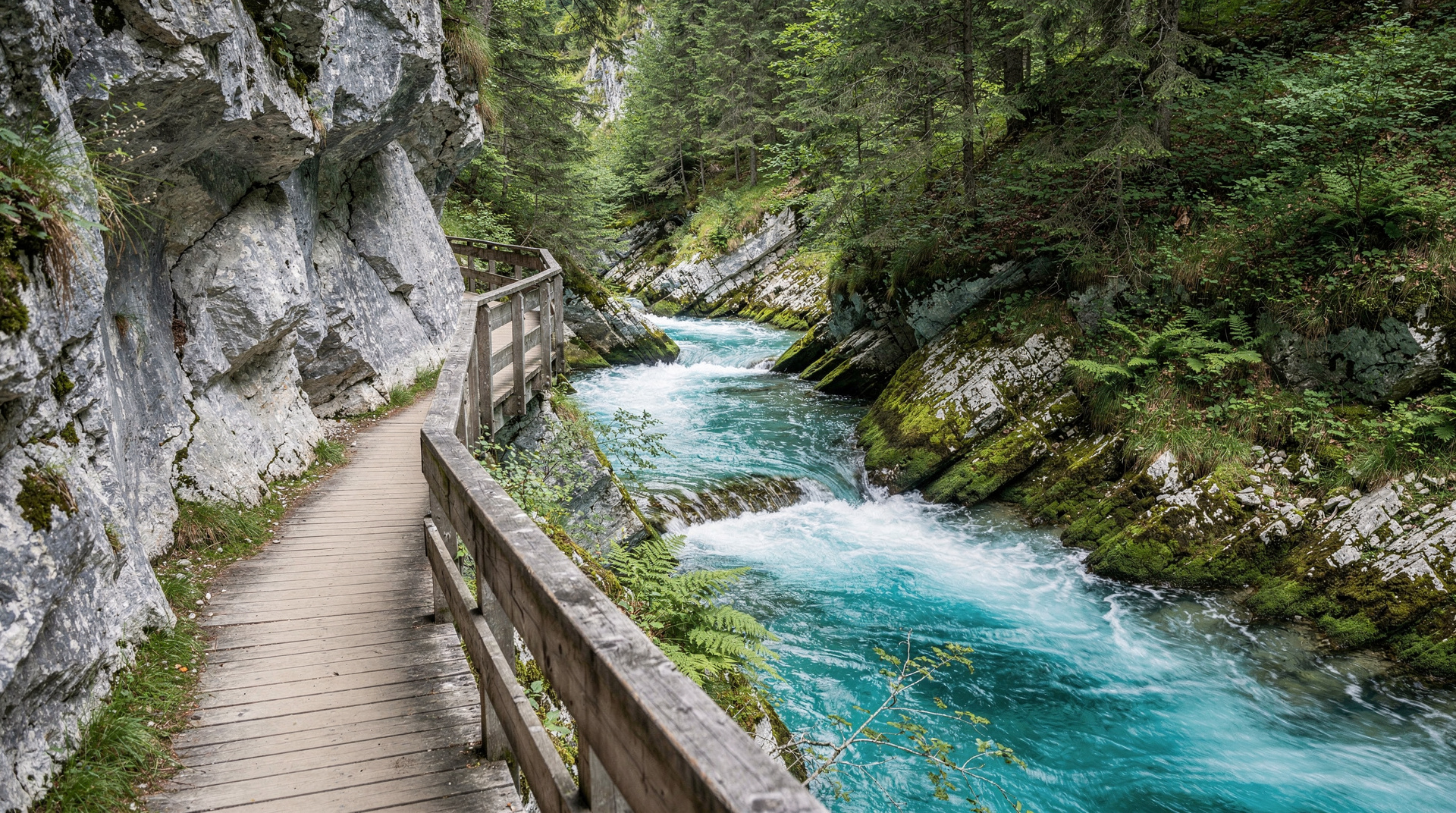
Šum Waterfall, Vintgar Gorge: At the end of the Vintgar Gorge walk near Lake Bled, the Radovna River drops over a low tufa cascade into a large pool. It is modest compared with Boka or Savica, but the gorge setting — wooden boardwalk, aquamarine water, vertical limestone walls — makes the whole walk one of the finest waterfall experiences in the Julian Alps.
Strašnik Waterfall, Triglav NP: In the Vrata Valley below the north face of Triglav, the Strašnik stream drops down the valley wall in a thin white thread — dramatic because of the scale of the surrounding rock face rather than the volume of the fall. Visible from the valley road; a short walk reaches the base.
Brinta Waterfall, Kamnik Alps: In the Kamniška Bistrica valley above Kamnik, the Brinta stream falls over 50 metres in a narrow gorge accessible on a marked path (1.5 hours return). The Kamniška Bistrica valley is excellent for a day from Ljubljana — the gorge is spectacular in its own right and the Brinta is the highlight.
Waterfall of the Lobnica, Pohorje Massif: On the Pohorje plateau above Maribor, the Lobnica stream descends in a series of cascades through birch and beech forest — a series of small falls that together cover about 20 metres over 500 m of stream. A quiet, accessible alternative to the Julian Alps waterfalls.
Photography guide for Slovenian waterfalls
Slovenia’s waterfall photography is particularly rewarding because of the diversity of settings — gorge falls, valley-wall falls, and the unusual water-over-tufa type. Some technical notes:
Long exposure: A tripod and 2–10 second exposure (f/11–f/16, ISO 100) creates the silky water effect that is the standard waterfall image style. Overcast days are ideal — no harsh shadows, balanced light. A circular polariser reduces glare on wet rock and intensifies the green of moss.
Morning light at Savica: The gorge at Savica is north-facing and shaded most of the day. The exception is late spring and early summer mornings (before 10:00) when low sun may reach into the gorge briefly. This light is rare and golden — worth arriving early if you want warm-toned Savica images.
Boka from the valley road: The first view of Boka from the main Soča Valley road (before the turn-off for the approach path) gives an excellent telephoto shot of the full fall in its cliff context. A 70–200mm lens at 200mm compresses the scene usefully.
Action shots: For Peričnik’s walk-behind, wide angle is essential — you want to show the path, the rock overhang and the curtain of water together. In high flow, you will get wet; accept this and use a rain sleeve for your camera.
The waterfalls and the Slovenian water system
Slovenia has one of the highest renewable freshwater endowments per capita in Europe — 18,000 m³ per person per year, compared with a European average of around 4,500. This abundance comes directly from the Julian Alps’ exceptional precipitation (some stations on the windward side receive over 3,000 mm per year, making them among the wettest in Europe outside Iceland) and from the karst aquifer system that stores water underground and releases it slowly through springs, cave streams and waterfall source springs.
The Savica waterfall is a perfect illustration: the water falling there has descended through the limestone karst plateau for months before emerging at the cave mouth. The purity and constant temperature (the Savica emerges at around 7°C year-round) reflect the long underground journey.
This water eventually reaches the Sava River, then the Danube, then the Black Sea — one of the longest river journeys from source to sea in Europe, beginning in a narrow gorge above a quiet lake in the Julian Alps.
For Lake Bohinj context and the Savica approach in detail, the dedicated Savica guide covers the hike fully. For the full picture of Triglav National Park and its hydrology, the wildlife and nature guide is the starting point.
Which waterfall suits which kind of traveller
Not every waterfall on this list appeals to every kind of visitor, and being honest about that saves disappointment. Photographers chasing dramatic scale should prioritise Boka, whose 106-metre single drop is genuinely the country’s most imposing. Visitors who want an immersive, sensory experience rather than a distant view should prioritise Peričnik, where the walk-behind path puts you inside the waterfall’s spray rather than simply looking at it from a platform.
Families and less mobile visitors are best served by Savica, whose path — while uphill — is short, well-maintained and reaches a proper viewing platform rather than requiring scrambling. And anyone drawn to atmosphere over scale should seek out Kozjak, whose enclosed rock chamber creates a hushed, cave-like setting unlike any other waterfall on this list.
Building a one-day waterfall circuit
For visitors who want to see several waterfalls in a single day rather than choosing just one, the Julian Alps geography allows a reasonably efficient loop. Starting from Bled or Bohinj: Savica in the morning (25–30 minutes uphill, best light before 10:00), a drive over toward Mojstrana for Peričnik around midday (allow 1.5 hours including both upper and lower falls), then continue over the Vršič Pass into the Soča Valley for Boka in the late afternoon, when the valley road approach gives good side-lighting on the cliff face.
This covers three of Slovenia’s most distinctive waterfalls — a cave-emergence fall, a walk-behind curtain fall, and the country’s tallest single drop — in one demanding but genuinely rewarding day.
A gentler version drops Boka and stays in the Bohinj-Bled area: Savica in the morning, the Mostnica Gorge cascades near Stara Fužina at midday, and the Šum waterfall at the end of the Vintgar Gorge walk in the afternoon — three contrasting waterfall environments without the long drive over Vršič.
With children: the gentler Bled-Bohinj version is the better choice for families, since all three stops involve short, well-marked, non-technical paths under an hour each way. The Boka and Peričnik combination, by contrast, involves more driving and steeper approach paths, which suits older children and adults better than very young ones. Whichever circuit you choose, build in more time than the walking estimates suggest — children (and honestly, most adults) want to linger at pools and watch the water rather than move briskly from one fall to the next.
Triglav National Park full-day tour from BledFrequently asked questions about Waterfalls in Slovenia
Which Slovenian waterfalls can you walk behind?
Peričnik Waterfall near Mojstrana is the most famous walk-behind waterfall in Slovenia — the path runs directly behind the 52-metre lower fall, giving you an extraordinary view through the curtain of water into the gorge below. The path is wet and requires a waterproof or acceptance of a soaking. Also remarkable: Kozjak Waterfall near Kobarid, where the fall drops into an enclosed cave-like chamber and you stand looking at it from inside.Is the Savica Waterfall hike difficult?
The hike to Savica is relatively easy. From the Savica car park near Lake Bohinj, the signed path climbs steadily through forest for about 25–30 minutes, gaining approximately 80 metres of altitude. Some sections are steep stone steps. The total distance is about 1.5 km one way. The falls are visible from a viewing platform at the base of the gorge. Suitable for most walkers including older children.When is the best time to see Slovenian waterfalls?
Spring (April–June) is when waterfalls are at maximum flow — snowmelt from the mountains sends the highest volumes of water over the edge. June is particularly good: the flows are still high from late snowmelt while the paths are fully open. Summer (July–August) sees reduced flow but is still good. Autumn sees a secondary increase after October rains. In winter, the falls can freeze partially, creating spectacular ice formations.How do I get to Boka Waterfall?
Boka Waterfall is visible from the road in the Soča Valley, near Bovec. From the main road, a short signed path (about 15 minutes each way) leads to a viewpoint near the base of the fall. You can also reach a higher viewpoint with a steeper 45-minute walk. The full approach path to the plunge pool requires care as the trail is steep and sometimes slippery.Are there waterfalls near Ljubljana?
Not within easy walking distance of the city, but several are accessible as day-trip stops. The Rinka Waterfall in the Logar Valley (1h45 from Ljubljana) is excellent. Pericnik near Mojstrana can be combined with a Lake Bled day trip. Vintgar Gorge near Bled has a series of cascades and rapids rather than a single fall. Kozjak Waterfall near Kobarid is best combined with a Soča Valley day.
Top experiences
Bookable activities with verified prices and instant confirmation on GetYourGuide.