Slovenia with kids: a family trip diary, honestly told
The trip we almost didn’t take
We booked Slovenia largely because the flights were the right price and the dates worked. We had a 12-year-old, an 8-year-old, and a 5-year-old. My research on family-friendly Slovenia had returned the usual confident listicles that promised everything would be wonderful. This is not that article.
This is what ten days actually looked like with three children, what they loved, what bored them, and what we would change.
| Trip length | 10 days, every major region |
| Ages | 12, 8 and 5 |
| Family favourite day | Lake Bohinj |
| Biggest hit | Soča River rafting (age 6+) |
| Total avg cost/day | Around €150-200 for a family of five |
| Car needed | Yes |
Age spread matters a lot
The honest opening: Slovenia’s appeal varies significantly by child age. Our 12-year-old was ready for everything — the cave tours, the hikes, the history museum. Our 8-year-old was borderline on the harder walks but game for most things. Our 5-year-old needed constant calculation: is the path suitable for short legs? Is the walk short enough to not end in carrying?
The family travel sites say “suitable for all ages.” This is technically true in that children of all ages can physically be present at Lake Bled. Whether a 3-year-old enjoys a 6 km lake walk is a different question.
Our Slovenia for families guide has age-specific recommendations more granular than most.
Day 1-2: Ljubljana — better than expected
Ljubljana worked surprisingly well with kids. The pedestrianised old town is physically safe — no traffic anxiety, smooth surfaces, easy café stops. The castle has a tunnel and a play area that kept the youngest occupied while we looked at the view. The funicular is thrilling for a 5-year-old.
The Ljubljana Zoo in Tivoli Park was not on our original itinerary but a rainy afternoon made it inevitable. Smaller than city zoos in western Europe but entirely adequate for a morning, and €8 per adult.
The Slovenian Ethnographic Museum near the train station is unexpectedly excellent for children — it has interactive exhibits on traditional crafts, a recreated village room, and a costume collection that the kids tried on. Free on Sundays.
Day 3: Lake Bled — peak crowds, peak beauty
We arrived at Bled at 11am on a Saturday in June, which was a mistake that all the travel advice I read had warned against and I ignored anyway. The car park was €8 for four hours. The lake path was shoulder-to-shoulder for the first kilometre.
By 12pm we had walked far enough east that the crowds thinned. By 1pm, on the south shore past the rowing club, we had stretches of path to ourselves. The kids found a section where they could throw stones in the water without anyone near them.
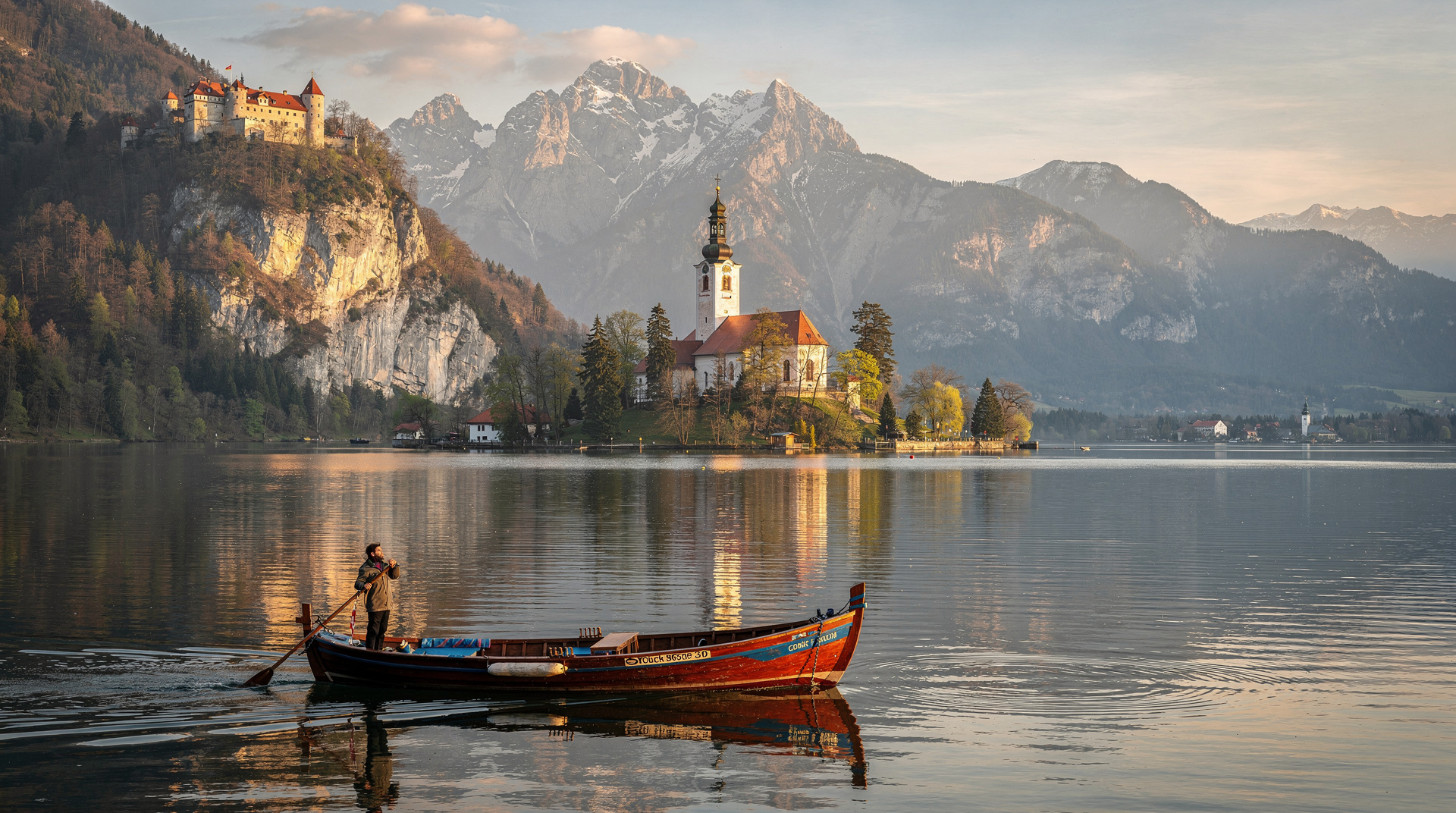
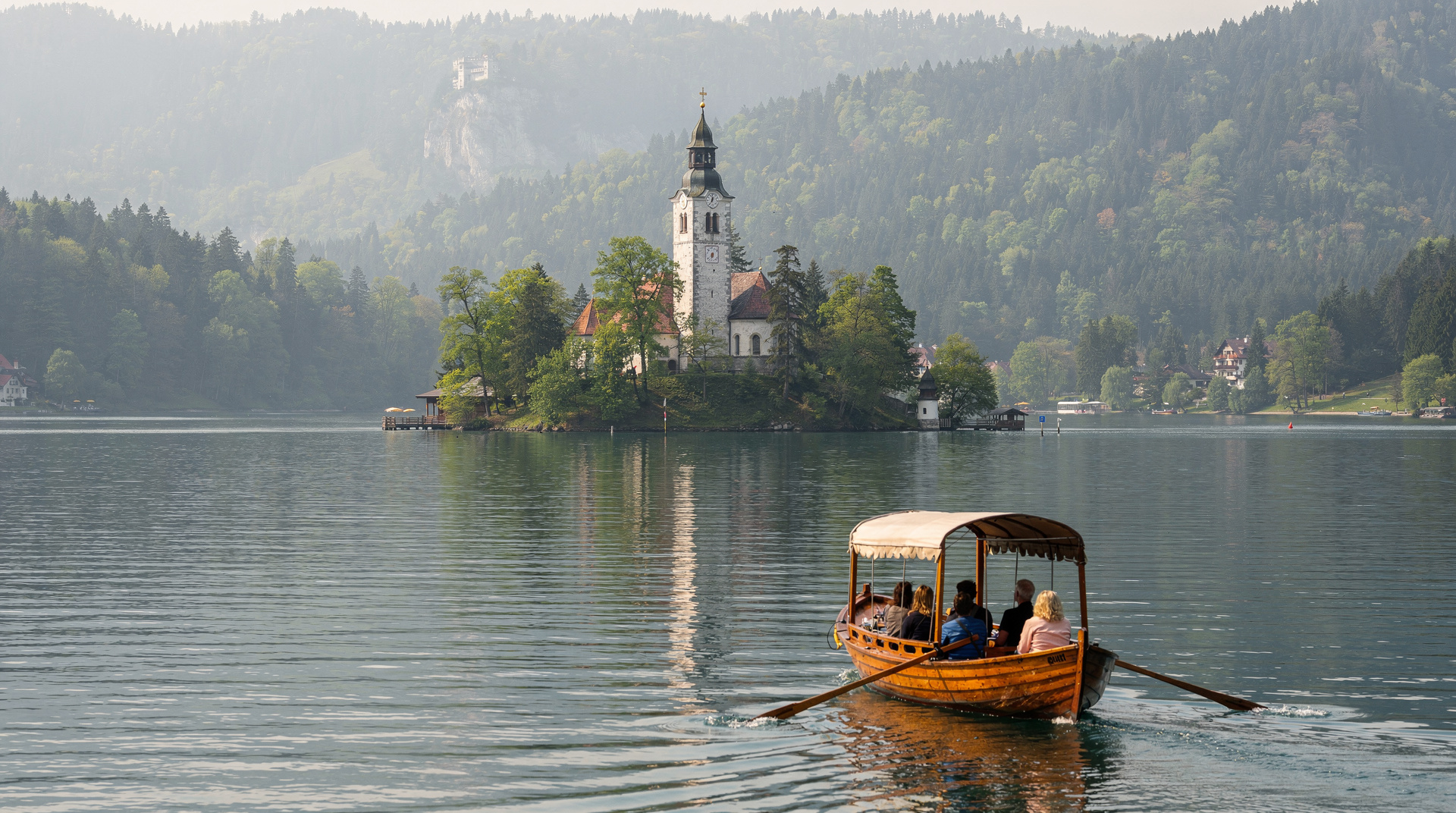
The pletna boat to the island (confirm the fare at the pier or with the Bled tourist office, bled.si). We went. The island is 20 minutes of rowing and 20 minutes of church. The 8-year-old rang the bell. The 5-year-old climbed the 99 steps with dramatic commentary. The 12-year-old photographed the view. Total experience: 1h30, genuinely memorable.
Day 4: Bohinj — the day everyone agreed was the best
Lake Bohinj was the unanimous family favourite. The lake has an accessible gravel beach area at the eastern end (Ribčev Laz) where children can swim or throw stones, a river mouth with shallow water, and picnic areas. We rented a paddle boat for 1h (€12). We had lunch at a lakeside gostilna for €12/person including drinks.
The afternoon: Vogel gondola. The 5-year-old spent the gondola ride pressed against the glass with her mouth open. The view at the top of the lake 800 m below, the mountains in all directions, the ski lifts stretched up the hill — it took 2 minutes to ride and the children talked about it for three days.
Cost for the day at Bohinj: gondola €80 (family of 5), lunch €60, paddle boat €12, snacks €15. Total €167, or €33 per person. That is a good day.
Day 5: Postojna Cave — worth the price, with caveats
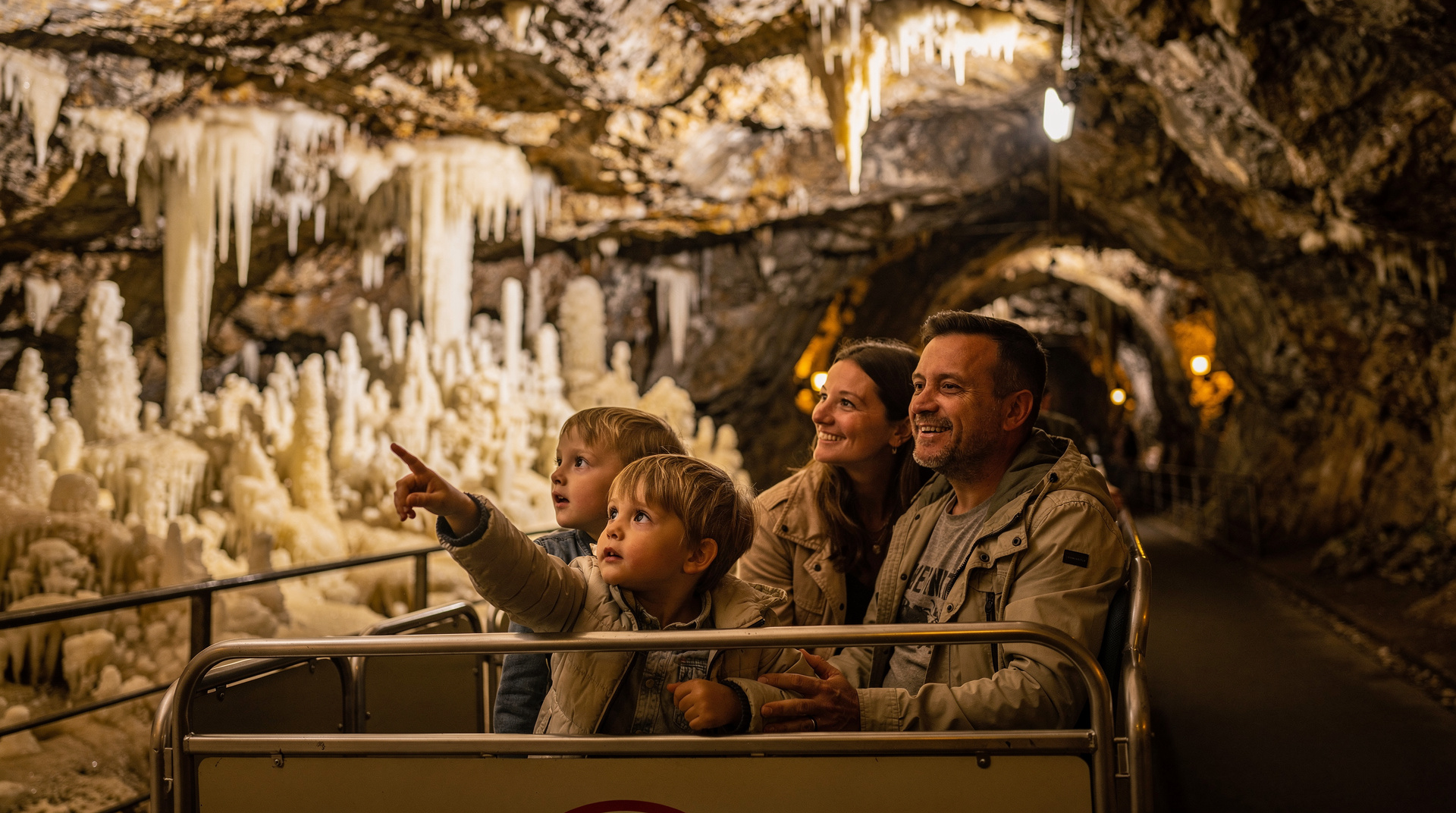
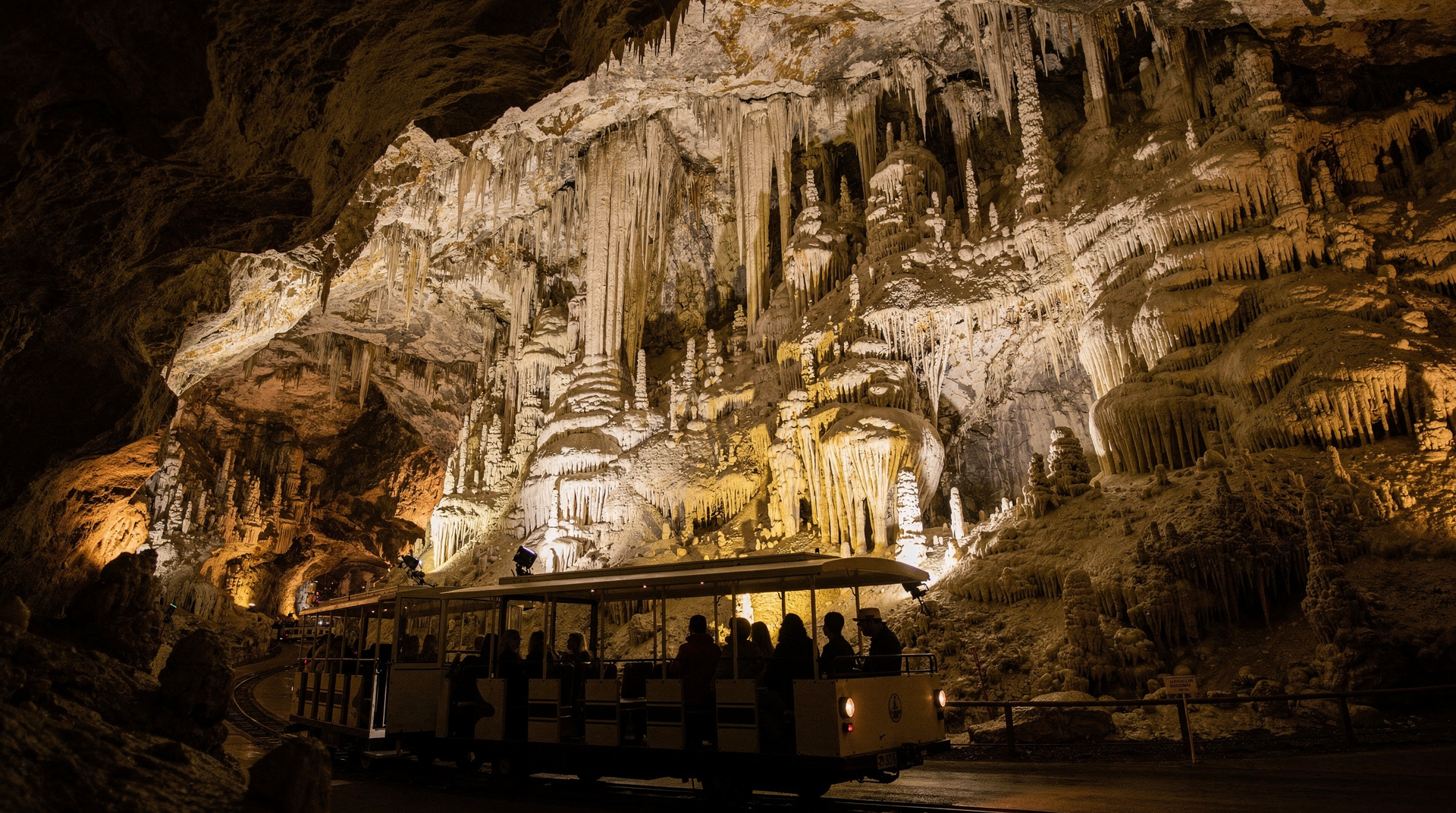
Postojna Cave is designed for tourism in a way that almost nothing else in Slovenia is. This cuts both ways: the mini-train, the organised tour, the dramatic lighting — all of it is slightly absurd and entirely successful with children.
Our 5-year-old: terrified of the dark sections, completely fine once the lights came on in the main chambers, delighted by the miniature train. Our 8-year-old: fascinated by the proteus (the blind cave salamander). Our 12-year-old: initially sceptical, ended up asking more questions than either of the younger children.
The combined Postojna + Predjama ticket (around €50 for an adult; see child prices on the official site, postojnska-jama.eu) is the right call. Predjama Castle is 20 minutes by car. The castle built into a cliff face is one of the more cinematic things in Slovenia and requires only a moderate amount of walking up a hill.
Allow 5h for both sites combined.
If you would rather not drive with tired children, a private trip to the cave and the cliff castle from Ljubljana takes the navigation and parking off your hands.
Day 6: Soča Valley — highlight for the older two
The drive over the Vršič Pass was a family experience in itself: 50 numbered hairpin bends, children counting them, increasingly enthusiastic as the number increased. The view from the top was genuinely breathtaking. The 5-year-old was asleep by hairpin 30 and missed the whole thing.
The Soča River at ground level: the 8 and 12-year-olds were immediately transfixed by the colour. We walked to the Napoleon Bridge in Kobarid and looked down at the water. The 12-year-old asked if she could go rafting. We had not pre-booked; we found a half-day family rafting trip departing the next morning with a local operator near Bovec for €45 per person. In hindsight, booking this in advance rather than gambling on availability the night before would have saved us a genuinely stressful few hours.
Soča River whitewater rafting from BovecDay 7: rafting on the Soča — highlight of the trip
The Soča rafting was the day the children talked about for months afterward. The operator was excellent, the safety briefing was thorough, and the river itself — the turquoise water, the gorge walls, the cold spray — exceeded expectations for everyone.
Age minimum for family rafting on this section: typically 6-7 years old. Our 5-year-old did not participate; she stayed with one of us on the bank at a viewpoint, which was actually fine — watching the raft from above is also enjoyable.
Days 8-9: coast and back
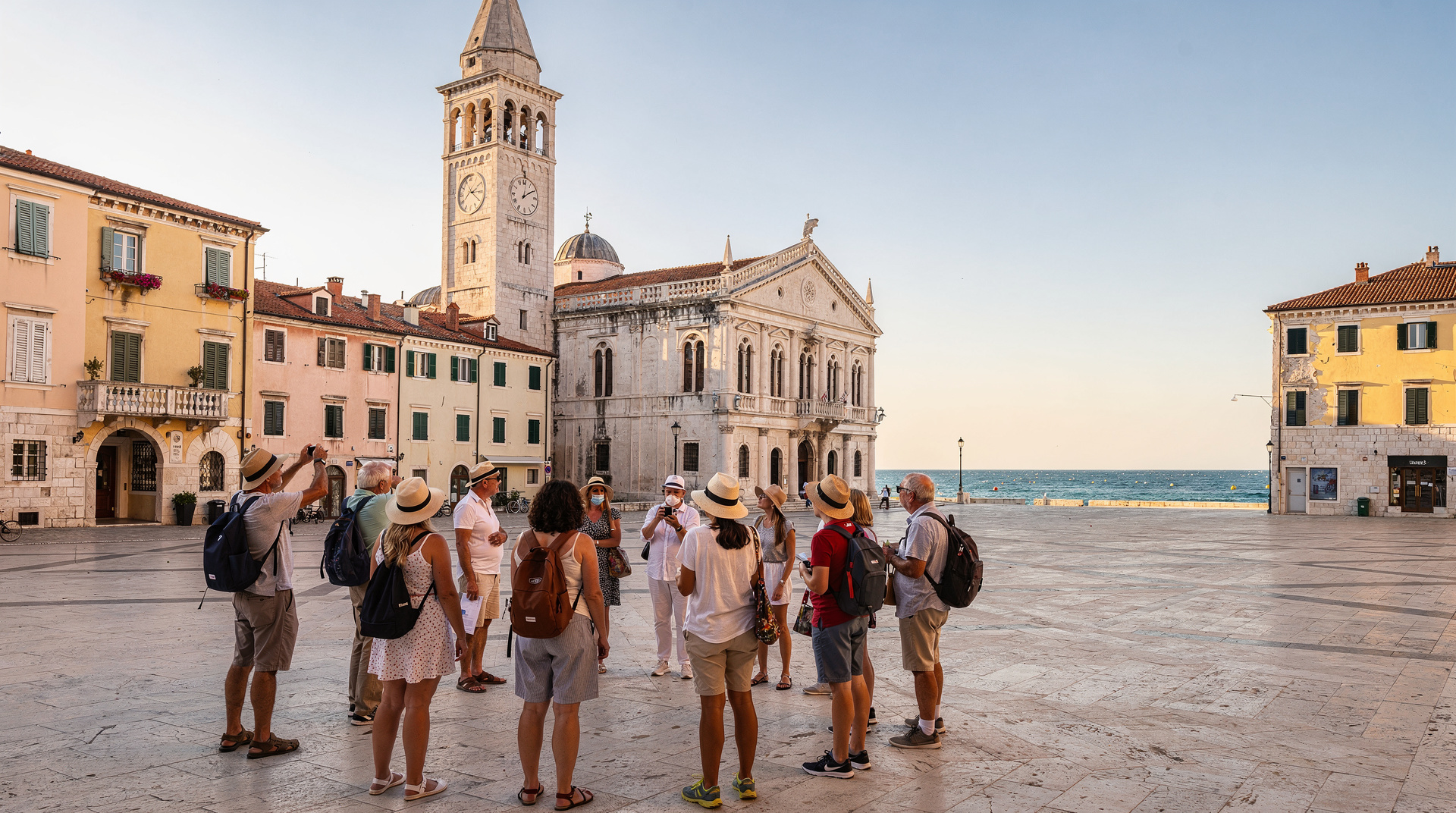
Piran works well for children: the piazza, the ice cream vendors, the clear-water harbour where they dropped a jellyfish-shaped ball on a string for two hours. The campanile steps gave everyone a mission with a view as a reward.
Swimming in the sea: the Portorož beach (10 min from Piran) has a designated children’s swimming area, lifeguards in summer, and the necessary combination of snack bars and public toilets.
What we would do differently
More time in the Soča Valley — we rushed through Kobarid and would have benefited from an extra day. Less time driving, more time in the same places. And book the rafting in advance.
The Ljubljana with kids guide and the Slovenia for families guide are more useful than most family travel articles on this country. Read them rather than the generic “Slovenia is family-friendly” listicles.
The honest verdict
Slovenia with children of mixed ages is a very good family holiday with some practical challenges. It requires a car, some planning around opening times and ages, and realistic expectations about what a 5-year-old can manage hiking-wise.
The rewards are outsized: the caves, the lakes, the river rafting, the mountains viewed from gondolas — these are the things children remember. Not the restaurant food, not the architecture. The physical experiences.
For families with children aged 6 and above, Slovenia is a genuinely excellent family destination. For families with very young children, it is manageable with adjustment. For families seeking a beach holiday: consider adding a few days in Piran rather than building the whole trip around the coast.
What children actually learn in Slovenia
This might sound like post-hoc justification, but bear with it: Slovenia has a specific educational value for children that other destinations do not.
The caves (both Postojna and Škocjan) introduce children to geological timescales in a way that classrooms cannot — standing in a chamber formed by 5 million years of limestone dissolution is an embodied experience of deep time. Our 8-year-old asked the question “but how do they know how old it is?” on the bus back, and we spent 40 minutes working through radiocarbon dating in terms she could understand.
The Kobarid Museum, for children of appropriate age (probably 10+), introduces the First World War in a specific, located way rather than as an abstraction. The scale of the casualties on the same road you drove this morning. Hemingway here, in this valley, in 1917.
The thermal spas introduce the idea that geological forces produce heat, that the earth is warm underground, and that humans have been using this heat for hundreds of years. Our 5-year-old described Terme Čatež as “the hot magic pool from underground” and her understanding of what was happening was not entirely wrong.
Practical family logistics
Car seats: required for children under 135 cm. All rental companies provide them; book at the same time as the car to ensure availability.
High chairs: available at all but the smallest rural gostilne; ask when reserving.
Children’s menus: common in tourist-area restaurants; less common in local gostilne (order from the main menu and ask for half portions — almost always accommodated).
Nappy changing: available at all motorway service stations and most major attractions. Less reliably available in small village restaurants.
Children’s prices: attractions consistently offer child rates. Postojna Cave has its own child rates: see the up-to-date prices on the official site, postojnska-jama.eu. The gondola at Vogel is about 60% of the adult price for children.
Swimming safety: the Soča River has strong currents in the gorge sections; always consult local knowledge before children enter the water. The designated swimming beaches at Lake Bohinj and Lake Bled have supervised areas.
The driving realities with children
The mountain roads that make Slovenia spectacular — the Vršič Pass, the Mangart road, the narrow valley approaches — require focused driving attention that is not compatible with responding to children. Plan breaks before the dramatic sections; explain the experience in advance so children know what to expect; and consider whether the specific routes are appropriate for your youngest traveller.
The Vršič Pass hairpin bends are exciting for older children and potentially distressing for very young ones. The Mangart road is narrow, vertiginous single-track — genuinely not appropriate with young children who might be frightened or distracting.
The car rental Slovenia guide and driving Slovenia guide cover the driving logistics. For families without driving confidence on mountain roads, the bus-and-gondola approach to Bohinj and the direct bus to Bled cover the main highlights without mountain driving.
What we’d tell a family planning the same trip
If we were rebuilding this itinerary from scratch, we would cut the trip from ten days to eight and add a rest day mid-trip rather than pushing through every region back to back. Three children of mixed ages tolerate novelty well but tire of transitions — a new town, a new bed, a new set of rules every single night wears them down faster than any single activity does. A rest day at Bohinj, which was already the unanimous favourite, would have cost us little in terms of missed sights and gained us a genuinely calmer middle of the trip.
We would also front-load the rafting booking. Both the Soča Valley rafting and the Bled pletna boat are activities that benefit hugely from being pre-booked rather than arranged on arrival, particularly in June-August when operators fill up. The gamble paid off for us, but it added a layer of stress to an evening that did not need it.
Splitting activities by age when interests diverge
By day 6, it became clear that our 12-year-old and 5-year-old wanted structurally different days — the older child wanted more physically demanding, longer activities (rafting, longer hikes, museum depth); the youngest wanted shorter bursts of novelty with frequent breaks. Where possible, splitting the group for half a day (one parent with the older two doing something more ambitious, one parent with the youngest doing something gentler, then reconvening for dinner) worked better than forcing every activity to suit every age. This is worth planning for explicitly if your children span a similarly wide age range, rather than assuming a single itinerary will satisfy everyone equally.
Planning the next trip around what worked
If we went back, we would use this diary as a filter rather than a script. The days that worked had one clear highlight and plenty of slack around it. Our family itinerary for five days follows that logic, and it is a gentler starting point if ten days across every region sounds like too much. Choosing the season matters too: the best time to visit Slovenia guide helps match weather and opening times to your children’s ages.
For the lake days, Bled versus Bohinj is worth reading before you decide where to base yourselves, and our Lake Bohinj guide covers the shoreline we enjoyed most. If rain or tired legs force a change of plan, the Ljubljana day trips guide offers short outings that do not demand a full day in the car.
Top experiences
Bookable activities with verified prices and instant confirmation on GetYourGuide.