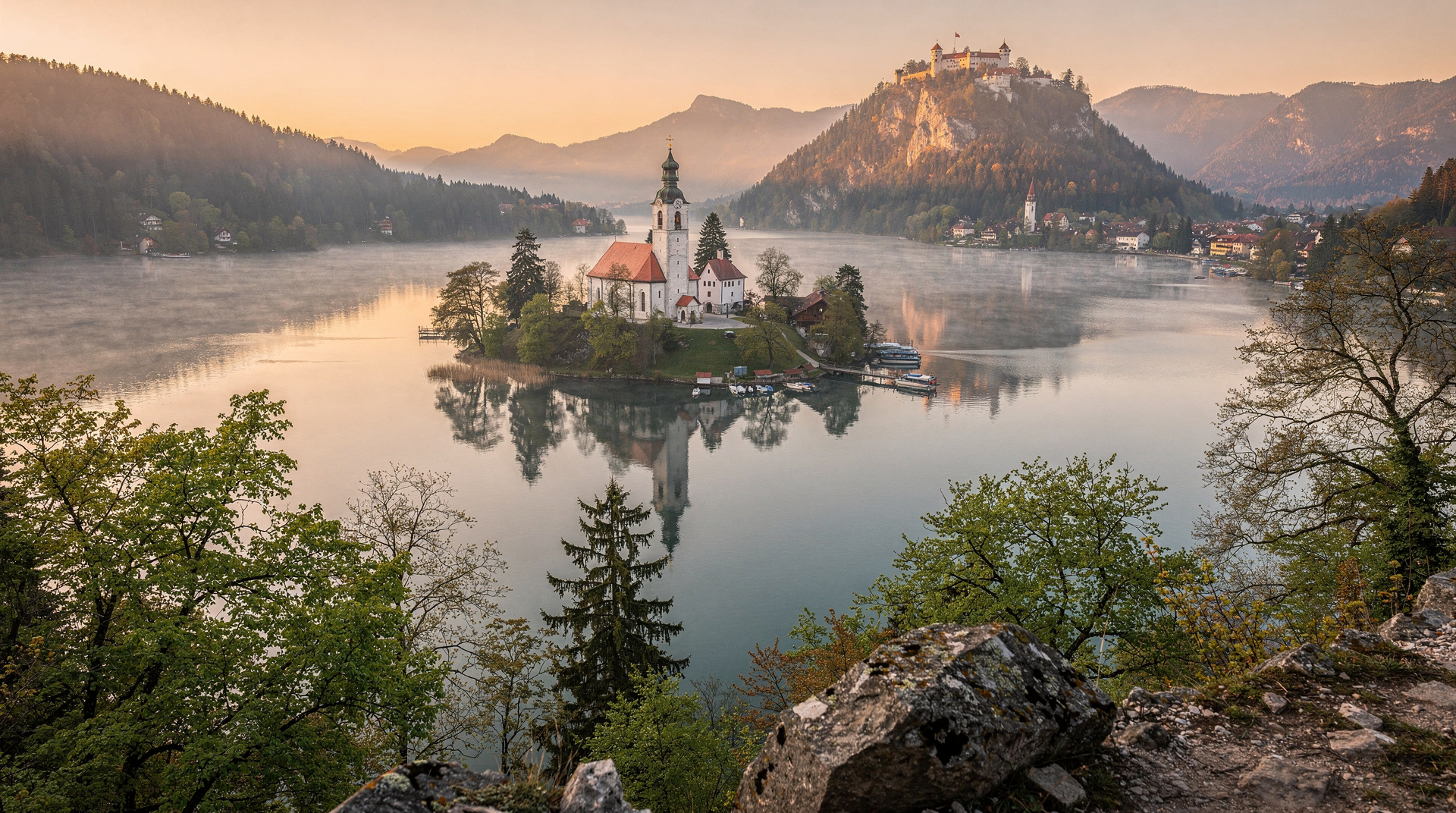
Lake Bled photo diary: what the pictures don't tell you
The photograph that launched ten thousand itineraries
You know the image before you arrive: an emerald lake, an island with a church, a castle on a cliff, mountains closing the horizon. You have seen it so many times that it starts to feel like a stock photo, like a place invented for screensavers.
Then you turn the corner on the approach road and there it is, and it is exactly as advertised, and for a moment you understand why everyone keeps sharing it.
What the photograph does not show is everything that happens next.
| Where | Lake Bled, Julian Alps, 55 minutes from Ljubljana |
| Best light | Dawn (6-7am) for the classic Ojstrica shot |
| Island crossing | Pletna boat, 20 minutes (confirm the fare at the landing or with the Bled tourist office, bled.si) |
| Circuit walk | 6 km, around 2h with stops |
| Avoid | 10am-4pm June-August at the main viewpoints |
What the classic viewpoints actually look like
The postcard image is taken from Ojstrica viewpoint on the south shore — a 20-minute scramble above the lake that rewards the effort with a view that places the island, the castle, and the mountains in the same frame. The Lake Bled complete guide has directions.
From Ojstrica at 6am in June, with mist still sitting in the valleys and no other visitors yet arrived: this is as close to the photograph as reality gets. The light is soft. The lake is still. The church bell rings on the hour.
From Ojstrica at 11am in August: thirty people with tripods, a drone whirring overhead, and a steady procession of hikers arriving from the car park below. The scene is still beautiful. It is also a scene rather than an experience.
This distinction — beauty that exists despite its audience versus beauty that only reveals itself in quiet — runs through everything about Bled.
The island: worth visiting or not?
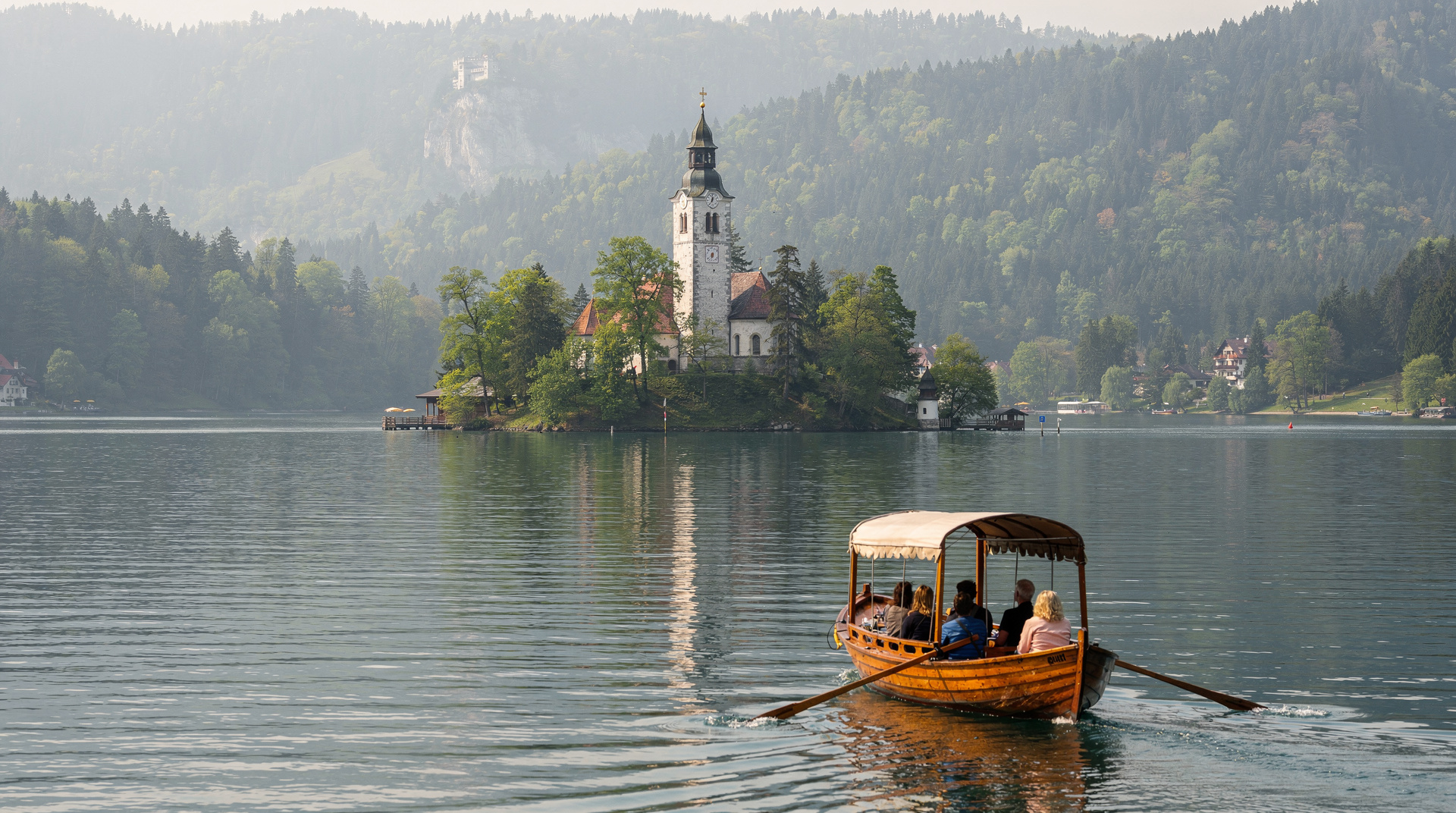
The island is reached by pletna boat, rowed by traditional oarsmen who stand at the stern and push with long oars. The crossing takes 20 minutes; confirm the fare at the landing or with the Bled tourist office (bled.si). On the island there is a church with 99 steps (legend holds that climbing them while carrying your partner guarantees happiness), a bell you can ring for a wish, and a small museum.
The honest assessment: the island is charming. The main thing you see from it is the lake you were just on — you do not see the island itself from the island. The view from the south shore or from Ojstrica is more striking than the view from the water.
If you are here for the atmosphere and the history, go. If you are here for the view, stay on shore and walk instead. Our guide to visiting Bled Island has the full breakdown, including whether the pletna boat is worth the price.
The castle: better than its reputation
Bled Castle is consistently underrated by visitors who expect something grand. It is not a palace — it is a fortified bishop’s residence from the eleventh century, perched on a 130-metre cliff. The interior has a museum, a wine cellar and a printing workshop where you can make a parchment souvenir. None of this is the point.
The point is the terrace, which offers the best eye-level view of the island and the lake. At sunset, when the light drops behind the Karavanke mountains to the northwest, the lake surface catches the colours and the island church glows. This is the shot that the postcard does not use because it requires presence at a specific time of year and day.
Finding quiet at Bled
The practical reality: Bled gets very crowded from June to September. Car parks fill by 9am. The walking path around the lake (6 km, flat, beautiful) is shared with cyclists and pushchairs from mid-morning.
The strategies that work:
Arrive before 7am. The lake at dawn, before the tour buses, is a genuinely different experience. The circumference walk takes 1h45 at a leisurely pace. Walk it anticlockwise from the main car park: you reach Ojstrica in the second half when the light is at its best.
Stay overnight. The town empties markedly in the late afternoon as day trippers leave. Evening and early morning belong to overnight guests.
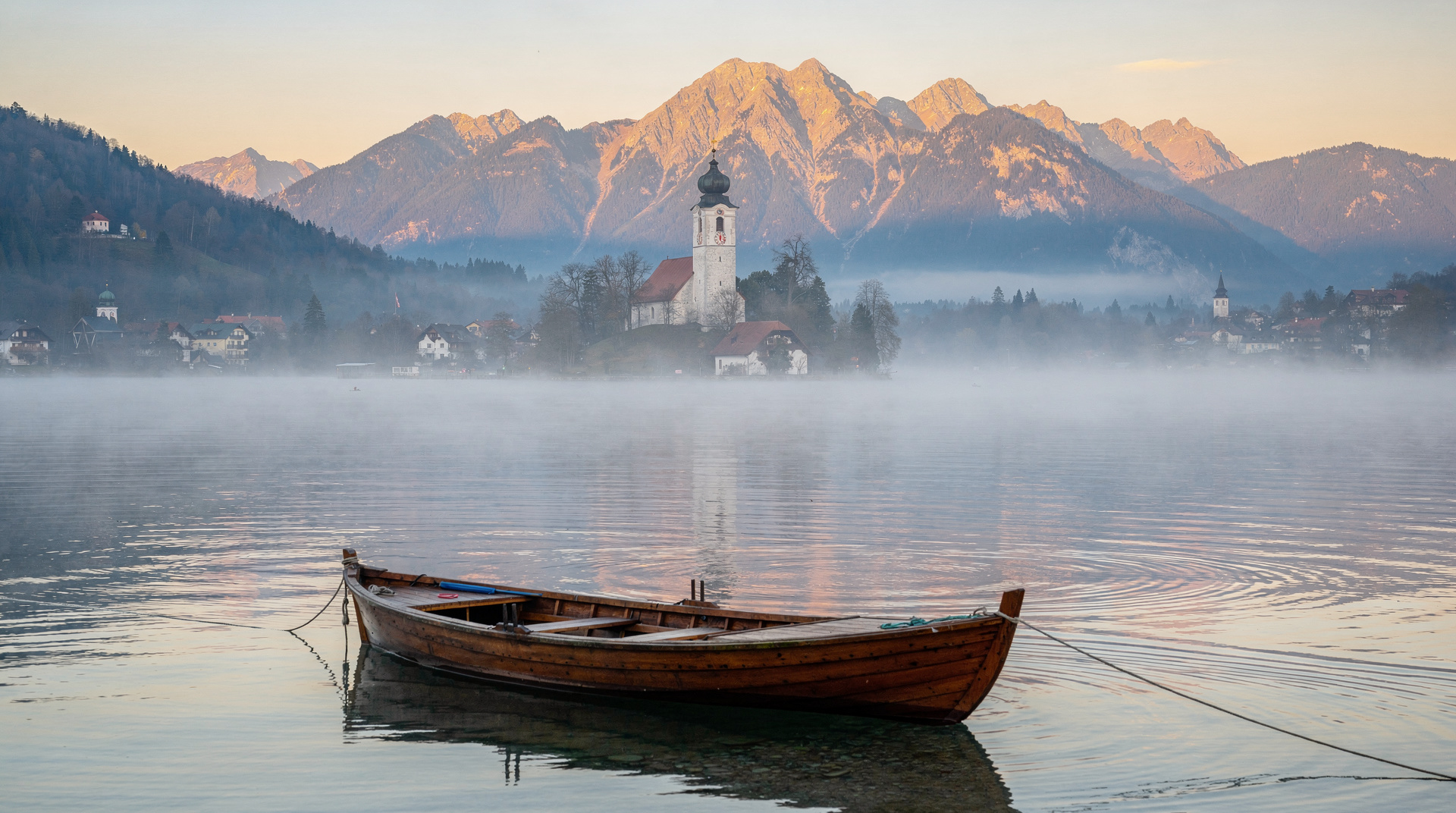
Visit in October. The summer crowds are gone. The water is still warm enough for a brave swim. The chestnut trees around the lake have turned. The views include mist in the valley. The number of visitors is a fraction of July.
The alternative: Bohinj
Lake Bohinj is 30 minutes by car from Bled, sits inside Triglav National Park, and is roughly four times the size. It receives approximately one-tenth of Bled’s visitors.
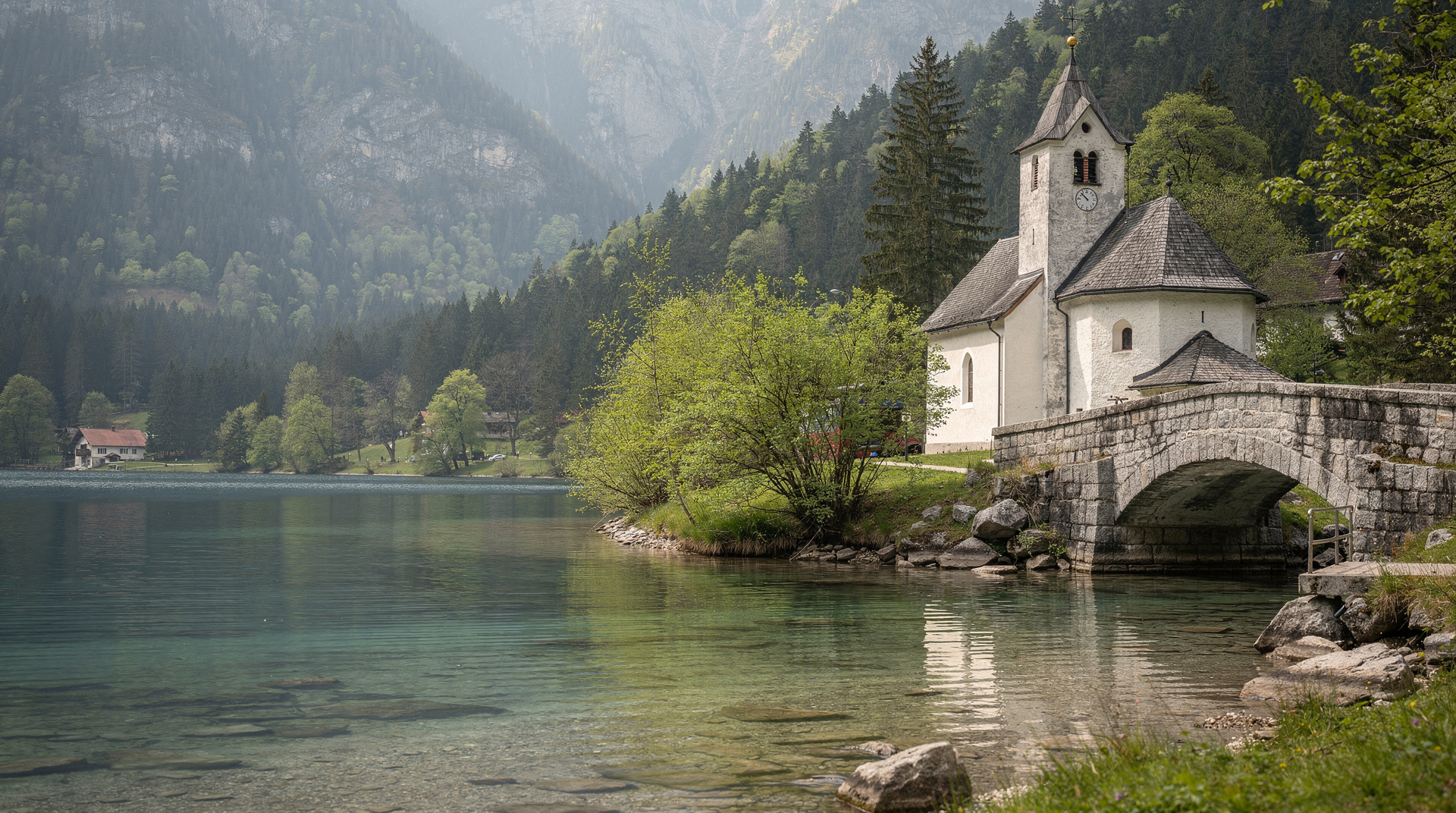
I spent a morning there expecting a consolation prize and found something that improved on the original. The lake is wilder, more open, less manicured. The village of Ribčev Laz at the eastern end has a 13th-century church, a stone bridge, and a view across the water toward Vogel mountain that changes hour by hour as the clouds move.
The Bled vs Bohinj comparison lays out the differences in detail. The short version: if you have seen one photograph too many of Bled island, Bohinj is the antidote.
Photography notes
The classic Ojstrica viewpoint faces east toward the castle, which means morning light hits the castle and afternoon light hits the island. For the standard postcard composition (island in foreground, castle and mountains behind), morning is better.
The view from the Grand Hotel Toplice terrace — at water level on the north shore — frames the island in the lake without the castle, and catches the mountains differently. This is where the professional travel photographers tend to set up.
For something less visited: the viewpoint from above Zasip village, on the road to Bled from the motorway, offers an elevated view of the lake from the north that most visitors drive past without stopping.
Beyond Bled: the rest of the Julian Alps
Lake Bled is the entry point to the Julian Alps rather than the destination itself. An hour’s drive over the Vršič Pass drops you into the Soča Valley, where the landscape has an entirely different character — rougher, greener, with fast water rather than a still lake. Two days there recalibrates your sense of what “beautiful” means.
Vintgar Gorge is 4 km north of Bled: a wooden walkway along a river gorge that took 2 million years to form. Note that the gorge closes November through April for winter. For summer visits, arrive by 8am to beat the crowds.
Kranjska Gora and the Vršič Pass driving road are an hour further north and dramatically less visited. The road over the pass has 50 numbered hairpin bends; you stop counting after 20.
The honest summary
Lake Bled is not overrated — the photograph is real, the landscape is genuinely extraordinary. What is overrated is the idea that visiting solves the problem. The experience of Bled depends entirely on when you are there and how willing you are to walk rather than stand.
Come early. Come in autumn if you can. Walk around the lake rather than looking at it from the terrace. Go to Bohinj. The photographs will take care of themselves.
The seasonal versions of Bled
Each season produces a fundamentally different version of the lake, and understanding this transforms the way you plan a visit.
Spring (April-May): the lake level is at its highest, fed by snowmelt from the surrounding mountains. The water is cold and very clear. The island church has just been freshened up after the winter closure of the pletna service. The south shore chestnut trees are in new leaf. The mountains above still carry snow. This is the Bled that features in the spring-issue travel magazines: verdant, clean, not yet crowded.
Summer (June-August): the full-season version. Warm enough to swim (the lake surface reaches 22-24°C), long evenings, the rowing season in full swing. Also the most crowded version, with the car parks filling by 9am in July and August. The photography from Ojstrica is cleaner in the early morning summer light than at any other time of year.
Autumn (September-October): the author’s recommendation. The chestnut trees turn; the water is still warm enough for a determined swim; the crowds drop; the morning mist over the lake is at its most reliable. The full lake circumference walk in October, when the colour is at peak and the island church is visible through amber-tinted trees, is the finest single pedestrian experience in Slovenia.
Winter: when the lake freezes (roughly every 5-7 years, depending on temperatures), Bled in winter becomes extraordinary — skaters on the lake surface with the island visible through ice, the castle above carrying snow. In most winters the lake does not freeze fully; instead it is grey and still, the mountains white, the trees bare, and the island church more austere than any summer photograph.
The walk around the lake: section by section
The 6 km circumference walk deserves more detail than most guides give it.
East shore (from main car park heading anticlockwise): the casino and hotel terrace section, the rowing club, the beach area at the east end. Wide path, comfortable, accessible. Families with pushchairs.
North shore: the Grand Hotel Toplice and Vila Bled section; narrow path at the waterline, some sections stepping over rocks. The view south toward the island is the classic eye-level composition.
West shore: the quietest section. The path narrows through forest above the lake. Some uphill and downhill. The view back toward the castle and island from the western end is the least-visited composition in the Bled circuit.
South shore (the section back to the car park): Ojstrica viewpoint access path is on the left about 1.5 km into this section. The chestnut grove that lines the south path is at its best in September-October. The most photographically productive kilometre of the circuit.
Allow 2h for the full circuit at a comfortable pace with stops. The Lake Bled complete guide has the detailed map and section descriptions.
Getting on the water yourself
The pletna boat gets you to the island, but it does not get you close to the waterline the way paddling does. Renting a rowing boat or a stand-up paddleboard from the east shore gives an entirely different vantage: low over the water, close enough to the island to shoot the church without the crowds gathered on its steps. A SUP session at 7am, before the wind picks up, is one of the more reliable ways to get a clean reflection shot of the castle.
Lake Bled stand-up paddleboarding sessionFor a longer water-based outing, a guided kayak trip on the Sava river below the lake shows the same limestone-and-forest landscape from a completely different angle, away from the tourist-boat traffic entirely. The SUP at Lake Bled guide covers rental logistics for anyone preferring to go it alone rather than book a guided session.
Day trips that reward a camera
If you would rather not drive, a guided tour combining Lake Bohinj, Savica Waterfall and Lake Bled covers the region’s best compositions with the logistics handled for you.
Bled is also the natural base for reaching several of the Julian Alps’ other photogenic sites without changing hotels. Vintgar Gorge, 4 km away, has a light quality inside the canyon — filtered green through the tree canopy above the wooden walkway — that is unlike anything at the lake itself; arrive at opening time for empty-walkway shots. The Vintgar Gorge guide has the access details and opening hours.
Further afield, Lake Bohinj and the Vogel gondola above it deliver an elevated, wide-angle composition of a lake and mountain range that no viewpoint at Bled can match — the gondola climbs 550 metres in under 10 minutes, and the platform at the top looks down over the entire valley. A guided day combining Bled with the gorge and Bohinj is a practical way to cover the region’s best compositions in a single day without driving logistics via the Julian Alps hiking guide.
The kremna rezina tradition
One Bled detail that belongs in a photo diary as much as the scenery: the kremna rezina. This is a vanilla custard slice — two layers of puff pastry around a thick vanilla cream — that was invented at the Park Café in Bled in 1953 (the precise origin story is somewhat contested but the Bled provenance is not). The Park Café is still there, on the north shore, still serving the same pastry.
The kremna rezina costs approximately €4-5. It is served on a small plate with a paper napkin. You eat it at a table with a view of the lake. This is not deep culinary philosophy; it is a genuinely good pastry in a genuinely beautiful location, and the combination has been sustaining visitors to Bled for 70 years.
Where to stay for the best light
Overnight guests get the two windows most day-trippers never see: the empty lake at dawn and the emptying town at dusk. The properties on the north and west shores — closest to the Grand Hotel Toplice terrace and the quieter photography spots — put you within a 10-minute walk of the best morning light.
Staying instead in nearby Radovljica, a well-preserved medieval town 7 km away, trades lakefront convenience for cheaper rooms and a five-minute drive to the same dawn shots. The Lake Bled complete guide covers accommodation by shore and price bracket, and pairs well with the how to visit Bled Island guide for planning the pletna crossing around the light rather than the crowds.
Top experiences
Bookable activities with verified prices and instant confirmation on GetYourGuide.