Hidden villages of Slovenia: seven places the tour buses miss
| Number of villages | 7 featured, 7 more mentioned |
| Access | Car required for all of them |
| Detour time | Under 30 minutes from the standard circuit |
| Best season | Harvest (Sept-Oct) for wine villages; summer for Alpine ones |
| Cost | Free to visit; some entry fees for castles/mines |
The places that don’t feature in the top-ten lists
Most Slovenia itineraries hit the same circuit: Ljubljana, Bled, Bohinj, Postojna, Piran. This circuit is popular because it works — these are genuinely excellent places. But Slovenia rewards the visitor who arrives with a looser plan and more days.
The villages in this article have in common that they are beautiful, relatively undiscovered by foreign tourists, and accessible within reasonable distances from the main routes. None of them requires a specific detour of more than 30 minutes from the standard circuit.
Smartno, Goriška Brda
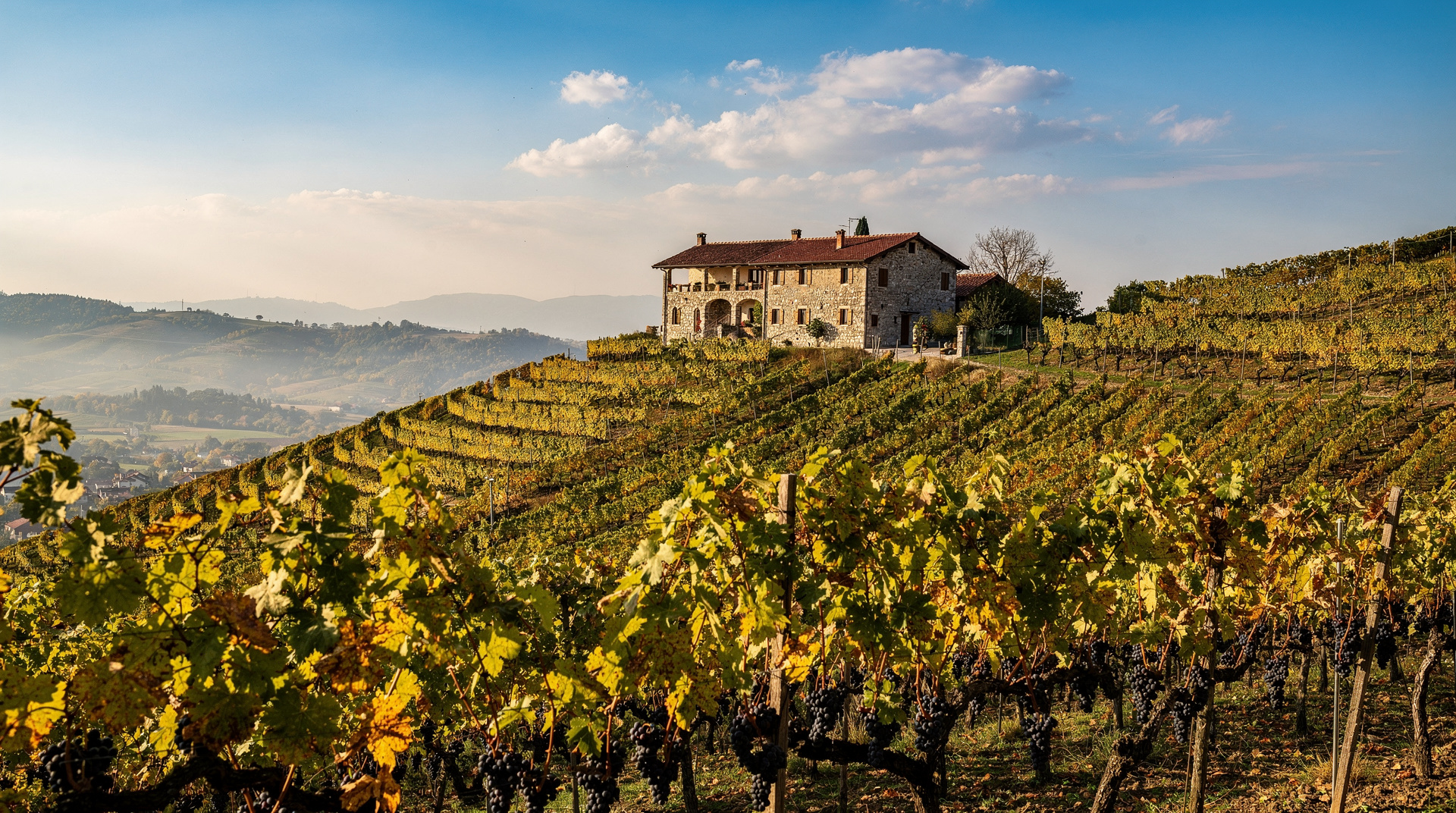
Goriška Brda — the wine country in Slovenia’s southwestern corner — is already a minor discovery for most visitors. Within it, the walled village of Smartno is the discovery within the discovery.
The village dates to the 14th century and retains its original fortified perimeter: stone walls, a gate tower, narrow lanes radiating from a central square. The population is around 100 people. The views from the walls in every direction encompass vineyards on the hills, the Julian Alps to the north, and the Italian Collio zone immediately across the border.
There are two restaurants in the village; both serve local wine and seasonal food without ceremony. In harvest season (September-October) the village is at its most atmospheric; the smell of fermenting grape juice carries on the evening air.
Access: 1h45 from Ljubljana via the Vipava Valley. The Goriška Brda wine guide has the regional context.
Log pod Mangartom
This is a small village at the end of the Mangart road in the Soča Valley — the highest road in Slovenia. The village itself is a cluster of farmhouses at around 600 metres, with the Mangrt cliff rising directly above it to 2679 metres. In 2000, a catastrophic landslide buried part of the village and killed seven people; the scar on the hillside is still visible.
What the village offers: a genuine sense of what Alpine life looks like when it is not curated for visitors. A handful of farmhouse guesthouses operate in summer. The road above rises through limestone cliffs to the saddle at 2055 metres; the driving is serious but the scenery is extraordinary.
Access: from Bovec, 15 minutes south and then up the Mangart road.
Stanjel, Karst plateau
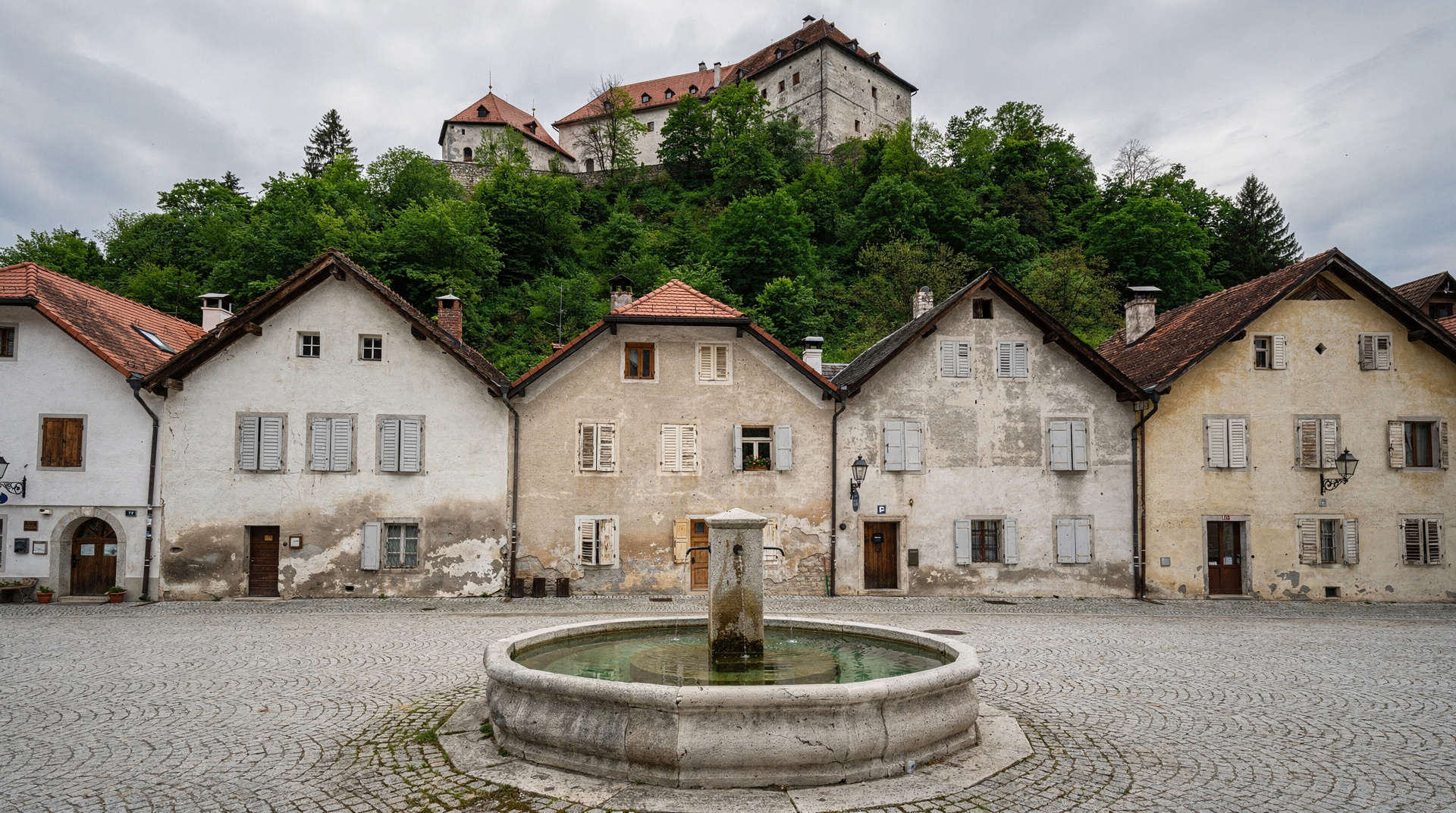
The Karst village of Stanjel sits on a hilltop above the grey limestone plateau, with a rebuilt Renaissance castle, a church, and a Baroque garden designed by Maks Fabiani in the early 20th century. The village was heavily damaged in the First World War and carefully rebuilt in the interwar period.
What makes Stanjel distinctive is the quality of the stone: the entire village is built from the pale grey Karst limestone, including the walls, the pathways, and the terraced gardens. The effect is monochromatic and austere and quite beautiful, particularly in the angled light of evening.
Access: 30 minutes from Postojna Cave, on the road toward Nova Gorica. Easy stop on the circuit between the Karst and the coast.
Idrija: mercury and lace
Idrija is not conventionally a village — it has around 6,000 residents — but it has the scale and atmosphere of one, and it offers something unique: a UNESCO World Heritage mercury mine that operated continuously from 1490 to 2010 and shaped the entire town’s architecture, culture and economy.
The mining museum and underground tour are excellent and genuinely different from the cave tourism of Postojna. The mine is cold (12°C year-round), informative, and not crowded. The town above produces traditional bobbin lace — also UNESCO-listed — and the lacemaking school has been operating since 1876.
Access: 1h from Ljubljana toward the Soča Valley. A natural stop on the route west.
Radovljica
Most visitors to Lake Bled drive past Radovljica without stopping, which is a mistake. The medieval old town square — Linhartov trg — is one of the finest Baroque town squares in Slovenia: arcaded townhouses with painted facades surrounding a central space. The Lectar Inn has been a gingerbread bakery since at least the 14th century; the beekeeping museum documents the Slovenian tradition that gave the world the first published work on beekeeping.
Access: 7 km from Bled on the main road from Ljubljana. Can be visited en route without adding meaningful time.
Kamnik: the Franciscan alternative
Kamnik is 25 km northeast of Ljubljana and receives a fraction of the tourists who go to Bled, despite being equally historic and considerably more authentic. The medieval old town has two castles — the lower castle built into a rock above the main street, and the upper Mali Grad with a Romanesque chapel at the top — and a Franciscan monastery from the 13th century.
The real purpose of Kamnik for active visitors is access to Velika Planina — the shepherd’s plateau 1666 metres above the town, reached by cable car and chairlift. The plateau is one of the most unusual landscapes in the country: a functioning pastoral ecosystem with wooden huts, resident herders in summer, and views of the Kamnik-Savinja Alps in all directions.
The Velika Planina guide covers the access and the hiking routes.
Logar Valley head village
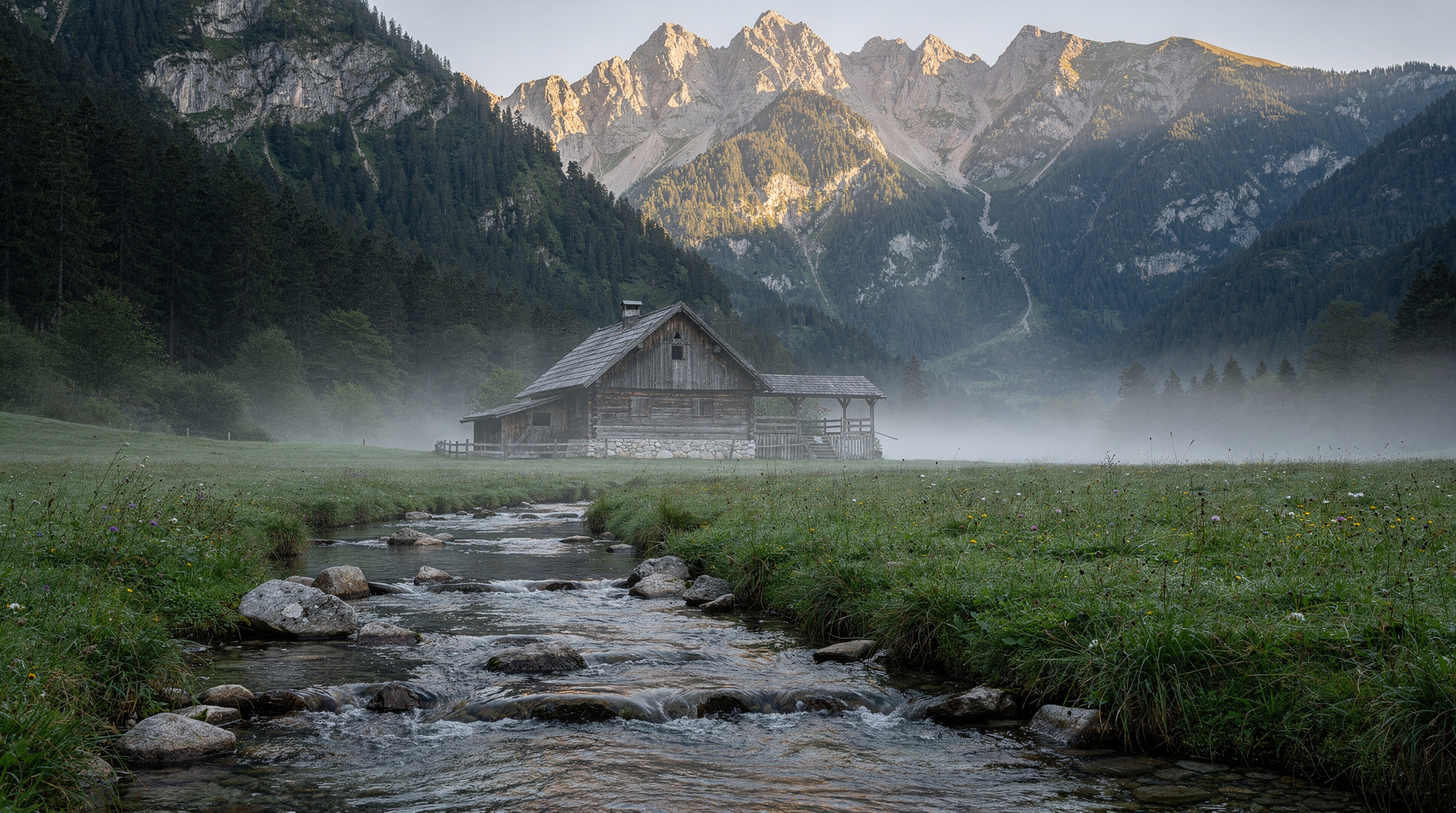
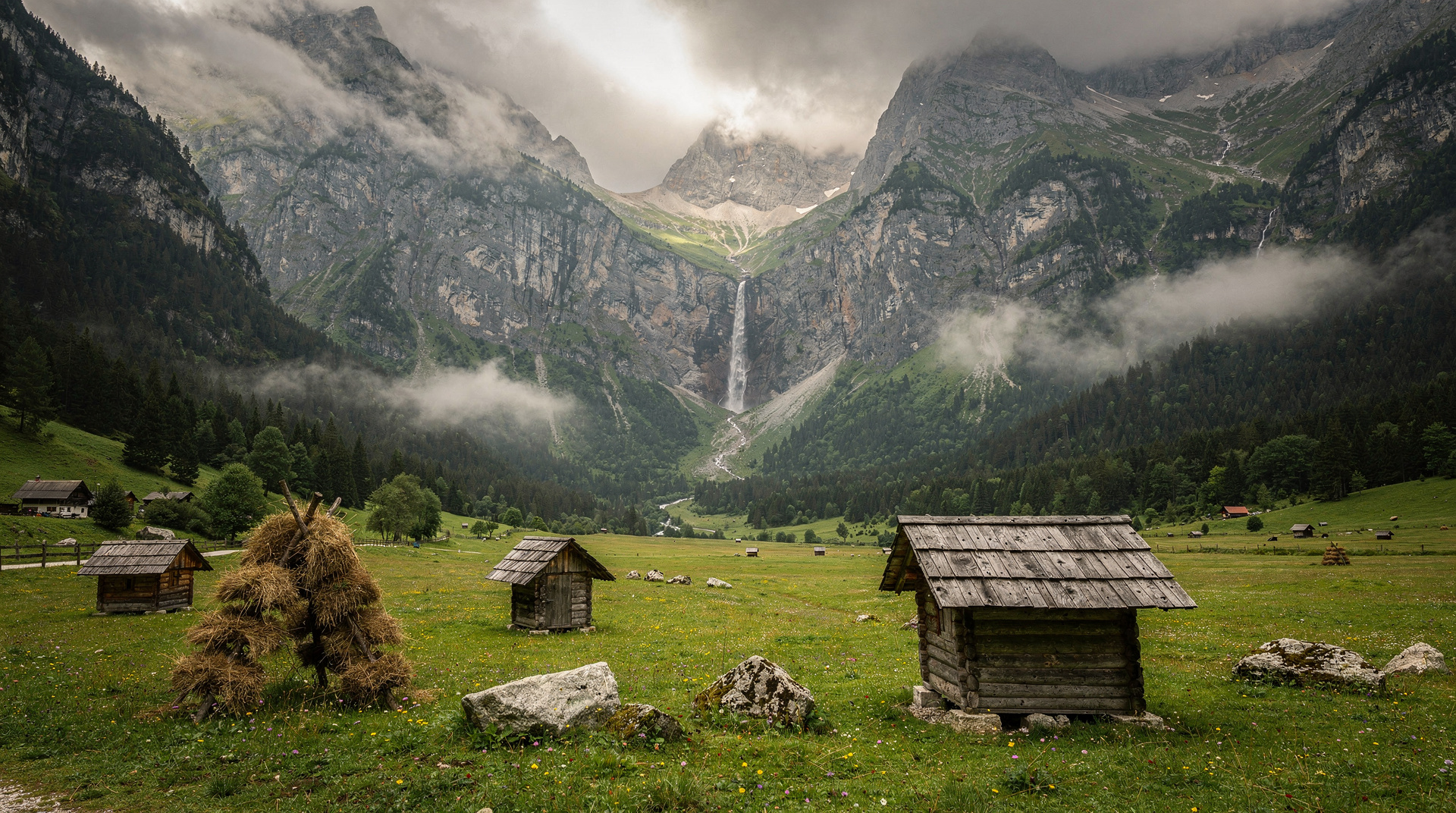
At the head of Logar Valley — a hanging glacial valley in the Kamnik-Savinja Alps — the hamlet of Logarska Dolina consists of a handful of farmhouses, a church, and a valley-bottom road that ends at the Rinka Waterfall. The valley is enclosed by 2000-metre peaks on three sides; entering it is like walking into a natural amphitheatre.
The farmhouse guesthouses in the valley offer accommodation and home-cooked meals: buckwheat soup, cured meats from the farm, local cheese. In early summer, wild flowers cover the valley floor while snow persists on the surrounding peaks. In autumn, the forested walls of the valley turn gold and red.
Access: 1h30 from Ljubljana via Kamnik, or 2h from Maribor. An entry fee applies to the valley road in summer (approximately €7 per car). Our Logar Valley guide has the full details.
Grouping the villages into day loops
| Loop | Villages | Base |
|---|---|---|
| Wine country | Smartno, plus the Brda ridge road | Goriška Brda or Nova Gorica |
| Karst and coast | Stanjel, plus Piran old town | Koper or Postojna |
| Alps and Soča | Log pod Mangartom | Bovec |
| Bled area | Radovljica, Kropa | Lake Bled |
| Kamnik-Savinja | Kamnik, Logar Valley head village | Kamnik |
Grouping villages this way turns a scattered wishlist into two or three realistic half-day detours rather than a separate trip for each one.
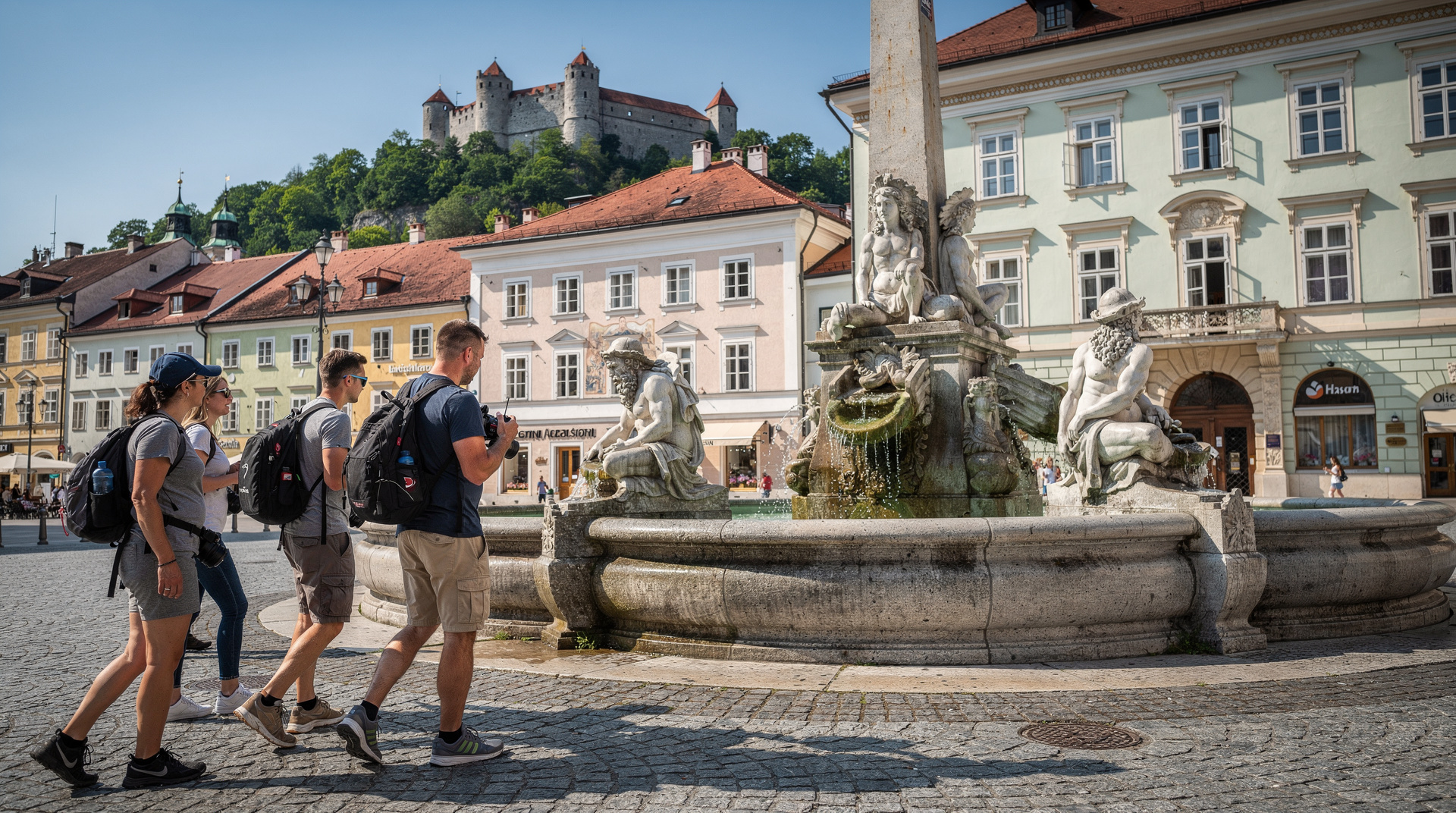
If navigating unmarked village roads on your own feels like more effort than reward, a guided old-town walking tour of Ljubljana covers the closest equivalent urban discovery — the secrets and courtyards most visitors walk past:
Ljubljana hidden secrets and old town walking tourApproaching these places
None of these villages are on the main tourist circuit for a reason: they require a car and a willingness to drive roads that Google Maps marks as “scenic route” rather than fastest. The rewards are proportional to the effort.
Getting around Slovenia covers the logistics of car rental, driving conditions and road types. For a trip specifically built around rural and village Slovenia, the Slovenia in autumn guide is worth reading — the quiet season shows these places at their best.
More villages worth a detour
Eight more villages worth noting for travellers who have exhausted the standard circuit:
Ribčev Laz (eastern end of Lake Bohinj): technically a hamlet rather than a village, but the view from the stone bridge over the Sava Bohinjka toward the lake — with the church of St John the Baptist to the left and the lake stretching west — is one of the finest in the Julian Alps and receives a fraction of Bled’s attention.
Kropa (Kropa valley, near Radovljica): an ironworking village that produced hand-forged nails for the Habsburg Empire from the 14th century until the 20th. The houses are built with the compact precision of a working industrial community; the forge museum documents a tradition that employed the entire village for five centuries.
Dol pri Hrastniku (central Slovenia, Trbovlje area): not conventionally beautiful, but the Slovenian industrial heritage here — the mining towns of central Slovenia, built in the Habsburg industrial period — has an architectural character entirely different from the Alpine villages, and is almost entirely unvisited by international tourists.
Beltinci (Pomurje, eastern Slovenia): a village in the flat Pannonian plain, notable for its carnival tradition (the Pust) and for the surrounding wetland of the Mura river — one of the last wild lowland rivers in Europe, protected as a UNESCO Biosphere Reserve since 2022. The reed beds and oxbow lakes of the Mura are exceptional for birdwatching.
Šempas (Vipava Valley): a small wine-growing village that hosts the chestnut festival in late October and has several family wineries that welcome visitors without appointment outside harvest week. If you would rather not drive between cellars, a guided wine tasting in the Vipava Valley gives you the same small-producer feel with someone else handling the logistics.
Šentjur (Savinja Valley, near Celje): the base for visiting the Šmarjeta hills, a low ridge above the valley with panoramic views of the Savinja basin and access to several small wineries making local-variety whites.
Bukovje (near Ptuj): a village in the Jeruzalem wine region, one of the highest wine-producing areas in Slovenia. The view from the Jeruzalem hill over the Slovenian and Croatian wine country is extensive and completely un-crowd-managed.
Staying overnight instead of just passing through
Most visitors treat these villages as a stop on a driving day, but staying a night changes the experience. Smartno and several of the Brda hilltop villages have farmhouse rooms and small guesthouses from around €60-90/night — waking up inside the walled village, before the day-trip traffic arrives, is a genuinely different atmosphere from a midday visit. Kamnik and Radovljica both have small hotels in their old towns that put you within walking distance of the castle and square after the day visitors have left. The where to stay in Slovenia guide covers rural and village accommodation options beyond the main tourist towns.
A note on what “hidden” means
The word “hidden gem” has been overused to the point of meaninglessness in travel writing. These villages are not hidden in the sense that nobody knows about them — most are visited regularly by Slovenians and by Austrian, German and Italian tourists who have been coming to the region for decades.
What they are hidden from is the English-language international travel media, which has focused its attention on the circuit of major sites and has not fully mapped the rural landscape behind them. The gap between what is written about in English and what is worth visiting is larger in Slovenia than in most European countries.
Filling that gap requires a car, a few days extra, and the willingness to follow a road because the scenery looks interesting rather than because a guidebook told you to. Getting around Slovenia by car is the practical starting point for this kind of travel.
Top experiences
Bookable activities with verified prices and instant confirmation on GetYourGuide.