Slovenia's overtourism debate: how crowded is it really?
The problem with the conversation
Slovenia’s overtourism debate has two distinct failure modes. The first is denial: “Slovenia is undiscovered, go now!” articles that describe 2025 Bled as if it were 2010. The second is overcorrection: “Slovenia is ruined by tourists” takes that treat a crowded July weekend at Bled as representative of the whole country.
Neither is accurate. The reality is more geographically specific and more manageable than either framing suggests.
| Genuinely crowded | Bled, Vintgar Gorge, Ljubljana old town in July-Aug |
| Manageable with timing | Same sites before 8am or after 6pm |
| Rarely crowded | Soča Valley, Brda, eastern Slovenia, thermal spas |
| 2023 overnight stays | 6.8 million, modest by European standards |
| Fix in progress | Parking limits, shuttle system, trail reservations |
Where the crowds actually are
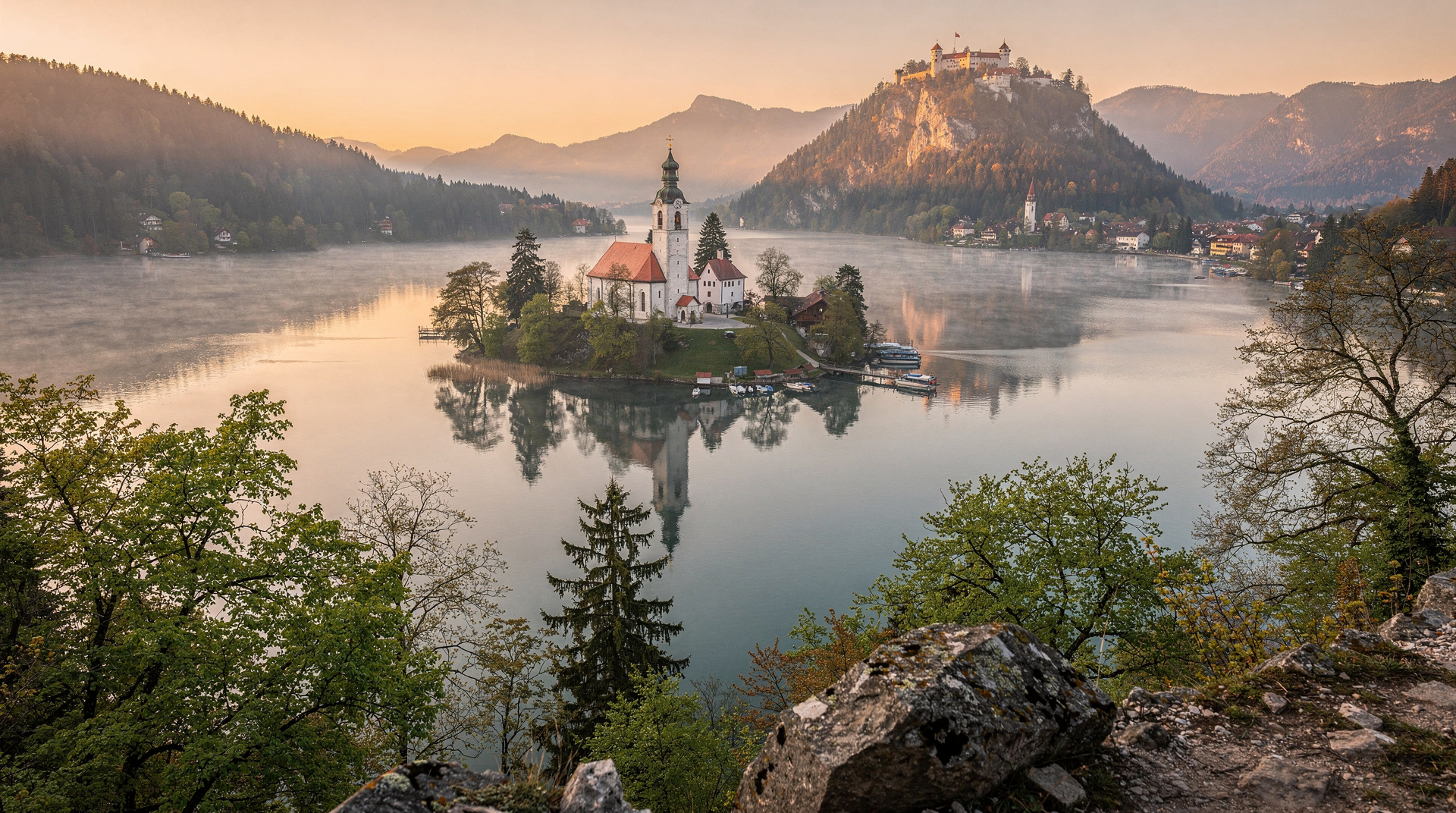
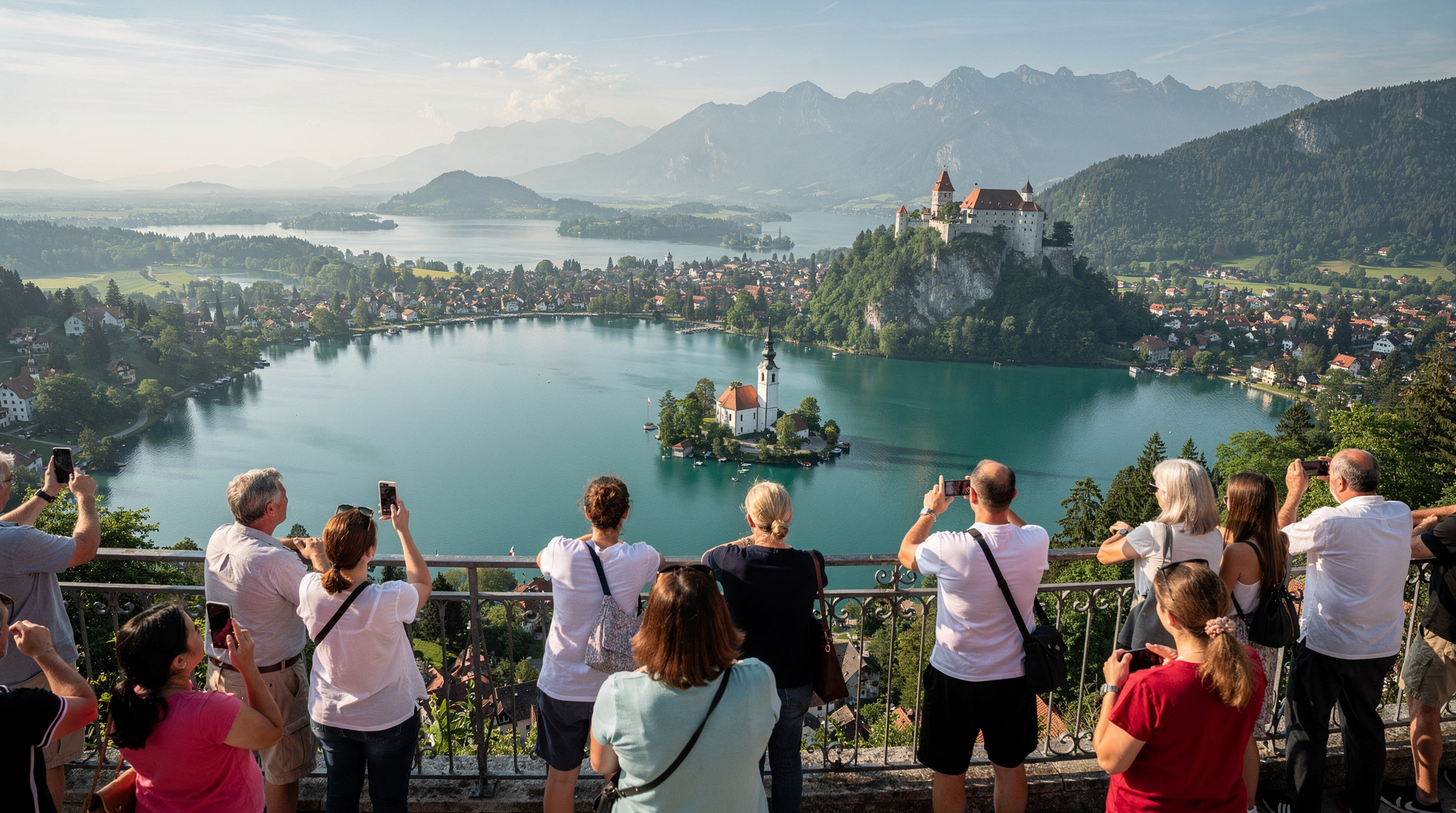
Lake Bled: the most acute case. The car parks at Bled fill by 9am on summer weekends. The south shore path in July and August is shoulder-to-shoulder with visitors. Tour buses arrive in convoy from 10am. The island boat service has queues. This is genuine overtourism, concentrated in a 2 km radius.
The mitigation: the experience becomes entirely manageable with timing. Before 7:30am, the lake belongs to hotel guests and early walkers. After 6pm, the day-trippers have largely gone. The problem is peak-hour crowding at a specific site, not the site itself.
Vintgar Gorge: similar pattern. The gorge is 1.6 km long and has one entrance and exit. In July at 11am, it functions like a single-file corridor with a queue to enter. At 8am, it is quiet enough to photograph without people in every frame.
Ljubljana old town: the pedestrianised core is manageable by European standards. The comparison city for crowd levels is Bruges rather than Venice — noticeable, occasionally annoying, not yet debilitating. The Metelkova district and most residential neighbourhoods are entirely free of tourist congestion.
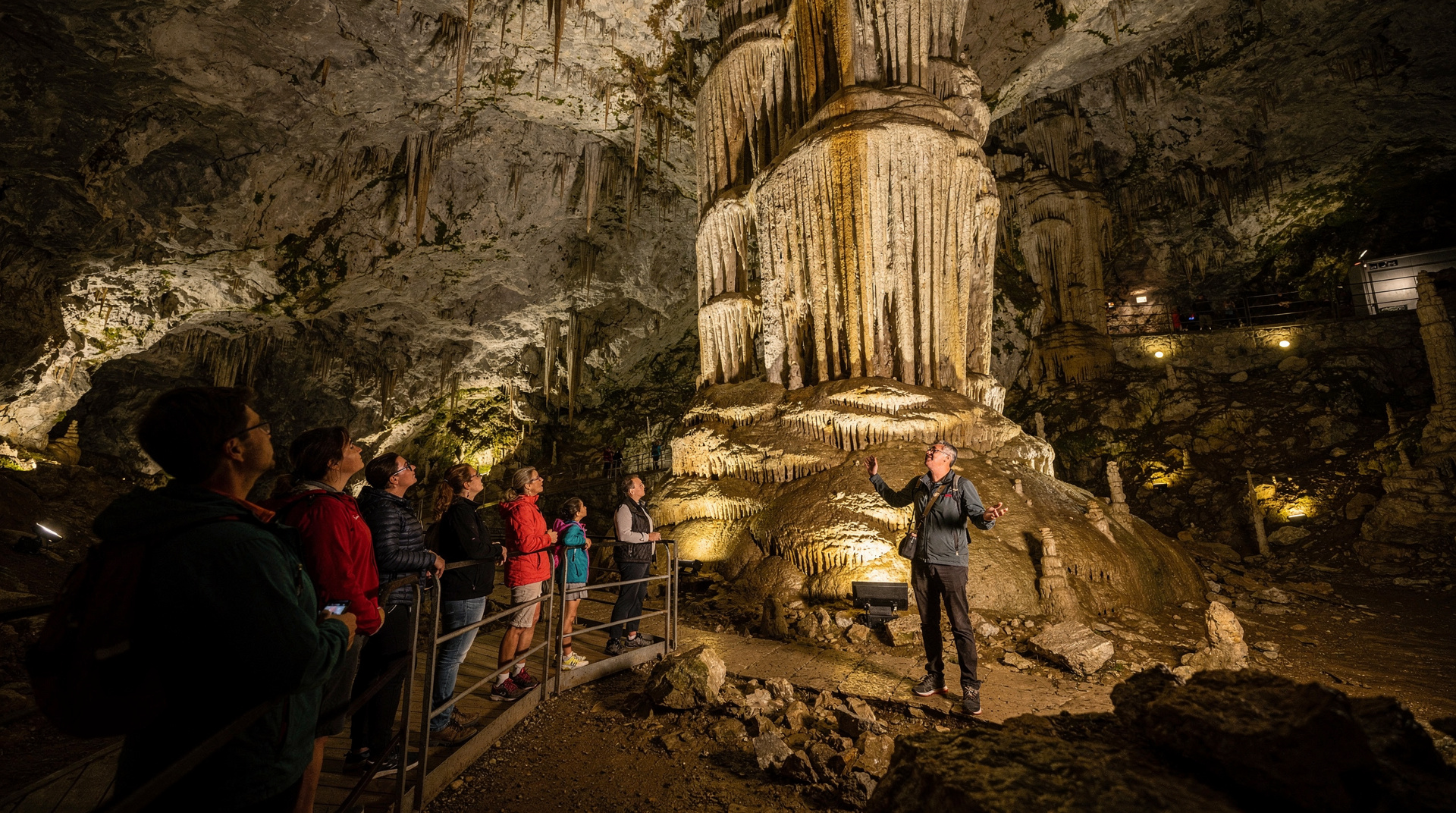
Postojna Cave: commercial and managed accordingly. The crowds are part of the experience. The cave itself is large enough to absorb them.
Piran: the old town can feel saturated on August weekends. On weekday mornings in September, it is genuinely quiet.
Everywhere else: the Soča Valley, the Goriška Brda wine region, the Logar Valley, Kobarid, the thermal spas, eastern Slovenia — all remain far below the crowd threshold that would impair the experience.
What the numbers say
Slovenia received approximately 6.8 million overnight tourist stays in 2023. Compare: the Netherlands (population 18 million) received 45 million overnight stays. Czech Republic received 35 million. Slovenia’s overall tourist density is modest.
The problem is concentration: a disproportionate share of those visits cluster in Ljubljana, Bled and Postojna, in the months of July and August. The overcrowding is real but geographically and temporally specific.
What Slovenia is doing about it
The Slovenian Tourism Board has explicitly committed to a “responsible tourism” framework that includes visitor distribution goals — encouraging visitors toward the eastern regions, the thermal spas, the wine country, and the shoulder seasons.
Specific measures at Bled: the municipality has imposed overnight parking restrictions around the lake, introduced a paid shuttle system from outer car parks in summer, and is exploring reservation systems for the Ojstrica viewpoint. None of this fully solves the problem; all of it moderates it.
Triglav National Park has implemented a reservation system for the most-visited trails and the Triglav summit ascent, reducing the concentration of visitors on critical routes.
The honest local perspective
Slovenians in Bled, Ljubljana and the main tourist areas are largely supportive of tourism as an economic fact — accommodation owners, restaurant staff and tour operators have obviously benefited from the growth. The tension, where it exists, is about quality: the mass-market tourism that fills Bled in July does not spend proportionally per person compared to the visitors who stay longer and explore wider.
The village of Bled has around 8,000 residents. In peak summer, the daily visitor count approaches 20,000. This is a ratio that strains infrastructure — parking, waste management, trails — regardless of how well-behaved the visitors are.
Outside the three or four most-visited sites, Slovenians report no significant tourism impact on daily life. The small towns of the wine country, the villages in the Soča Valley, the thermal spa towns — these receive visitors without the saturation dynamic.
Practical strategies for visiting without contributing to the problem
Arrive early or late at Bled: the 7am timing shift is not inconvenient for anyone staying overnight. See our avoiding crowds at Bled guide for the specific strategies.
Choose Bohinj over Bled: identical landscape quality, one-tenth the visitors. The Bled vs Bohinj guide makes the case.
Spread your visit across regions: three days in the Soča Valley, two in Ljubljana, one in the wine country — this is a more rewarding trip than five days at Bled, and reduces your concentration impact.
Go in May-June or September-October: both the crowds and the prices are significantly lower than July-August. The weather is comparable for most activities.
Stay local: choosing accommodation in Tolmin rather than Bled, in Piran rather than Portorož, keeps money in communities that depend on it less and distributes impact more widely.
The Slovenia sustainable travel guide covers the broader responsible tourism framework. The overtourism guide has specific site-by-site strategies.
Choosing tours that spread rather than concentrate visitors
The choice of tour operator matters more than most visitors realise. A large fixed-departure coach tour that stops at Bled for exactly 90 minutes at 11am contributes directly to the peak-hour crush described above; a smaller group tour timed for early morning or structured around less-visited stops has a materially different impact.
Bled and Vintgar Gorge small-group morning tourFor visitors specifically wanting to see the country’s quieter side without giving up guided context, a private tour through the Logar Valley or eastern Slovenia — Maribor, Ptuj, Celje — covers ground that mainstream itineraries skip entirely, redistributing spend toward towns that depend on it more.
Logar Valley and Solčava road private tourWhy the shoulder seasons matter more than they sound
The gap between peak and shoulder season in Slovenia is unusually wide for a country this size. September, in particular, retains summer-quality weather at Piran and in the Soča Valley while visitor numbers at Bled drop by roughly half compared to August. The Slovenia in autumn guide and Slovenia in spring guide cover both shoulder windows in more depth.
The best time to visit Slovenia guide and the Slovenia weather month-by-month guide quantify this in more detail; the practical takeaway is that shifting a trip by even three or four weeks either side of peak summer meaningfully changes the crowd experience without meaningfully changing the weather.
The visitor distribution problem
One of the structural reasons for the concentration is that most travel content — articles, social media posts, travel guide recommendations — focuses on a circuit of five or six places. Lake Bled, Ljubljana, Postojna Cave, Piran, and the Soča Valley account for the majority of visits to the country. The other 80% of Slovenia’s territory — eastern Slovenia, the Kamnik-Savinja Alps, the thermal spa region, the wine country — receives a fraction of the attention despite offering comparable or superior experiences in many respects.
Maribor is Slovenia’s second city and has a medieval old town, the world’s oldest documented vine (the Old Vine, still producing wine after over 400 years), and the best-preserved Habsburg city centre in the country outside Ljubljana. It receives perhaps one-tenth of the foreign tourist visits that Bled does in a comparable peak summer week. There is no crowd problem in Maribor.
Ptuj — the oldest town in Slovenia, with a Roman-era hilltop castle, a medieval walled quarter, and some of the country’s most interesting museums of carnival culture — sees even fewer international visitors.
The Logar Valley in the Kamnik-Savinja Alps is a glacially carved hanging valley of considerable beauty that charges a modest entry fee to manage the car numbers and has almost no queuing problem.
The practical implication: the overtourism story in Slovenia is a problem that visitors can personally opt out of by spending even two days in places that are not on the standard circuit. Your trip becomes more interesting; your footprint on the most-pressured sites reduces. This is the concrete meaning of “responsible tourism” at the individual level.
The longer-term question
Slovenia’s government has committed to a tourism strategy that targets quality over quantity — higher spending visitors, longer stays, broader geographic distribution. Whether this strategy succeeds depends partly on policy and partly on whether the travel media starts covering the country’s full width rather than its Instagram highlights.
The concern among Slovenian tourism professionals is not that the country will be permanently damaged by tourism — it is small enough and well-governed enough to manage that — but that the window for the quality of experience that currently distinguishes Slovenia from overtouristed alternatives is finite. The best time to visit Slovenia guide makes this point implicitly: the shoulder seasons are not just weather choices but choices about what kind of experience you want.
For the visitor planning in 2025-2026: the window is not closed. The Soča Valley in May is still extraordinary. Bohinj in October is still half empty. The wine country is still off-radar for most international travellers. Go soon, and go wide.
Case study: what happened to Bled and what it teaches
In 2015, Bled was manageable in July with a mid-morning arrival. By 2019, the morning arrival window had moved to before 8am. By 2023, even a 7am arrival on peak summer weekends found the south shore car park filling. This trajectory is documented by visitor numbers: Bled received approximately 2.8 million day visitors in 2023, up from roughly 1.5 million in 2015.
The causes are multiple: travel media coverage, Instagram growth, budget airline route expansion, and general European tourism recovery post-pandemic. No single cause is individually reversible; the aggregate effect on the site has been cumulative.
The lesson is not that Bled has been destroyed — it has not. The lesson is that sites with a specific carrying capacity and a single-access geography (one lake, one island, one castle, one famous viewpoint) saturate faster than sites with distributed geography. The Soča Valley, by contrast, has a 70 km river corridor, multiple access points, dozens of activities, and no single must-visit spot. It can absorb more visitors without a comparable quality degradation.
For future-proofing your trip: sites with distributed attraction (the Soča Valley, the wine country, the thermal spa region) are structurally more resistant to overcrowding than single-point attractions. Building itineraries around distributed rather than concentrated experiences is both more interesting and more sustainable.
The accommodation distribution problem
One of the mechanisms driving overtourism at Bled is the accommodation geography: approximately 80% of accommodation in the greater Bled area is within 5 km of the lake. This concentrates overnight visitors as well as day-trippers and amplifies the morning surge.
The alternative: staying in Radovljica (7 km from Bled, excellent medieval old town, significantly cheaper accommodation) and treating Bled as a day visit. Staying in Kranjska Gora (35 km from Bled, ski town, quiet in summer) and visiting Bled and Bohinj as day trips. Both approaches distribute accommodation spending more widely and reduce peak pressure at the lake.
The where to stay in Slovenia guide covers accommodation options at the alternative bases.
What responsible tourism is not
A brief note on what “responsible tourism” in Slovenia does not require: it does not require avoiding the popular sites entirely, which would be both impractical and unnecessary. Vintgar Gorge is worth visiting; so is Lake Bled; so is Postojna Cave. These sites exist to be visited.
What it requires is timing those visits thoughtfully, distributing the remainder of your trip across the country’s wider landscape, staying overnight rather than day-tripping wherever possible, and choosing accommodation and food providers that keep more of your spending in the local economy.
These are choices that improve your experience as well as reducing your impact. The visitor who arrives at Ojstrica at 6:30am in October has a better experience than the one who arrives at 11am in July, and a lower-impact one. The interests are aligned.
The Slovenia sustainable travel guide and the avoiding crowds at Bled guide cover the practical applications.
Top experiences
Bookable activities with verified prices and instant confirmation on GetYourGuide.